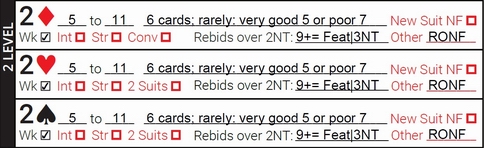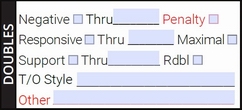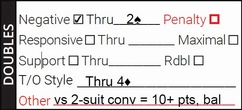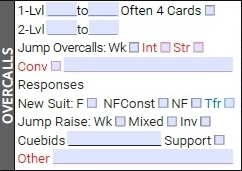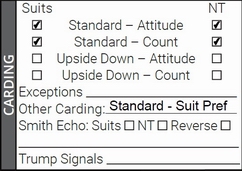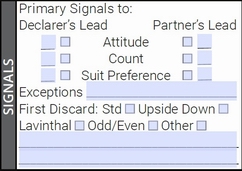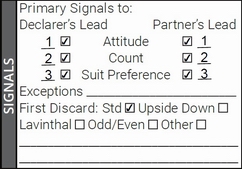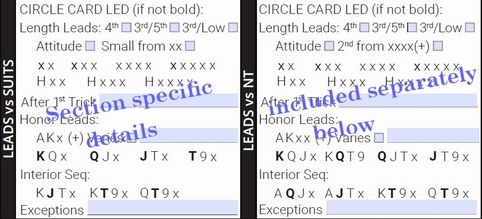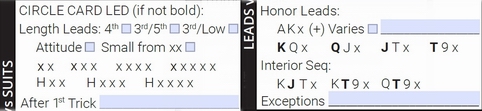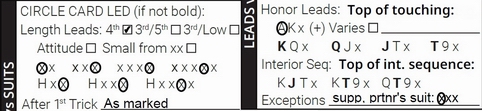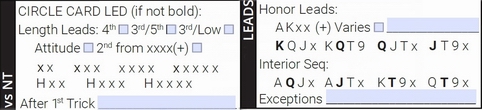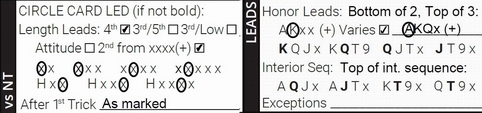
ACBL Convention Card ©MJH 2022-2025
(Content modified: August, 2026)
(File modified: August 15, 2026 6:43 pm)
This site works better with Javascript enabled.
Michael J. Hannah, Los Ranchos, NM.
This Manual contains complete information
to help your partnership fill out your Convention Card
to accurately reflect your conventions and agreements.
Includes complete examples reflecting a straight SAYC System.
While I have made every effort to be accurate I cannot legally warrant in any way that the Bridge information mentioned in this document is accurate or useful, and any use of these personal notes is at the user’s own risk. Any comments related to the extensive citations of ACBL references are tried to be identified as solely my best understanding and personal interpretations of those official sources. The ACBL is the final authority concerning their official meanings. Errors are inevitable and mine alone. I would appreciate them being reported to me via email so that I can quickly correct them.
Synopsis of this Manual for
About the SAYC System Examples
Sections & SAYC Examples Hyperlinks
Defensive Carding Agreements
Two areas, Blank agreements
Defensive Play: Ordering Strategies, Overview
Synopsis of this Manual for
ACBL’s 2022 Convention Card Form
This web page, roughly equivalent to an over 200 page printed manual, was written and edited over more than a year and a half. It is an extensive, and hopefully sufficiently complete and thorough, explanation of this topic. It begins with a set of introductory material. First is a short History of the evolution of ACBL’s Convention Card Forms leading up to this newest Form. Then the Manual Overview describes the structure of the main part of this document which directly matches the structure of the new Form. A list and description of official ACBL References identifies the sources of the extracts cited with numerous endnotes on issues throughout the Manual, and describes how the citation hyperlinks work. This introductory material then includes a somewhat detailed discussion of the actual Ways ACBL’s new Form and its PDF file might be filled out either by hand or by using a computer program. It also discusses how this document identifies what could be left blank or what entries must be used if a partnership choses to use a system with a Minimum of Agreements. This introductory material concludes with an explanation of why I used ACBL’s Standard American Yellow Card© (SAYC) system to create the filled out examples for each Section of the Form.
The main part of the Manual consists of Descriptions and Examples of each Section printed for the Front and Back of the card. Each Section’s description discusses every field’s purpose and meaning. Each description includes a brief Section Overview of every convention listed by name to at least identify its purpose. Most importantly it details how to use each part of the Section to enter a partnership’s system agreements as well as non-agreements associated with the topics of that Section. Each Section’s description also tries to identify which of the agreements indicated in a given entry would require having an ACBL Announcement or Alert, and if its Alert should be delayed. Each Section also includes suggestions of how to indicate a system which chooses to have a minimum of agreements about this Section’s topics. Finally each Section's general description is followed by a separate Example image and the explanation of the entries made in that Section to reflect ACBL’s full SAYC system.
In addition to the introductory material and these detailed descriptions of each Section of the Form, the Manual also includes general notes about some duplicate bridge issues related to agreements indicated on a Convention Card. It describes and identifies a sequence of actions which may occur in the Clarification Period at the end of the auction when, among other things, delayed Alerts must be announced and explanations of partnership agreements may be requested. That Clarification Period’s description also indicates when Misexplanations of agreements given during the auction should be corrected. Finally this Clarification Period description explains delayed Alerts, which includes a general principle of which calls should be Alerted, includes ACBL’s rules for which alertable agreements on the Form should have their Alerts delayed, and when and by whom the delayed Alert and its explanation should be made.
When filling out any Form of an ACBL Convention Card keep in mind two imperatives:
• Both players of a partnership must complete identical1 Convention Cards.
• Their cards must reflect all the agreements of the partnership. This means the entries in every Section of the Form must reflect their actual agreements for that topic. Those entries should include indicating where appropriate that they have “not discussed” or have explicitly made “no agreements” for that topic, especially where the Form implies default agreements.
ACBL’s downloadable 2022 Convention Card Form
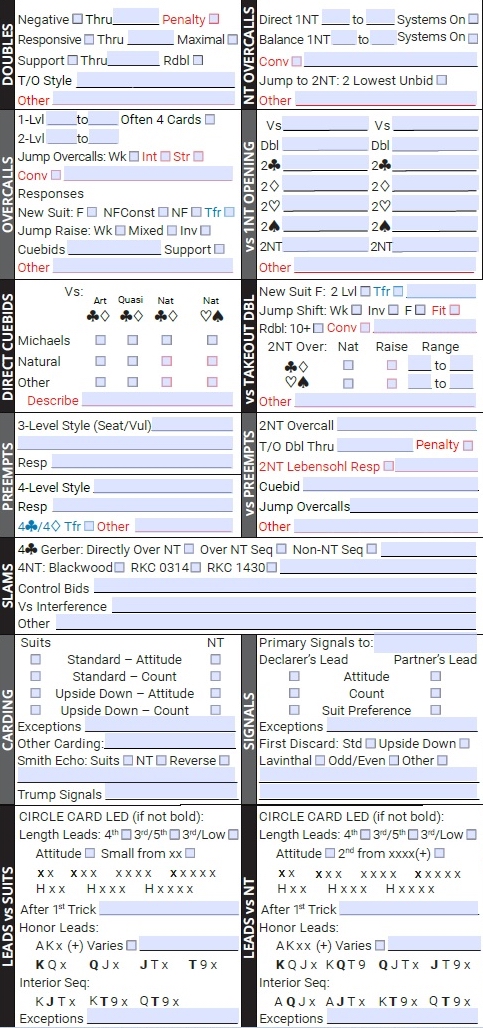
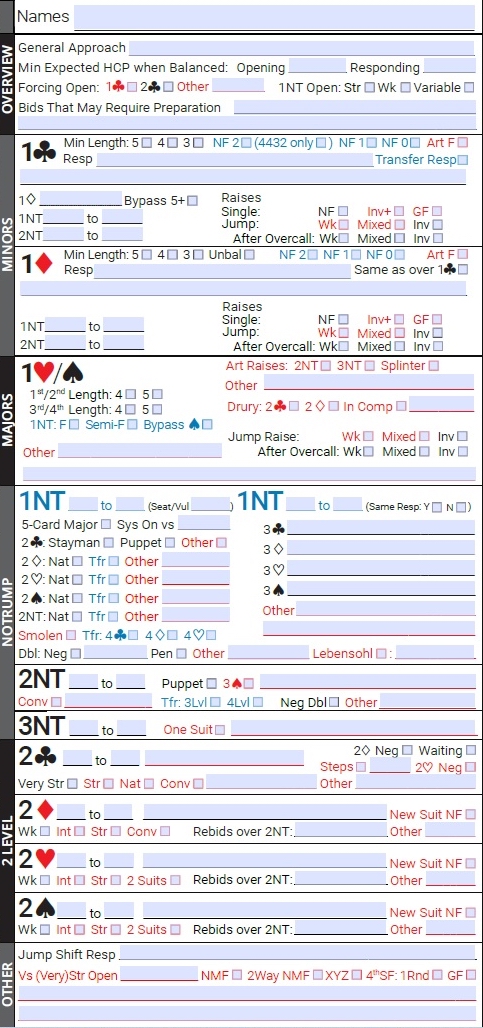
The new Convention Card Form as shown in the image above (right-click should allow separately viewing each side’s image enlarged) was first officially introduced in a March 2022 article published in the ACBL Bridge Bulletin and detailed in 14 subsequent monthly articles.2 The ACBL makes available a version of the new Form as shown above (created 3/25/2022) for download3 as an on-line PDF file.4 [Due to some issues with this dated version I recommend downloading my more current One-page Modified Form explained below.] The 2022 Form allows recording a partnership’s own system conventions and agreements using the fillable fields and check boxes in each Section. (See also the topic below about “Ways to Fill Out the new Form”.) The completed Form can then be saved and used as the partnership’s convention cards. Each of those monthly Bulletin articles provided introductory comments about a Section of the new Convention Card Form. They also identified some of the places where this new Form expanded and modified several areas from the previous ACBL Form. This new Form is intended to make it more easy to identify those currently common conventions with common meanings which the ACBL believes modern partnerships are likely to be playing.
The previous Form was introduced by the ACBL in 1988 and last partially revised in 2012. As of July 2023, and reported in a post on the Bridge Winners Forum, the ACBL has approved players either to continue using the layout of the previous Form or to start using the layout of this new Form in all ACBL events. Further as indicated in that post, ACBL has made available a downloadable PDF file of a slightly updated version of the previous Form which still uses that previous layout (now called the Classic Form to distinguish it from either the previous or this “new” Form). This recently updated Classic Form only differs from the previous Form by a few minor additions of some new fields and boxes as noted below, and some changes to text colors to reflect the changes to the Alert Procedure as of 2023.
Changes in the 2023 “Classic Form” from the previous Form
• Minor Opening: Transfer Resp. in Blue
• Over Opp’s T/O Double: Transfer Resp. in Blue
• Direct Cuebid: Over Artificial Bids all three meanings in Black
• Items now printed in black since no longer alertable
• NT Opening response of 2♣️ Puppet Stayman
• Other Conventional Calls: Weak Jump Shifts Not in Comp
• Special Doubles: Support doubles and redoubles
• Items now printed in red since alertable
• Major and Minor Opening responses: Forcing Double Raise
• Notrump Overcalls: Jump to 2NT explicitly meaning Minors
• Direct Cuebids: Strong T/O over both Minor and Major
• Leads: low of a doubleton versus both Suits and Notrump
Following this collection of introductory information the Table of Form Links below has an image of each side of the Form with hyperlinks alongside each Section of the Form. This Manual’s discussion of those Sections could simply be read sequentially through the Manual. It is organized in their physical order on the Form, first those down the front (right) of the Form, then those down the back (left). However I recommend starting at the hyperlinks on that Table of Form Links which will jump directly to the desired Section’s description or its companion Standard American Yellow Card© (SAYC) example. Clicking on the Form Links button at the bottom left of the browser’s window will jump to these Table of Form Links from anywhere in this document.
The Name of each Section of this new Form is now identified by a printed vertically shaded column at its left containing the upper-case label for that Section. Each Section’s discussion starts with my overall description and comments about that Section followed by an explanation of the filled-out SAYC example reflecting the ACBL’s SAYC system agreements for that Section. An SAYC Overview about these examples is provided separately below. A blank image of that Section of the Form, or its filled out image of the SAYC example, generally will remain at the top of the browser window while scrolling through its corresponding description or explanation below.
Each Section’s description is originally based on that Section’s monthly Bridge Bulletin article as cited above in the History, but also now includes my expanding those descriptions and including additional comments. These comments include at least a brief description of every convention which is explicitly named on this new printed Form, as well as noting which choices among agreements to be identified in this Section may require Alerts or Announcements. While a partnership may not have an agreement to use one of these named conventions, if a player notices it is marked as an agreement on an opponent’s card this Manual’s descriptions and comments may at least give them a general idea of what it means. Also they might now notice an agreement they already have as being one of these named conventions, and thus simply need to check its box.
As can be seen in the Form’s image, shown above and as part of the Table of Form Links, as well as in the separate images for each Section, within the Form’s detail text the symbols for the Diamonds and Hearts suits are not a solid color red, instead they are only an outline and often in black, i.e. ♢ and ♡. [In most cases for clarity I choose to fully color these suit symbols within the comments of this Manual, i.e. ♦️ and ♥️.] The reason for these suit outlines on the Form is to allow anything printed in red throughout the Form’s text to represent the need for an Alert, and anything printed in blue to indicate required Announcements.
While my Manual is not an official ACBL document, most of the expanded descriptions and added comments of the general ACBL rules, and of the agreements which can be recorded on the new Convention Card Form, have endnote citations to the below listed official ACBL publications. Thus my comments are intended to reflect ACBL rules and definitions. Likewise the explanations of the example ACBL SAYC agreements have endnote citations to that system’s separate set of publications listed below. I have used the most current versions of these publications available to me at the time of creating this Manual.
The sources listed below of Convention Charts, General Conditions of Contest and Laws of Duplicate Bridge, plus the Duplicate Decisions applying those laws, contain restrictions on what conventions are or are not allowed to be played in various ACBL contests. This Manual attempts to identify any such restrictions applicable to each Section based on my interpretation of the source’s extract in the endnote cited for that interpretation.
The Alert Procedure contains ACBL’s requirements on calls to be either alerted or announced. This Manual attempts to identify such requirements for these actions for all the calls which might be recorded in a given Section, as well as for the specific agreements entered as the SAYC examples. Whether or not to make these required actions are based on my interpretation of the Procedure’s rule which is cited in an endnote for each requirement.
This Manual tries to indicate when within these references alerts and announcements are explicitly required or are explicitly specified (required) to not be made. But whether or not to take these actions can be interpretations when neither a requirement nor a prohibition is specified.5 I often suggest in this Manual that it is a courtesy to the opponents to alert or announce in these unspecified cases if the agreement of the call’s meaning is likely to be unexpected or unfamiliar to that pair. However such actions should (or should not) always be done consistently for all hands against that opponent to avoid unauthorized information.
I have also included as a separate topic the definition and description of a Delayed Alert to help determine whether one of these required alerts would be delayed based on the Alert Procedure and the Laws of Duplicate Bridge. As these delayed Alert actions must be made during the Clarification Period, “when” they should be made by each partnership is indicated by their place in my recommended sequence of the Period’s defined actions which is listed in the beginning of the overall description of this Period.
If Javascript is enabled, clicking on an endnote marker number in the text will not only jump to that citation reference in the Endnotes but will also dynamically highlight that one endnote with a leading ⏩ and a contrasting background color to make it easier to spot among the other endnotes. The browser BACK button will return to the place in the text containing that clicked endnote marker number. Also clicking on any endnote’s number when browsing anywhere within the collected Endnotes will jump to that endnote’s reference point in the text. That referencing endnote marker now will be dynamically highlighted with an upwards ⯅ within its surrounding text to make it easier to spot.
Most citations throughout the Manual reference the following ACBL sources. The links provided to most ACBL PDF files are generic URLs which should access the latest version of that source, which may be more current than the version referenced below.
• “Conventional Wisdom”, Bridge Bulletin articles, starting with an overall introduction to the new Form in Volume 88, Number 3, March 2022, and separate articles introducing each Convention Card Section: Volume 88, Number 4, April 2022, through Volume 89, Number 5, May 2023. The 14 separate Section articles are extracted and available on-line as a single PDF File from the ACBL.
• ACBL Convention Charts, effective date: February 16, 2026. Available on-line as a PDF file from the ACBL.
• General Conditions of Contest - All Events. Effective August 1, 2019 (Revised 11/21/24). Available on-line as a PDF file from the ACBL. Separate appendices available on-line from the ACBL cover: Special Conditions for the use of Bidding Boxes and Screens (Appendix G, Revised 11/17/2022), Online Events (Appendix I, Revised 1/30/2019) and Online Play (Appendix O, Edited 2/18/2021).
• Laws of Duplicate Bridge. 2017 Revised Authorized Edition, Effective September 25, 2017. Available on-line as a PDF file from the ACBL. Online play is not addressed in this Manual.
• ACBL Alert Procedure. Effective February 16, 2026. Available on-line as a PDF file from the ACBL.
• The “Red Alert: Updates to ACBL’s Alert Procedure” article6 in the January, 2021, ACBL Bridge Bulletin, available as a separate PDF file from the bridgewebs.com site.
• The ACBL Club Director’s Handbook. Revised 2023. Available on-line as a PDF file from the ACBL.
• Duplicate Decisions, “A Club Director’s Guide for Ruling at the Table”, Revised September 2020. Available on-line as a PDF file from the ACBL. The decisions are explanations and rulings based on the above 2017 Laws of Duplicate Bridge. Online play is not addressed in this publication.
Any reference to “SAYC”, such as the SAYC examples for each Section, refers to ACBL’s official default Standard American Yellow Card© System as defined in the following sources:
• SAYC System Booklet (revised January 2006). Available on-line as a PDF file from the ACBL.
• Standard Yellow Card, ©1988, SP1-937 Inv #170351—Rev. 1/06. Available on-line as a PDF file from the ACBL.
• Standard Bidding with SAYC [cited as SBwSAYC], Downey & Pomer, Master Point Press, ©November 2005, ISBN 1-897106-03-3 available for purchase.7
Which method to use in filling out the new Convention Card Form depends greatly on whether the partnership’s agreements can easily be identified by simply using the pre-printed fillable fields and checkboxes provided by the ACBL’s available Form. Otherwise it may require the partnership obtaining access to more complex tools to modify the format of that Form for added ease of use and/or to enable identifying more custom agreements.
All the methods listed below start with obtaining a copy of the official ACBL Form, either found preprinted at an ACBL club or tournament or downloaded8 as the standard PDF file mentioned in the History section above. The methods below for filling out this Form range from simple to complicated, but basically fall into two categories:
• Use the existing Form to fill in its pre-printed fields either by hand or by a PDF viewer program. The most common program is the Acrobat® Reader® from Adobe® usually simply called Reader in this document. The Reader program is available for free and works on most computers9 or tablets using full Windows or macOS, and on mobiles10 using Windows, iOS and Android.
• Modify the actual format and fields of the available Form to create a Form which is similar in look to the existing Form. A similar document could be created by hand, or by a word processor or graphic image program. The available programs from Adobe® to create a modified PDF file include the Acrobat® Standard which has some editing features but does not have form creation or editing capabilities11, and the full professional product Acrobat® Pro with its companion suite of tools which is usually simply called Acrobat Pro in this document. [I use an older version of Acrobat Pro which has been available as a one-time purchase of a perpetual license fixed product called Acrobat Pro 2020. But Acrobat Pro is now only available12 from Adobe as a subscription version called Acrobat Pro DC (which stands for “Document Cloud”).]
Fonts in the ACBL Form’s PDF File
Both the ACBL Form and my modified Forms have fonts embedded in the PDF file. By default, Adobe applications will primarily use system fonts, meaning if a document contains a font not installed on your computer, it will automatically substitute with a similar font available on your system. For printing I recommend changing this behavior so the Adobe application will utilize fonts embedded in the Forms instead of relying solely on system fonts. Within the application go to “File” > “Print” and select “Adobe PDF” as the printer. Now click on the “Properties” button and select the tab “Adobe PDF Settings”. Uncheck the option “Rely on system fonts only; do not use document fonts” then close the settings window.
It still may be desirable to have a Form use some different font than those embedded in the ACBL PDF file. If the output desired is simply a separate document or image, any font available on the system might be used. However if such a font is to be used in a PDF file it must13 be a font installed on the system with static font face definitions. The Reader program can only use different fonts for Text Comments, but Acrobat Pro can use any of these static fonts installed on the system for modifying existing text or adding new. By examination the following are the defaults within the downloaded official ACBL PDF Form for comparison:
• Embedded Fonts— ACBL used these fonts for the fixed background text on the Form and their font definitions are embedded within their PDF file as shown by File > Properties > Fonts. They cannot be changed with Reader but could be changed by Acrobat Pro. They include: OpenSans-Semibold (used for the vertical Section labels), Roboto-Light (used for most fixed background text and labels), Roboto-Medium (used for the large dark numbers in the titles of the bid Sections), Roboto-Bold (used for the Bold card characters in the Leads Sections), and UniversalStd-NewswithCommPi (used for suit symbols). Note that the Roboto family of fonts does not include the suit symbol characters, so this added font was needed for those fixed background characters.
• Apparently built-in fonts— Helvetica is listed as a sans-serif font choice among the embedded fonts near the top of the drop-down list of fonts available for Comments. If it is chosen for Comment text in some cases it seems both Acrobat Pro and Reader will automatically embed ArialMT and use it instead of Helvetica for this text. ArialMT is an old Adobe version of the default Microsoft Windows Arial sans-serif font and seems to be automatically available within the Adobe products. While it is not listed in the drop-down list of available Comment fonts, nor in File > Properties > Fonts as an embedded font unless actually used, it is likely to become the font for text entered and does contain the suit symbol characters.
In addition the Adobe-Pi font is used for the “tic mark” graphic character in check boxes.
• Font Colors— Custom color definitions of text may be desired such as for Alert/Announce Comment text. The built-in color mix to indicate these meanings are not pure red and blue. Their RGB definitions can be set as custom colors for use in the Adobe products and are: Alert red (R236, G28, B35), Announce blue (R5, G122, B182).
These three methods in this category retain the new Form’s layout unchanged as defined in the available standard PDF file, but each differ in the activities required to enter the data about the partnership’s agreements. Since this new Form reflects more of the commonly used modern agreements, I believe ACBL expects this category of methods to be the most frequently used and be sufficient for most partnerships. [Note that if a Form’s fixed fillable field is too small to identify an agreement I “believe” a field could refer to an attached separate sheet with numbered notes. The field’s entry then could simply have “Note 14”. If this is not acceptable to ACBL rules and regulations I assume some reader of this Manual will point me to an official statement.]
• Fill out the printed blank Form by hand to identify the partnership agreements.
Pro: This method is the simplest, most flexible, and least expensive method, and does not use a computer which all other methods require. Anything can be written anywhere on the Form. Generic Red and Blue ink can even be used to identify Alertable and Announceable items.
Con: Copies must be filled out from scratch, or color photocopied. Changes in agreements are likely to require marking out entries or starting over with a whole new blank Form.
• Use a basic PDF program like the free Reader to enter text using the Form’s existing fillable fields and checking the existing boxes as appropriate.
Pro: Programs like the Reader make this an easy method to identify most common partnership agreements by simply entering text in the existing fillable fields and checking the available boxes on the PDF Form. Note that with a little bit of effort14 any of the suit symbols can be entered as part of the text in these fillable fields as needed since the font defined by ACBL for these fields does contain those characters. Separate completed PDF files could be created for each different partnership to be copied and printed15 as needed.
Con: If this free software is simply used to enter data in its basic mode it is limited to the predefined features of the PDF file being used, such as ACBL’s Form. This limits entering any custom information on the Form which is not provided by those predefined features. Further by default all text being entered will be in both the predefined font and color for that field, generally either black, even if it is preferred to be some other color.
• Use the advanced “Comment” feature within the free Reader to add text and symbols, customized by font and color, in ways and areas not part of the design of the Form.
Pro: This method is really just a variation on the above method, and requires no further financial expenditure or extra software. However it involves using Reader’s Comment feature16 which requires more computer skills and somewhat tedious manual work. While Reader has no mechanism to modify the default color or font of text entered in pre-defined fillable fields, both modifications can be defined for Comment text. However the choice of fonts for Comments is limited to the system’s installed static fonts, but not the fonts which may have been embedded within the PDF file itself. For example the definition of the standard Form’s background font face of Roboto-Light is embedded in the document but is not generally listed for a Comment font as it is unlikely to be installed by default on a Windows system. Warning: not all fonts available for Comments contain the four suit symbol characters and may display such characters as a simple dot. Thus, if the Comment is to include such a character the font must be chosen appropriately.
Note: Any non-default Comment fonts chosen are likely installed in and will print on the printer on that computer. However, if the file is copied to another computer the font chosen may not be installed on that computer or printer, and that system’s software (such as Reader) will likely automatically alter the font to something installed on the system which will affect both its display and printing.
Such Comment text may be added over the top of, and thus “apparently” within, a fillable field to thus allow different fonts with possibly a non-default color to display in those fields. While a single Comment can only use one font or color, multiple separate differing Comments can be positioned in a row for a single entry. Fillable text with default features could even leave spaces as room for internal placement of Comments in colors different than the field’s predefined default color. Further, by using this “Comment” method the prefilled file could be shared and any existing PDF Comments in the file could be easily modified or removed from that file and replaced with others as desired, also using only the free Reader.
I find Adobe’s default setting of a color highlight of the fillable fields interferes with placing and seeing non-default colored Comment text placed on top of (thus “apparently” within) any such field area. Such non-default colors are typically desired for emphasis or to express Alert/Announce meanings different than the default color produced by that field. As a Tip if such colored Comments are to be used in either Adobe program, when placing them on top of a fillable field area the PDF option “Edit > Preferences > Forms > Highlight Color > Show border hover color for fields” should be unset. This will make it easier to see the placement of such Comments within these fillable fields, and to preview the final look of the Form since this field highlight color will not be present when printed. [In my opinion using customized colored Comment text and symbols to clarify Alert and Announce requirements for entries, such as I use in the SAYC example Form, makes the resulting printed Form much more helpful and usable.]
Con: While the increased flexibility of the “Comment” feature is capable of somewhat customizing the nature of entries in unchanged PDF form, I did find Reader has several editing limitations and the work was tedious. For example there is no Reader capability to modify or add custom fillable fields or check boxes.
Modify the standard format of the Form
These two methods in this category are used to change the ACBL’s new PDF Form’s layout and format but generally require some appropriate computer program to do so. The difference between them is based on the output nature of this modified Form:
• produce a strictly hard-copy image of a modified Form, usually complete with all the entries describing the partnership agreements, or
• create a replacement fillable PDF file of a modified Form with possibly new and different fillable fields and checkboxes which can then be used to fill in multiple separate partnership agreements.
The motivation to modify the standard Form can be to have a simplified Form to make it more readable by changing the fonts or sizes used, or by removing the distraction of agreement options not used by the partnership. Alternatively the motivation could be to have a more complex or simply different Form. This could be if the partnership agreements are sufficiently complex or special that the basic Form is inadequate to accommodate entering more numerous and possibly uncommon agreements in a meaningful and readable way. Custom sized fields and different checkboxes could be added to reflect additional conventions and identify uncommon agreements not easily indicated on the standard Form.
With any motivation for modifying the Form, at either end of the complexity spectrum, the applicable restrictions from the ACBL’s “General Conditions of Contest”17 and “Duplicate Decisions”18 should always be followed. They do allow for the use of non-ACBL provided convention cards, especially at the Club level, so long as they remain “similar” to the published ACBL Convention Cards, and so long as any red or blue colors used identify Alertable and Announceable calls respectively.
• Use some already available word processing or image program which will allow either loading and modifying the image of the ACBL PDF Form or allow creating a completely new image.
Pro: This is done to produce a static image of a modified Form able to be printed which shows the partnership agreements. While such a modified Form image could simply be drawn and completed by hand, creating some format of a reusable computer image seems more likely. The main advantage of this method is more flexibility usually without added expense. Much of the appearance and text of the Form could be modified to enhance the ability to record and better reflect the specific special agreements of the partnership. Since it could start with an image of the standard Form, the resulting modified image could be created in a manner to ensure it is “similar” to that original ACBL Form image.
Con: Depending upon the capabilities of the software used, even if one could start with an image of a Form with some fields completed, the desired modifications may be complicated and time consuming to accomplish. Usually all text and entries would be added to the image to reflect the partnership agreements. However this method may be worth the effort for some partnerships as once created that document might still be easy to modify to reflect different partnership agreements.
• Load the actual ACBL PDF Form file or a modified Form image into some computer program, such as Acrobat Pro, able to create and modify PDF Form files with fillable fields.
Pro: This produces a replacement modified fillable PDF Form. Its main advantage is total flexibility in changing the appearance and text of the Form while retaining as output a fillable Form able to accommodate entering different agreements for different partnerships. Features of such programs like Acrobat Pro’s “Prepare Form” tool usually can even start from a blank page or accept either an existing PDF file or a modified Form image as the basis of creating a modified PDF Form. This method could be a follow-on to the above method of creating a modified image as the basis. Once created and saved, the modified PDF Form could be opened and filled out simply using the free Reader.
In general any aspect of the ACBL Form’s format usually can be modified by such programs. Such modifications could include altering the fixed background text and their properties on the Form, adding or deleting fillable fields and checkboxes and their layout, and even defining the default font and color properties of the text that will be entered in those fields. Often programs like Acrobat Pro have tools which can embed the actual font definitions of the text being used within the PDF file. This separate action would be required to ensure a shared file will retain its look on a system without those fonts installed.
Con: The capabilities and ease of making the desired modifications will depend upon the software used and one’s familiarity with it. Most such full-featured software, such as Acrobat Pro, is not free and its expense can be an issue for some partnerships unless they already have access to such a program. Further I found it can take some significant learning of its program features and tedious meticulous work to get exactly the look one desires. Yet some players may feel it worth the cost and effort to construct a custom fillable Form which can then be used to document their non-standard agreements and conventions as appropriate for different partnerships. However, too much modification “might” make the Form so unrecognizable to either the opponents or an ACBL tournament director19 that they no longer find it “similar” to the standard ACBL Form and thus it may not be accepted for ACBL use. Therefore as noted above all modifications should bear in mind ACBL’s “similar” requirements.
As examples of the final method above to modify the standard Form I used Acrobat Pro’s advanced “Prepare Form” and “Edit” tools to create a one-page Form nearly identical to the standard Form, and an equivalent two-sided Form intended for added accessibility to individuals with limited eyesight. I then entered the SAYC system agreements in each Form to produce example convention cards. As described below that modified one-page SAYC convention card is used as the example in this Manual for filling out each Section of the Form. These modified Forms and SAYC convention cards can be downloaded from my web site.
This downloadable Form appears essentially identical to the one-page ACBL standard Form. However it corrects the non-red printing error mentioned in the SLAMS Section, removes an extra unused fillable field in the SIGNALS Section, and adds fields in that Section to optionally identify an order of precedence for signals. It also thickens the colored Alert and Announce check box outlines for added emphasis. If entries are made using a PDF program such as Reader it uses ACBL’s red or blue color definitions as appropriate for the entered item.
Most significantly it alters the sequence of the fields which will be highlighted in-turn when using the Tab key in Reader to change to the “next” field. Tabbing through this modified Form will thus follow the sequence of Sections and their individual field descriptions and explanations as they occur in this Manual.
Two-sided Modified Big Print Form
This downloadable Form was a more ambitious project. In addition to the modifications in the one-page Form above, I wanted to create a format which was more accessible to the many elderly players in our Club. This special two-sided format is intended for added accessibility to individuals not only with limited eyesight but also who may be color blind. Each “side” of this “Big Print” Form will print on the front and back respectively of an 8½ by 11 sheet. While I retained ACBL’s Roboto-Light sans-serif font for most background text I increased it to 14 point versus the standard Form’s 8 point size for added readability which is a font size suggested by typical “Big Print” recommendations.
Recommendations for accessible print also specify that color may not be the only indicator of some information. Common versions of color blindness are Red-Green which can cause red to appear black, and Blue-Blind where the color blue cannot be detected. As generally recommended I included textual cues (in addition to color) to indicate the presence of these two color codings on the Form. Red on this Form now adds a red exclamation mark (‘!’) as the textual cue to show Alert, and Blue on this Form now adds a blue double dagger (‘‡’) as the textual cue to show an Alert accompanied by an Announcement. These textual cues also allow a black and white copy of this Form to still indicate Alerts and Announcements. For people with color vision the standard use of color provides a significant contrast to normal text. For the same reason these cue characters are printed in bold to provide an equivalent clear contrast to normal text for users with limited color vision (or when printed in black and white). Finally a small letter ‘a’ with a stroke (‘ⱥ’) is provided as an additional available textual cue for “non-alertable” to precede a non-alertable black Comment entered on a line marked as default for alertable comments. [This Unicode ‘265C’ character does exist in the Helvetica font.] All these textual cue characters are also included as removable text in the fillable Notes field at the bottom of the front of the Form, and can be copied into custom Comments as needed.
Any preprinted colored text label now is followed by the appropriate textual cue defined above. Those text labels ending in a colon ‘:’ apply to multiple following elements. The appropriate textual cue now precedes the colon which applies to all those elements. Colored check boxes are typically preceded by some text labeling that box, so the color cue appended to the label will apply to that box. If the colored check box is not labeled, textual cues bracket the box. In addition the larger 12 point “tic mark” within the larger check box now is in the outline color. Fillable fields underlined in either color typically are preceded by some text labeling that field, so the color cue following that text label will apply to that field. If such a field is not labeled it has the cue at least at its end and sometimes also at its beginning, and the text entered will default to that color. However Comment text of a different color than the defined default for the field can be placed on top of any fillable field area using whatever color desired (including black) as described in the above method. (However such non-default colored text should be preceded by its appropriate textual cue character to override the default meaning of the field.) Finally since the text, fillable fields, and check boxes are enlarged, a few fields within Sections have had to be slightly repositioned to accommodate this larger two-sided format.
This downloadable convention card uses the above one-page modified Form to describe the SAYC system agreements. An image of each filled Section of this convention card is used as the SAYC examples throughout this Manual where those system entries for that Section are fully explained.
Because the SAYC system agreements were entered in the modified Form by only using the free Reader program, this convention card provides an example of how special system agreements can be entered on this new 2022 Form, including using custom color Comments on top of fillable fields. Further the Comments and example prefilled system entries in this PDF file can be changed or deleted, as well as having other Comments and entries added, all using only Adobe’s free Reader program.
As described in some detail below, this convention card is a much more complete description of the SAYC system than the typically available very abbreviated small preprinted Standard Yellow Card. I encourage ACBL clubs and tournaments to consider making available printed copies of this fully filled-out convention card. It not only more completely describes this system, but could be useful since SAYC might be required to be played at an ACBL tournament in the absence of a substantially completed partnership card.
Two-Sided Big Print SAYC Convention Card
This downloadable convention card uses the two-sided “Big Print” modified Form intended for added accessibility to individuals with limited eyesight as described above. The same entries to describe the SAYC system agreement which are used in the one-page Form are used in this Form. I also encourage ACBL clubs and tournaments to consider making available printed copies of this limited-vision accessible more fully filled-out SAYC convention card.
This new Form has many fields and boxes which try to reflect the wide range and extensive number of agreements a partnership might have during both the auction and the play of the hand. As noted in the initial announcement20 of this new Convention Card:
“While it may seem like a lot of information — especially at first — it’s perfectly fine to only fill out the areas that apply to your partnership.”
Partnerships which are new to duplicate Bridge, or are not interested in using and remembering lots of agreements, may choose to have a very minimum of agreements to indicate on this Form. In most cases of Bidding Agreements it is perfectly appropriate for a partnership to have no agreement about a given topic, or have not discussed that topic in order to develop an agreement. As a result a partnership may either leave many areas of the card unmarked, or include a required entry indicating such a lack of agreements. But any field or option on the Form that could indicate an agreement which the partnership does have must be marked.
However the ACBL rules require at least a basic agreement be made and indicated for some of the significant topics on the Form, such as for Carding Agreements. For example a field may require an entry (such as the HCP range for opening No Trump), or a set of option boxes may require at least one box to be checked (such as the minimum length of a minor opening). Conversely, in some cases if some areas of the Convention Card which are printed with defaults (such as for Defensive Leads) are otherwise left unmarked this can imply the partnership is using some “standard” set of agreements. If that is not the case an entry should explicitly indicate what is the agreement. Finally in some cases ACBL considers agreeing to use some conventions common and expected, such as Conventional Doubles. In these cases either the partnership should agree to play them, or avoid any actions which would imply them. If they do make any action which would normally be assumed to have a meaning as part of an expected convention, they must make a required Alert to indicate it does not have that expected meaning.
Therefore I have tried to indicate in the description of every Section of this Form what I believe are the minimum basic markings required to be indicated when playing in an ACBL sanctioned game, and suggestions about how to avoid actions which would require an Alert. While it may be sufficient for some Sections to make no entries, specifying something is especially necessary for Sections where marking nothing is either not permitted (e.g. Blank Carding Agreements) or would either be ambiguous or imply some common agreements. That marking may indicate the basic agreements of an assumed convention, or as little as indicating a limited agreement, or if allowed marking no agreement or not discussed for the topic. However as noted above, the information of all agreements (explicit or implicit, and whether the minimum or beyond or different than this minimum) which the partnership does have is required to be indicated on the Form and available to their opponents21 by marking any field or option on the Form that reflects that agreement.
The term no agreement would be used by a partnership has if they have discussed and explicitly decided to have no exact or firm agreement about the meanings of a call or play or an entire topic. The alternative term not discussed means what it sounds like: the partnership has not sufficiently discussed the topic to agree on a specific meaning of a call or play. In either case this asserts that neither partner has specific expectations about its meaning when it occurs. A partnership should recognize that any agreed understanding between these two players of a call or play may be reached22 implicitly or explicitly, but in either case it would be an agreement23 which must be disclosed24 when required.
A partnership may specify either of these two terms as appropriate and permitted, both on the Form and when asked, because no discussion or understanding has been reached between them. However, a player still may have a general expectation of the “typical” duplicate bridge meaning of a call or play. A player at an ACBL event can expect both their partner and the opponents to have reasonable reasons for their actions even with no discussion or agreement, and can assume they are not acting randomly. Thus an implicit understanding of a partner’s reasons for making a call or play must be disclosed when required if based on experience with this specific partner. But a player need not indicate or disclose implicitly assumed reasons25 based solely on inferences drawn from their own personal knowledge and experience of matters generally known to duplicate bridge players.
When asked by an opponent whether a call or play has an agreement, if this partnership has not even a minimal agreement the partner should say either of the above two terms as appropriate. But they should not say “I don’t remember” even if that is the case. They also should never try to guess whether or not there is an agreement or what they “think” it might be, as this could be unauthorized information to their partner. If they cannot remember, then the partnership probably has not adequately discussed it to make it memorable. They should instead reply “Not discussed” and may26 require calling the Director to verify this is the case. An ACBL Appeals committee also indicated27 that it would be “proper” for advanced players who reasonably might be assumed to have discussed the topic to add to their response some additional comments about “principles” or experiences pointing in one direction or another when there is a “no firm agreement”, but that response is not explicitly required. [See also the Clarification Period description below which includes when to correct Misexplanations, such as where there actually was or was not an agreement or it was different than what was stated.]
As noted at the end of the Synopsis of this Manual, partnerships should be aware that both members must have and use the identical completed convention card. If not, then the ACBL General Conditions of Contest for any ACBL sanctioned duplicate game say the partnership may only play28 the ACBL Standard American Yellow Card© (SAYC) system (or other basic methods approved by that tournament’s director), whether the game is face-to-face at a local club or a tournament, or on-line such as at Bridge Base Online LLC (BBO). [The very fact that a Director could require using the SAYC agreements implies to me that all players at an ACBL sanctioned event would be expected to have a basic knowledge of this system and be able to use those agreements.]
For some History of SAYC see the 2010 post by Morris “Mojo” Jones and added comments from others. It explains that: “SAYC was introduced in 1988 by the ACBL as a standardized system for events that would require no alerts.” He reports that ACBL developed it as a reasonably simple system with a few popular modern conventions identified by a “standard” convention card for use specifically in “individual” tournaments, where you would have a different partner for every round. They called these “Yellow Card Individual” events at the tournaments. The convention card itself was printed on yellow paper and they offered a companion detailed 8 page document [the SAYC System Booklet] of exactly the specifications of this system indicated by this card, later revised in 2006 with very little modification. “…people saw the value of having something concrete that could be agreed to in seconds that should be well-understood, especially given the detailed text description.” [My understanding is that it would “require no alerts” because everyone in the event was playing the exact same completely specified system.]
Among other personal reasons explained below, since ACBL defines its SAYC system as the default set of bidding conventions and carding, I have used that SAYC system and its agreements as the examples for filling out all of the Sections on this new Form. Each Section’s examples are headed by an image of that filled-out Section extracted from a completed convention card PDF file I created using ACBL’s new Form.
As noted above I was able to complete a Convention Card reflecting the SAYC system by simply entering the agreements on either the standard ACBL 2022 Form or my slightly modified Form. This was accomplished simply by using only the Comment feature in the free Adobe Reader. where the completed entries identified the “straight” SAYC agreements. That completed Form can be downloaded as one of my modified versions of this convention card Form. But this modified Form is still readable, fillable, and editable by using the free Adobe Reader. As an alternative to the widely available (over) simplified Standard Yellow Card I encourage clubs to consider making available this pre-printed fully filled-out new Form Convention Card describing the complete straight SAYC system.
What boxes were checked and what text was entered on my example Form are based on my understandings of the fixed conventions of the SAYC system. My example entries in each Section representing that system are based primarily on and cited to the two 2006 ACBL official documents listed in References above:
• the complete description of the system with examples which I cite as SAYC System Booklet, and
• its companion preprinted Convention Card which I cite as Standard Yellow Card.
As these were published (and revised) on the same date by the ACBL they should be considered together. Often the SAYC System Booklet may be incomplete or unclear about a specific topic where an example on the printed Standard Yellow Card will make the issue clearer, or vice versa.
Further clarifications and comments which I include generally are based on details found in the reference that is the authoritative book Standard Bidding with SAYC which I own and often cite in these pages as SBwSAYC.
From the first page of ACBL’s SAYC System Booklet [emphasis added by me]:
“While there are no choices in the present day SAYC … a pair could use the SAYC as a base and make one or two modifications. If you do make a modification or two in an open game, you should announce that fact to the opponents – if they think you are playing straight SAYC and they know SAYC, they would not know about your modifications.”
In creating these examples for ACBL’s new Convention Card Form I thus included only what I understand to be the “straight” agreements of this ACBL system as defined in the above official ACBL publications of its fixed set of conventions. I have not included any modifications to this fixed set of basic agreements, even those which modern partnerships may be likely to employ. On this example Form I tried to record all of SAYC’s conventions which are able to be identified using the Form’s provided fields, but found it necessary to add a few more entries to the Form to be complete.
I resisted the urge to add, subtract, or modify SAYC’s defined agreements except for a very few situations which I believe are authorized in the definition of this system. The Standard Yellow Card has a section labeled “Defenses vs. Opp’s Conventions” which does not appear as a separate topic area on either the new or the previous full ACBL Convention Card Forms. The only reference to this Standard Yellow Card section in the SAYC System Booklet is a NOTE on its very last page29 which states that when playing the ACBL’s SAYC system [emphasis added by me]:
“You may add defenses to the opponents’ conventions (e.g., unusual vs. unusual, and Mathe over big club). Put these convention-defenses in the section “Defenses vs. Opp’s Conventions” on the left-hand side of the [SAYC specific Yellow] convention card.”
[In general I believe these added defensive conventions likely would now be entered on this new Form in the OTHER Agreements Section, or as part of documenting defenses in a more specific Section.]
SOS Redoubles which are mentioned within the booklet30 is the only entry31 on the Standard Yellow Card in that defensive conventions section. In light of this example I choose to interpret the above NOTE in the booklet as implying that if modifications to SAYC are simply adding defenses to opponents’ conventions, and these modifications are now recorded (somewhere) on the partnership’s Convention Card, then partnership agreements which only added these defensive conventions to SAYC could still be considered using a “straight” SAYC system. As a result I have included a (very) few such modifications on this example card, most of which are also encouraged by the SBwSAYC book.
Personal Opinion concerning the SAYC System
Even though this system is over 45 years old I find it is still a very usable basic system. However I entered these SAYC agreements on a full 2022 Convention Card Form because it seems clear to me the pre-printed Standard Yellow Card always assumed that this card was just a simple indicator that the partnership was using the complete SAYC system exactly as defined in the companion booklet. I believe that much too minimal card (which uses a very simplified and abbreviated version of the previous Form’s format) has done a grave disservice both to ACBL and to the useful and robust system it references. In my opinion that overly simplistic card makes SAYC falsely appear to most modern casual players to only include those very minimal ordinary conventions printed. While limiting to only those few printed conventions might be appropriate for beginning to teach a new player, if a partnership claims to be using SAYC in an ACBL sanctioned tournament then I believe its original uses show they are claiming to be using all of SAYC. That full system includes considerably more than what is printed on its limited yellow indicator card. As Morris “Mojo” Jones stated in his 2010 post mentioned above: “To truly play SAYC you should use its set of conventions without changes, love ’em or hate ’em… There are great advantages to having a precisely spelled-out system that both parties understand.”
Thus I believe it important to understand that the full official SAYC system was always defined as much more than just the few conventions printed on its simplified Yellow Card. The complete system officially defined in the SAYC System Booklet is often even more than the limited descriptions I have found in most basic bidding guides to SAYC. In fact since SAYC often defines follow-on responses and rebids to its conventions, it is even more than the inclusion of all the identified conventions I have been able to record on this example Convention Card. Thus in addition to the official publications I especially recommend the SBwSAYC book cited above which tries to more fully describe this complete system, as well as mentioning useful modifications which would still fit well in a custom system using SAYC as a base.
I believe Keith Wells (ACBL Tournament Technical Analyst) said it best on July 2, 2020 in a reply to a post32 on the Bridge Winners forum which he felt unfairly disparaged the SAYC system [emphasis added by me]:
“Success in bridge is not tied to which system you play, but how well you know the system and your ability to picture possibilities so that you can use it to its fullest capabilities.”
In my opinion many players do not know the complete official SAYC system or use it to its fullest capabilities. Hopefully describing SAYC by use of these examples in this Manual may help in making users more fully aware of this old but robust ACBL system.
Table of Form Links to
Section Descriptions & SAYC Examples
|
|
||
|
|
||
Front of the Card
(Right-Hand Side of Card)
Like ACBL’s previous Convention Card Form which prints on one side of a page, this Form is expected to be folded left-behind-right and placed on the table as the player’s Convention Card with the right-hand side up. As shown above that side is considered the “front of the card”. It is expected to be read first as it begins with the OVERVIEW Section starting with the partnership’s Names (plural) at the top. As mentioned above, the ACBL General Conditions of Contest require33 that both cards of a partnership must be identical. Thus a Convention Card is not for a single person but for a partnership, so it should have both names (and probably their ACBL numbers) of this partnership entered in that field.
Under the names on the front are first some limited spaces to record the General Approach to this partnership’s bidding system. This area provides only a quick general summary of their system’s major special agreements. The remainder of the entire Form provides separate Sections to describe their complete agreements in more detail. Rather than the previous Form which first provided a section to record NoTrump openings, the new right-hand side arranges the Sections for recording agreements concerning opening bids in ascending rank order of the opening from top to bottom: MINORS, MAJORS, NOTRUMP, 2 LEVEL, and OTHER.
OVERVIEW Section34
|
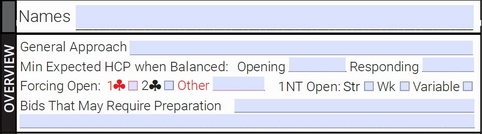
Following both names of the partnership, this OVERVIEW Section begins with the General Approach which is often just the common name of the basis of the system of agreements being used. However if a system name implies a fixed and/or well-known set of agreements (such as SAYC), and the entries on this Form reflect having added to, subtracted from, or changed those recognized agreements, then the phrase used here should make any opponents viewing the card aware that there are differences from that system’s fixed or known definition. Two lines which appeared in this Section in the previous Form (and are still on the “Classic Form”) are removed this Form: Two Over One and Very Light. Depending upon one’s definitions Two Over One is considered by some a specific system whose name now would be entered as the General Approach, or by others as simply a specific convention defining some responses to Opener which now would be included in the markings for those responses in the appropriate Section. Very Light is a term associated with some conventions which was mentioned35 in the now outdated 4/2016 version of the ACBL Alert Procedure. If the partnership has agreements for such pre-alertable conventions I suggest they should be entered in the Bids That May Require Preparation field as described below. Replacing the above two removed lines is a new line: Min Expected HCP when Balanced. This must identify the agreed minimum High Card Points (without distributional points) expected for both Opening and Responding balanced hands. Like the previous Form any Forcing Open agreed to be used must then be indicated. The most common, expected, and thus non-alertable agreement is indicated by checking the box for the artificial Very Strong 2♣️ Forcing Open described in its separate Section of the Form. As I understand it, since it is expected and at the two-level it does not require a pre-Alert. Any one-level Forcing Open indicated requires36 a pre-Alert if its agreed meaning is: • Not Natural (i.e. Artificial) for the suit bid, thus generally considered forcing, OR • Natural for the suit bid, but explicitly Forcing. Note that a requirement for a pre-Alert is different from a requirement to alert or announce. A forcing 1♣ is the most common one-level Forcing Open and thus has its own red box to be checked which indicates it is also alertable. It may be agreed to be forcing as part of a convention or simply agreed to be Strong or Very Strong, either of which would be more clearly defined in the separate 1♣️ opening Section of the Form. Any Other alertable Forcing Opens, whether at the one or some higher level, should be indicated in this field and would similarly be more clearly defined in that opening’s Section. The general level of strength of a 1NT Open must be checked, where ACBL’s definition of Str (Strong) indicates the minimum of the agreed range is 14+ HCP and any smaller minimum should be marked as Wk (Weak) regardless of the maximum. The Variable box would be checked to indicate the partnership agrees to use different HCP ranges for a 1NT opening depending upon vulnerability and/or seat as described more completely in that bid’s separate Section. The field for Bids That May Require Preparation is like a “pre-Alert”, where significant non-common artificial conventions (e.g. Flannery) should be noted as a help to opponents.37 This should list conventions that the opponents at this event probably rarely encounter, and/or that likely require them discussing an appropriate defense to in advance. In my opinion what is entered here should be whatever a partnership considers is likely helpful to the expected opponents. The Bulletin recommended that what bids are entered in this field be dependent upon the knowledge of the opponents that will be encountered during an event when using this card. For example, in some ACBL Clubs Flannery (or some other artificial convention) may be rarely encountered and thus should be listed as a notice and a help to any opponents. But I can imagine in other Clubs or event the convention may be played so regularly by such a majority of opponents it may not be of any help if listed in this OVERVIEW Section. Other examples might include agreements which are unusual but might not be alertable, such as unusual “Very Light” calls: Openings, 3rd hands, Overcalls, Preempts, and T/O Doubles. (As described above these agreements used to have boxes in this Section on the previous Form.) This field should also include any pre-alerts which are required38 by the partnership’s agreements, e.g. Artificial Opening Preempts39 below 3NT. More details about what is summarized in this Section will be entered elsewhere on the Form; this Section simply provides a quick general summary of the major special features of this partnership’s agreements. |
|
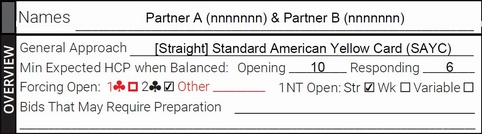
Since a card reflects a specific partnership’s agreements, both Names (and ACBL membership numbers) are entered. This example OVERVIEW Section identifies the General Approach of the agreements as “[Straight] Standard American Yellow Card (SAYC)”. If a partnership uses SAYC as a basis for their own system but simply decides not to play (or have to remember) some of its fixed conventions, I recommend being sure to exclude them from the card and identify the General Approach with a phrase like “Simplified SAYC”. If the card (also) reflects additions and/or changes to ACBL’s fixed set of conventions, enter something like on my partnership’s cards: “[Modified] Standard American Yellow Card (SAYC)” as a more appropriate help to opponents to understand our agreements. For the value of Min Expected HCP when Balanced, straight SAYC system does not explicitly specify a minimum HCP for a balanced Opening hand which is too weak to open 1NT. Since SAYC requires40 at least 13 points (with distribution points) for opening a Major, this lower minimum would usually occur when opening a minor. The Convention Charts require41 at least Average Strength42 for any Natural opening bid in a suit. Therefore I chose43 10 HCP for this entry which seems to meet all relevant guidelines. The minimum SAYC expects44 for Responding with a balanced hand is 6 HCP (usually for a 1NT response or a minimal raise). SAYC’s Forcing Open is identified in the heading45 of the Standard Yellow Card: “Strong Forcing Opening: 2♣”. (See also this opening’s SAYC example for the definition of this “very strong” bid.) As noted above this forcing open box is not colored red and does not to require an alert. As detailed in its example in the NOTRUMP Section below, an SAYC 1NT Open (not overcall) is Str (strong) since it is 15-17 HCP. I believe straight SAYC has no Bids Which May Require Preparation by the opponents so that field is left blank. (Most opponents probably “should” already have adequate knowledge about the straight SAYC system and not need preparation against it if playing at any ACBL sanctioned event). |
MINORS46
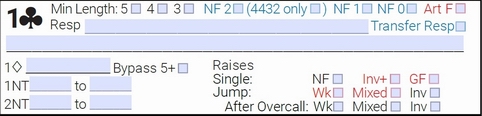
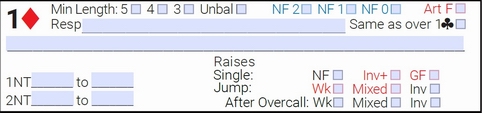
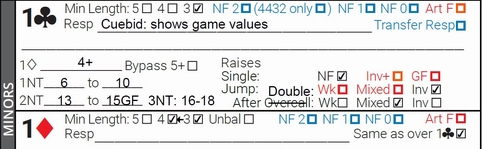
This new Form now has separate MINORS areas for 1♣️ and 1♦️ openings. With the popularity of many new artificial conventions for the 1♣️ opening bid its separate agreement options on this new Form have been expanded. The separate options for a 1♦️ opening are similar, including whether it is used for artificial openings. These two minors openings also have separate areas for agreements about responses to that specific opening, but there now is a box to check to indicate that all responses to the 1♦️ opening have the same agreed meanings as to the 1♣️ opening to avoid duplication of markings.
Both minor opening areas have a new box labeled “Art F” at the top right of their Sections. The Bridge Bulletin introduction to this Section does not discuss this box. I choose to assume that checking it indicates the same meanings as the pre-alert definition about any one-level forced opening noted in the OVERVIEW Section above. In other words it should be checked if the agreed meaning is: either truly Artificial (Art) for the suit bid and thus generally considered forcing, or Natural for the suit bid but explicitly Forcing (F). Thus if this box is checked this minor suit opening also should be indicated as a Forcing Open in that OVERVIEW Section of the Form. Note that the boxes indicating agreements of a “short” minor (less than 3) are explicitly indicated as non-forcing and thus such agreements do not qualify for a pre-Alert, but still require an Announcement.
A Quasi-Natural minor opening is a special agreement with an explicit meaning47 that is also referenced in this Form’s DIRECT CUEBIDS and NT OVERCALLS Sections. Such an opening has one of two possible Natural meanings:
• either the bid is Natural for the suit bid, or
• the bid shows a hand whose pattern (shape/distribution) meets the definition of a Natural NT opening but is outside (and usually weaker than) the 1NT Opening HCP range.
Note that for a Quasi-Natural 1♣️ opening which means Natural for the Club suit its definition48 specifically includes “4432”. If the minor suit opening means a a Natural NT opening pattern any suit (including the bid suit) “could be” the shortest suit. Thus a Quasi-Natural agreement will require an announcement that this bid suit “could be” shorter than three and the box indicating its appropriate minimum length also should be checked. While not indicated as required I suggest entering “Quasi-Natural” in the field below the field labeled “Resp” both as an aid to the partnership as well as to the opponents. If a Natural NT opening pattern the Opener will often rebid 1NT to further indicate the balanced and typically weak nature of the hand.
Note that the announcement of the agreed minimum length might be “could be one” instead of “could be two” depending upon whether the partnership agrees this Quasi-Natural bid’s possible NT opening shape can include a singleton suit. The ACBL definition49 of a natural NT opening shape now allows what used to be only one doubleton to be a singleton. Depending upon whether the partnership agrees to include a singleton as part of the Quasi-Natural shape the Alert Procedure specifically includes50 example announcements for either “short” minimum length.
Since ACBL considers either of the Quasi-Natural two meanings as Natural (even if the bid suit could be less than three) this agreement does not require a pre-Alert. I observe that a partnership might choose to restrict their agreed meaning of a Quasi-Natural NT opening pattern to require the bid suit to be at least length 3 and check that box. In that special case instead of an announcement the Quasi-Natural bid must51 simply be alerted since it will not be short but has two different specific possible meanings. Since the Form has no method to indicate this now alertable but non-forcing bid, similar to my comment above I suggest entering “Quasi-Natural” in red to show it is alertable in the field below the field labeled “Resp”. Especially in this case I also believe it would be appropriate and helpful to the opponents to include the term “Quasi-Natural” as a clarification of an announcement of any bid with this agreement, e.g. “Quasi-Natural could be two” or “Quasi-Natural could be one” regardless of what suit might be short.
|
The options for the 1♣️ MINOR opening bid have been expanded to require identifying the agreed shortest possible Min (minimum) Length of this opening. If the agreed minimum length of a natural bid of this suit is short (fewer than 3) the appropriate box can be checked for its NF (Non-Forcing) meaning, and those short minimum lengths must be Announced52 such as “Could be two”. Note that this 1♣️ area now also has a non-forcing box for the explicit and Natural “4432 only” shape. That box should be checked (do not also check NF 2) if it is agreed that this is the only hand shape where the Club suit could be bid with as few as two, although many systems would instead open 1♦️ with this hand. As noted in the above MINORS Section Overview, the need for a “short” announcement may be required because the 1♣️ opening is agreed to be Quasi-Natural since any suit could be short. If so, although not explicitly required, as mentioned in this Section’s Overview above I would probably indicate Quasi-Natural in the field below the field labeled Resp. As described in the MINORS Section Overview, the options for this opening now include a box to indicate if its agreed alertable meaning is either Artificial (Art) and forcing such as a Strong Club opening, or natural and Forcing (F). If this box is checked the 1♣ box also should be checked in the Forcing Open line of the OVERVIEW Section as this opening includes the need53 for a Pre-Alert. If this opening is always artificial and thus alertable but not forcing I believe it should be indicated in the field below the field labeled Resp. If the partnership has no explicit agreements about responses to this opening I suggest entering “Natural” in the “Resp” field, and then no other entries need be made in this area. The remaining fields provide entries to check or fill in the required information about most common responses to a 1♣️ opening. [The agreements entered in these fields will also be used as the response agreements for the 1♦️ opening if the “Same as over 1♣️” box in the 1♦️ area is checked.] There now is a box for specifying that the opening expects artificial Transfer Resp (Responses) from partner which the opener will announce when bid. (A box for this transfer convention has been added to the updated Classic Form in a manner where it would apply to both minor openings.) Like the previous Form there is a separate 1♢ field to clarify any special agreement of this response, and a box to indicate whether it is agreed this response may be bypassed in order to show a 4+card Major (often called a Walsh agreement). Checking this box now indicates that such a bypass may occur when the diamond suit has 5+ length. Although this box was labeled 4+ on the previous Form, do not check this box if it is agreed Responder may bypass this response with exactly 4 diamonds to bid a 4+card Major, as an agreement about that smaller length now does not need to be indicated. Typically this bypass is only done with a minimum hand so as to mention the 4+ Major in case Responder is unable to bid again. Otherwise most partnerships do not check this box as they agree Responder will show biddable suits “up-the-line”. Fields are provided to enter the required information about agreed HCP ranges of 1NT and 2NT natural responses, but there is no longer a box to indicate whether a natural 2NT is forcing, and no fields for the range of a natural 3NT response. Any NT response that shows a balanced or semi-balanced hand is considered Natural54 and thus not alertable. [If any of these NT responses are agreed to have an uncommon meaning of artificial or forcing I presume that agreed meaning should be entered on the lines above.] Concerning agreements about Raises, at least the first row should be checked. Note unless a Single Raise is agreed NF (Non-Forcing) the other response agreements are thus forcing and alertable.55 The other two rows could be left unchecked thus indicating No Agreement if the partnership agrees to never make a jump bid raise. [If using the Inverted Minors agreement the Single raise would be checked Inv+ (Invitational plus), and the Jump raise would be checked Wk (Weak). Thus as shown by the Form’s colors both would be alerted.] The previous Form’s options for Jump Raise agreements had similar boxes to the new Form to indicate general strength, but this new Form does not have boxes to indicate it is agreed to be forcing either when uncontested or After Overcall. (The updated Classic Form now shows an uncontested Force jump raise as alertable which the previous Form did not.) This Form still indicates that unless invitational (Inv) an uncontested jump raise is alertable.56 But the prior Force box for both jump raise situations has been replaced with a new box labeled “Mixed”, where that agreement is only alertable if uncontested, and is typically defined as having normal single raise values but with extra trump. |
|
Similar to the 1♣️ opening the 1♦️ MINOR opening options have been expanded to require identifying the agreed shortest possible Min (minimum) Length of this 1♦️ opening. If the agreed minimum length is short (fewer than 3) the appropriate box can be checked for its NF (Non-Forcing) meaning, and those short minimum lengths must the Announced57 such as “Could be one”. As noted in the above MINORS Section Overview, the need for a “short” announcement may be because the 1♦️ opening is agreed to be Quasi-Natural. If so although not explicitly required, as mentioned in this Section’s Overview I would probably indicate Quasi-Natural in the field below the field labeled Resp. Whatever the opening’s meaning its minimum may be different than for a 1♣️ opening. Plus there is a new non-alertable Unbal box to indicate that this 1♦️ opening is agreed to show an unbalanced hand. As described in the MINORS Section Overview, the options for this opening now include a box to indicate if its agreed alertable meaning is either Artificial (Art) and forcing, or natural and Forcing (F). If this box is checked this 1♦️ opening also should be entered as an Other Forcing Open in the OVERVIEW Section as it includes the need58 for a Pre-Alert. If this opening is always artificial and thus alertable but not forcing I believe it should be indicated in the field below the field labeled Resp. While the previous Form only had one shared area for response agreements for both minors openings, the 1♦️ opening now has it own separate Section. Its set of boxes and fields, identical to the 1♣️ area, can now identify the required information of most common responses in case any are different than those for the 1♣️ opening. However partnerships who agree to treat responses to these two opening bids the same (usually because they simply open the “better or longer minor”) don’t need to fill out the responses in this 1♦️ area. Instead complete the required information about the shared response agreements in the above 1♣️ area, then in this 1♦️ area after the required identification of its opening’s Min Length just check the box “Same as over 1♣️”. If any agreements for responses differ than for the 1♣️ opening then all responses must be explained. But if the only difference is that responses to the 1♣️ opening have agreements but the partnership has no explicit agreements about responses to this 1♦️ opening, then I suggest entering “Natural” in the “Resp” field and now no other entries need be made in this area. An equivalent box to the one in the 1♣️ area indicating this opening expects Transfer Resp (Responses) from partner is not provided. If this is also an agreement for the 1♣️ opening and the “Same as over 1♣️” option is checked that is sufficient. Otherwise if there are separate response agreements for this 1♦️ opening and Transfer Responses is an agreement it would require writing it in. (A box for this convention has been added to the updated Classic Form in a manner where it would seem to apply automatically to both minor openings.) Like the 1♣️ area the remaining fields provide the ability to check or fill in the agreed meanings of most common responses to a 1♦️ opening when they are different than those for a 1♣️ opening. The same fields are provided to enter the HCP ranges for 1NT and 2NT natural responses. Like the 1♣️ area there is no longer a box to indicate whether a natural 2NT is forcing, and no fields for the range of a natural 3NT response. Any NT response that shows a balanced or semi-balanced hand is considered Natural59 and thus not alertable. [Like for 1♣️ if any of these NT responses are agreed to have an uncommon meaning of artificial or forcing I presume that agreed meaning should be entered on the lines above.] Concerning agreements about Raises, at least the first row should be checked, and unless a Single Raise is agreed NF (Non-Forcing) the other response agreements are thus forcing and alertable.60 As also noted for the 1♣️ responses, the other two rows could be left unchecked thus indicating No Agreement if the partnership agrees to never make a jump bid raise. [If using the Inverted Minors agreement the Single raise would be checked Inv+ (Invitational plus), and the Jump raise would be checked Wk (Weak). Thus as shown by the Form both would be alerted.] The previous Form’s options for Jump Raise agreements had similar boxes to the current Form to indicate general strength, but this new Form does not have boxes to indicate it is agreed to be forcing either when uncontested or After Overcall. (The updated Classic Form now shows an uncontested Force jump raise as alertable which the previous Form did not.) This Form still indicates that unless invitational (Inv) an uncontested jump raise is alertable.61 But the prior Force box for both jump raise situations has been replaced with a new box labeled “Mixed”, where that agreement is only alertable if uncontested, and is typically defined as having normal single raise values but with extra trump. |
|
SAYC specifies opening in the MINORS only when there is no 5+ Major.62 However as noted in the OVERVIEW Section SAYC example, I believe SAYC allows a minor opening to be weaker (as few as 10 HCP) than a MAJORS opening (typically at least 13 points with distribution). Thus a weak hand with a weak 5-card Major suit might open a minor then rebid as appropriate. Regardless SAYC minor one-level openings show the longest minor or lowest if equal length, and SAYC has no artificial meanings, agreements, or conventions for these openings. As part of its simplification the Standard Yellow Card marks63 the promised length for both minors as 3+. Opening 1♣️ in SAYC is natural and non-forcing and is agreed to always show Min Length of at least 364, so that is the only box checked. Min Length for a 1♦️ opening in SAYC is agreed to usually be four. However in the one special case of shape [4=4=3=2] where neither Major is length 5+, diamonds may be bid with only 365 as still being the longest minor. To indicate this variable minimum I suggest following what was once recommended for entry on the previous ACBL Convention Card Form: check both the 3 and 4 boxes but write in66 a backwards arrow from 3 to 4, although simply checking 3 seems to be acceptable. In SAYC all 1♦️ responses are agreed to be the Same as over 1♣️ so that box is checked with no other entries in this Section beyond the above required indication of its Min Length. Straight SAYC specifies67 in principle responding “up-the-line”. If there is no 5+ card suit then SAYC agrees68 to bid the cheapest 4+ card suit. Thus a 1♦️ response would indicate length 4+ even if the hand held a 4-card Major. Therefore a 5+ diamond suit is not bypassed to show a 4-card Major, so the Bypass box in the responses area is not checked. All NT responses are natural and standard thus their agreed HCP ranges are entered.69 Since the box on the previous ACBL Form to indicate a natural 2NT response as forcing is now missing and SAYC defines this response as game forcing (GF), I choose to write that agreement in. Likewise the line on the previous Form where the HCP range for the natural 3NT response70 could be identified is also missing, so I also choose to write in its SAYC agreed range on this Form. The minimum support length for Raises of both Single and Jump responses are agreed to ensure at least a combined trump suit length of 8+ cards: i.e. for minors 5+ length for ♣️’s, 4+ for ♦️’s.71 SAYC does not include the common “inverted minors” convention, and there is no forcing minor-suit Raise in SAYC.72 Thus it defines the Single Raise as NF (Non-Forcing) 6-10 points.73 (A single raise over interference is a “free bid” and generally implies at least the same support length but more strength than an uncontested response.) When not in competition the SAYC Jump Raise of a minor is agreed to be Inv (Invitational) and is defined as a limit raise, 10-12 points.74 The only SAYC agreement75 for a Jump Raise response in competition is after a double as the overcall, so the printed “Overcall” is marked out and replaced with “Double” to show this limitation. This Jump Raise response over a double shows good trump support but fewer than 10 points, which matches the new Mixed term so that box is checked. I also note this agreement in the separate vs TAKEOUT DOUBLE Section for clarity. [I can find no SAYC mention of using a jump raise of a minor over any other interfering overcall.] Finally, SAYC agrees76 to use a Cuebid of the opponent’s suit after an interfering overcall that is not a double to show game values. This GF (game force) response is generally without clear direction and without “promising” support, and is entered in the special Resp (Responses) field. [Using this cue instead of a Jump Raise of partner’s suit often allows more bidding room to explore other lower level game contracts, and could be made with (possibly at most minimal) suit support.] |
MAJORS77
|
This MAJORS Section retains the boxes from the previous Form to require identifying the agreed minimum expected Lengths for opening a Major (not Overcalls). There are rows for the different opening seats as partnerships often agree to open a Major in later seats with only a 4-card suit. Note that if there is an agreement that either Major suit opening is not Natural or is Forcing it must be identified, probably in the bottom red underlined field of this Section, and the partnership must pre-alert that agreement.78 [If such a one-level opening is Forcing the Other box in the OVERVIEW Section on the Forcing Open line also should be checked and this opening bid entered in its field.] If the partnership has no explicit agreements about responses to these openings then I suggest entering something like “Responses: Natural” in the bottom red underlined field and now no other entries need be made in this Section. All boxes and fields other the above boxes indicating opening Lengths describe response agreements. First, if the 1NT response is agreed to be either type of forcing that box must be checked and the call announced79. Any non-forcing (and probably weak) NT response that shows a balanced or semi-balanced hand is considered Natural80 and not alertable and thus has no box. If F (Forcing) is checked then Responder expects Opener to bid practically 100% of the time. For Semi-F (Semi-Forcing) Responder can have up to invitational values, but Opener is then allowed to Pass and thus play in 1NT, usually when having only a minimum but otherwise balanced opening. Bypass ♠ must be checked if it is agreed that Responder will routinely respond with 1NT over 1♥️ with four spades (usually because the pair plays the Flannery convention). Regardless of whether or not the 1NT is also forcing at some level, this bypass agreement must be announced81 with “could have four spades”. However if the agreement is [only sometimes?] to respond 1NT over 1♥️ with four spades and three hearts in a normal context [possibly to show a very weak hand] do not check this box for announcing the bypass. There are boxes which would be checked for any agreements of the three responses whose meanings commonly are Artificial Raises and thus alertable82, each of which may have variations to their conventional meanings. The red underlined field labeled Other just below these boxes can be used to explain the meaning of the checked artificial raise (such as 2NT commonly meaning the Jacoby convention) or to indicate less common artificial and thus alertable response agreements, e.g. conventional raises such as Bergen. In comparison to the previous Form there is no longer a box or fields to indicate whether a natural 2NT response is agreed to be forcing or to show its range, and no lines for the range of a natural 3NT response over this Major opening. Only 2NT and 3NT responses agreed to be artificial raises have boxes on this Form. Next are ways for a passed-hand Responder to indicate agreed meanings of 2♣ and 2♢ responses to Opener’s uncontested 3rd or 4th hand opening of a Major which may be weak, such as:
Pass - (Pass) - 1M - (Pass); If one or both of these minor responses are checked to indicate an agreement for the artificial Drury convention they are alertable. Even though Responder is limited in strength due to being a passed hand, these conventional responses can be used to show Responder has strength and support, and Opener’s conventional rebids now can indicate the strength of their own Opening. If Drury is (also/only) agreed to be used In Comp (competition) that box should be checked and the adjacent field can indicate how, and over what interference of partner’s Major Opening, e.g. only over doubles. Finally there are several variations commonly in use on the “type” of Drury, such as 1-Way, 2-Way, 3-Way, Reverse or not, and Fit (some of which had boxes on the previous Form). It is probably appropriate to indicate the variation of Drury being played, probably in the adjacent field, so as to minimize opponents having to ask. The previous Form’s options for Jump Raise agreements had similar boxes to this new Form to indicate general strength, but this new Form does not have boxes to indicate it is agreed to be forcing either when uncontested or After Overcall. (The updated Classic Form now shows an uncontested Force jump raise as alertable which the previous Form did not.) This new Form still indicates that unless invitational (Inv) an uncontested jump raise is alertable.83 But the prior Force box for both jump raise situations has been replaced with a new box labeled “Mixed”, where that agreement is only alertable if uncontested, and is typically defined as having normal single raise values but with extra trump. Similar to the MINORS Section these two rows could be left unchecked thus indicating No Agreement if the partnership agrees to never make a jump bid raise. Finally the two Other fields at the bottom generally are for indicating artificial and thus alertable response agreements not covered above, such as: 3/1 invitational, game-try agreements, or perhaps follow-up bids after forcing or semi-forcing 1NT responses. |
|
SAYC defines Opening in the MAJORS as showing 5+ Length in any seat and generally shows either the longest Major or higher ranking of equal length.84 Further SAYC generally expects85 at least 13 points (with distribution points) for a Major opening. Straight SAYC does not include the 2-over-1 response convention, so the 1NT response is not checked forcing in any way and thus does not require any announcement. (SAYC defines the 1NT response as natural, 6-9 points, less than 3-card support. It is the response used over a 1♥️ opening86 if the hand also has less than four ♠️s; and is also the response over 1♠️ with that point range and less than 3-card support.) Over a 1♥️ opening an SAYC Responder with 6+ points agrees to respond a 4+ spade suit and does not Bypass ♠ so that box is not checked. (Otherwise over a Major opening an SAYC Responder with 10-12 points and no support bids the longest 4+ new suit at the two level to show the points.87) A 2NT jump response made without interference is the only SAYC agreement of an Artificial Raise of a Major and means88 the Jacoby convention: 13+ dummy points, 4+ support, Game Force. In addition to checking that box, since partnerships using other bidding systems may have other non-Jacoby artificial meanings for this raise I believe it is helpful to “Name” the SAYC agreed meaning of this artificial 2NT response by entering “Jacoby GF” in the field labeled Other below that box. In SAYC a 3NT response is not an artificial raise and thus is not checked. However this natural response has an alertable extra agreed meaning as described and entered below. SAYC does not include the Drury responses agreement which is indicated by making no entries on this line. Instead SAYC agrees that whether or not Responder is a passed hand, a 2-level response of a minor is natural showing it as the next highest 4+ length suit. [Drury is generally not needed with SAYC. A 2-level minor response to a 3rd or 4th hand opening of a Major is agreed as stronger than a “waiting” 1NT response, since bidding that new suit at the 2-level shows89 10+ points.] There are no boxes on this Form to indicate the agreed meaning of a single raise of a Major, which SAYC defines as non-forcing, 6-10 dummy points, at least 3-card support.90 A single raise over interference is a “free bid” and generally implies at least the same support length but more minimum strength (e.g. 10+ points) than an uncontested single raise response. Similar to MINORS, when not in competition the SAYC Jump Raise of a Major is agreed to be Inv (Invitational) and is defined as a limit raise, 10-11 points.91 The only SAYC agreement92 for a Jump Raise response in competition is after a double as the overcall, so the printed “Overcall” is marked out and replaced with “Double” to show this limitation. This Jump Raise response over a double shows good trump support but fewer than 10 points, which matches the Mixed term so that box is checked. I also note this agreement in the vs TAKEOUT DOUBLE Section for clarity. [I can find no SAYC mention of defining a jump raise of a Major over any other interfering overcall, but note the meaning of the single raise after an overcall above.] SAYC defines93 a natural strong balanced 3NT jump response as equivalent to SAYC’s 1NT opening but also showing exactly two-card support for opener’s Major. As this Form no longer even has a line to identify the defined range of this response I choose to enter this agreement in the bottom field. While the bid is natural, since the bid also shows an exact length in opener’s Major it is alertable.94 Finally, SAYC uses a Cuebid95 of the opponent’s suit to show game values, usually a GF raise, after an interfering overcall that is not a double, which is entered in the bottom field. [Using a cue instead of jump bidding partner’s suit allows more bidding room to explore other lower level game contracts, and could be made with minimal suit support. It also leaves a natural NT response over interference available to indicate strength in the opponent’s suit.] |
NOTRUMP96
The agreements for all levels of NOTRUMP Openings are recorded in the three separate areas of this one labeled Section. There is a full area for 1-level openings which includes fields to record agreements about conventional responses to that opening, Two more abbreviated areas exist for 2- and 3-level openings. (Note that there is also a separate Section on the left hand side of the card to describe NT OVERCALLS instead of these openings.)
|
ACBL requires entering the agreed range for a 1NT (one NOTRUMP) opening. Partnerships should also indicate the general meanings of the five 2-level responses the partner of the opener can make, even if those above the 2♣️ response are all simply marked natural (Nat). ACBL restricts97 any range agreements to show at least 10 HCP and not be greater than a 5 HCP range. If the announceable98 HCP agreed range for a 1NT opening is the same for all seats/vulnerabilities then identify the HCP range in only the left fields. Some partnerships agree to an alternate HCP range when vulnerable versus not, and/or when opening in 1st/2nd seats (i.e. before partner has a chance to bid) versus 3rd/4th (i.e when partner has already passed). If an alternate range is used then first enter the “normal” range for opening 1NT in the left hand fields, next specify the (usually less often encountered) agreed (Seat/Vul) (seat and/or vulnerability) situations which use the alternate range, and finally enter the alternate range in the right hand fields. The two ranges should only be used in distinctly separate bidding situations. These two ranges should not both apply in any given situations as such a situation would then likely define a NT opening range larger than 5 HCP.99 If two different ranges are entered but all responses have the same meanings in all situations check ‘Y’ for Same Resp (same responses). Otherwise check ‘N’ to indicate there are different responses or meanings used with the alternate range than those entered on the Form. (My modified versions of this convention card Form prevent checking both boxes.) And if there is only one range leave both of these boxes unchecked. [It is not clear there would be sufficient room on the Form, but I believe, if possible, any different alternate response agreements somehow should be indicated.] The balanced distribution of a natural NT opening is currently defined100 by ACBL as a hand with: no voids, no more than one singleton, which must be an Ace, King, or Queen, and that does not contain 10 or more cards in two suits combined. [Thus as the most extreme examples I can think of (where ‘H’ is a singleton Ace, King, or Queen), this definition of balanced now allows a hand as unbalanced as with two suits 5-4 such as (5-4-2-2) and (5-4-3-H), or even with two suits 6-3 such as (6-3-2-2) and (6-3-3-H), and (in my opinion absurdly) even allows one seven-card suit (7-2-2-2)!] If a 1NT opening hand is agreed that it may contain a 5-card Major then check that box, as normally such Major suits are agreed to have at most four cards with this opening, and only allowing a minor suit to have five cards. A partnership could agree to a more restrictive definition of no 5-card suits to force at worst 4-4-4-1, or also agree to no more than one doubleton instead of singleton thus ensuring only 4-4-3-2. However I believe any partnership agreement of a restriction beyond ACBL’s definition of a balanced distribution should be indicated on the Form. The “Sys On vs” (System responses to remain On versus) field is used to indicate that 1NT conventional System responses marked in this area are agreed to remain “on” after the specific interfering calls identified in this field. Examples of such interfering calls might be a double or some specific 2-level bids. This field exists since by default if an opponent makes any bid or a double over the 1NT opening, then conventional System responses like Stayman and Transfers are assumed “Off”. Thus with interference other than that specified in this field all responses are now expected to be natural. For this reason this field lists those specific interfering calls which are agreed to allow the System response calls that are still available above that interference to retain their conventional meaning as marked in this area. The Stayman box is checked if the agreement is to use that standard non-forcing convention implying the Responder has a 4-card Major. The Puppet box is checked instead if the agreement is to use that alternative Stayman convention which involves a method of finding out if Opener has a 5+ card Major. (Like the Same Resp boxes above, my modified versions of this convention card Form prevent checking both boxes.) Any agreements of the meanings of the 3♣/3♢/3♡/3♠ jump responses must be entered on the right, as well as the meanings of any Other special response bids or agreements. Next on the bottom line indicate whether Responder’s Dbl (Double) of an opponent’s overcall of the 1NT opening is agreed to be a non-alertable101 Neg (negative) double through the specified level, or is a natural Pen (penalty) double, or even some Other alertable agreement (such as a stolen bid double). If Other is the specific agreement its alertable meaning must be indicated in the following field. Finally check the Lebensohl box if agreeing to use this defensive convention over an intervening suit bid where responses can either show a stopper in that suit with a slow response or deny one with a direct response. For example a Responder’s 2NT response generally shows a stopper and slows Responder describing their hand by being an artificial Relay for Opener to bid an artificial 3♣. Responder can then use conventional bids to further describe their hand. Conversely a different response generally denies a stopper and directly describes something about Responder’s hand. If playing this Lebensohl convention in a non-standard manner and/or there are also agreed special artificial responses over interference other than 2NT, that should be indicated in the following field. [If the agreement is very non-standard I would probably enter something like “Ask” in the field.] |
|
All 1NT (one NOTRUMP) direct openings in SAYC use the same 15-17 HCP range in all situations, so the second set of alternate range fields are not used and the Same Resp boxes are left blank. The SAYC definition102 of the opening NT bid includes being able to have a 5-card Major so that box is checked. The SAYC system sources do not include its own system definition of a “balanced” hand for a natural NT opening. Thus I presume the definition103 in the latest ACBL Convention Charts of a natural NT opening bid or overcall which allows the one doubleton to be a singleton if that card is no less than a Queen would also apply to SAYC. Whether a partnership wishes a more restrictive definition of balanced which excludes this newly allowed singleton from their definition of NT openings, or requires it to be either an Ace or King, would be up to partnership agreement. I think it would be courteous to inform opponents of whatever is their agreement, but I don’t see any field which could be used to indicate this. I guess it “could” be included with the alert’s announcement of the range, e.g. “15 to 17, no singletons”, but I cannot determine if this would be appropriate. For the “Sys On vs” (System responses to remain On versus) field about interference of the 1NT opening, the SAYC System Booklet includes the agreement104 that versus an interfering double (X) all system conventional responses are to remain on after the 1NT opening (although the Standard Yellow Card only explicitly notes Jacoby transfers remaining on over doubles). Versus this specific interference of a double the SBwSAYC book defines105 an alertable106 artificial redouble (XX) response as an escape to mean a weak Minors Relay to Clubs similar to the conventional 2♠️ response. I entered this special defensive agreement in the Other responses field at the right. With this redouble response agreement the competitive auction remains one level lower than with the conventional 2♠️ response since Opener is now only being forced by the relay to rebid 2♣️. Like the conventional 2♠️ relay, if Opener’s 2♣️ rebid remains uncontested Responder either passes or corrects to 2♦️ for closeout. [Since all SAYC system responses remain on versus double, the 2♠️ conventional response also can be considered still “on”. However versus this specific double interference a partnership could agree to modify the 2♠️ response to mean a stronger Minors Relay (to the higher 3-level) than the now available equivalent lower level Minors Relay using redouble. It could even now mean something completely different such as “natural”, but such agreements are not suggested in straight SAYC.] Concerning the 2♣️ interference bid also included in the “Sys On vs” field in this example, see the more complete description of this agreement in the Modification comments below. This 2♣️ entry allowing “Systems On” automatically implies the defense agreement of an artificial alertable “Stolen bid” double of that 2♣️ interference to now mean Stayman. This is what allows all higher system conventional responses to remain on versus this interfering 2♣️ bid. The 2♣️ response107 in SAYC means non-forcing standard Stayman so that box is checked, but the system also includes the common “Garbage” Stayman108 extension where Responder has a weak (0-7 HCP) balanced 3-suited hand short in Clubs and plans to Pass any uncontested rebid by Opener. SAYC does not use the alternative 2♣️ “Puppet Stayman” convention instead of standard Stayman so that box is not checked instead. The 2♢/2♡ responses109 are the standard Jacoby announceable Tfr (transfers) to the next higher suit. The 2♠️ response110 is the weak alertable111 Minors Relay to 3♣️s where Responder will either Pass a 3♣️ rebid by Opener or raise to 3♦️ for closeout. The 2NT response112 is checked Nat (natural) which shows a balanced hand invitational to 3NT. The 3♣/3♢/3♡/3♠ jump responses all are defined113 as natural 6+ length, where a minor is invitational to 3NT and a Major shows Game Force (GF) and slam invitation. If Responder is not strong enough to invite slam with a 3-level jump response in a Major they would simply first use a Jaboby transfer to show the suit. [The agreement of the 6+length being sufficient for inviting was based on the old ACBL definition of expecting at least two cards in every suit of a 1NT opening. Thus combined with 6+ length ensured a working trump suit of at least 8 cards. If the partnership agrees to allow a 1NT opening with a singleton the agreed minimum lengths of these jump responses may need to be reconsidered.] SAYC does not include the Smolen responses so that box is not checked. Also none of the 4♣/4♢/4♡ jump responses as a type of Tfr (transfer) are checked, since the 4♣️ response is reserved for Gerber ace asking and the above strong and natural 3-level jump responses are used for appropriate invitations. Concerning the “Cuebid:” entry in Other at the right, the following excerpt from the SAYC System Booklet mentions opponent interfering “bids” (which does not include the “call” of double). Defining any responses over such interfering bids, strict SAYC includes the following additional special response agreement [emphasis added by me]: “If an opponent bids over your 1NT opener, conventional responses like Stayman and transfers are “off.” Bids are natural except for a cuebid, which may be used with game forcing strength as a substitute for Stayman.”114 Thus with an interfering bid over a 1NT opening, SAYC agrees that a cuebid response is a Game Forcing Stayman substitute to the now unavailable 2♣️ bid, as entered in the Other field on the right. Note that with the Modification agreement below if the interference is a 2♣️ bid Responder could either double for an invitational (lower level) Stayman or cuebid for a game force. [Since this cuebid must be made at least at the three-level it makes sense that Responder must have the values to force game, either in their Major with a fit or in NT.] Finally this agreement concerning interfering “bids” implies that SAYC does not include the Lebensohl convention which could be identified on the line below. Finally straight SAYC defines no special meanings for a Dbl (double) response over interference, so the Neg and Pen boxes are not checked. However, I believe the Modification described below which adds the defense of using an artificial alertable “Stolen bid” double when versus a 2♣️ interference bid to mean invitational Stayman is appropriate and could still be considered “straight” Stayman. Therefore I entered that alertable defensive agreement modification as an Other meaning for a double as the companion to including 2♣️ in the “Sys On vs” field above. [Modification] I agree with the SBwSAYC book that having no defense to interference over 1NT other than versus a double is very limited when there are many useful defenses to other interference. That book recommends115 partnerships agree to use a double of an interference bid of 2♣️ to have an artificial alertable “stolen” conventional meaning which would be announced as “Stayman”. This “stolen” double of the now unavailable normal Stayman response is agreed to have exactly the same meaning and strength as making that stolen bid when uncontested. This provides a way in this one instance to bid a standard non-forcing invitational Stayman call at its normal level as an alternative to having to use the SAYC specified higher level game forcing cuebid for Stayman. The book further indicates116 that simply by agreeing to this defensive treatment versus that interfering 2♣️ bid (just as is agreed when versus an interfering double) all systems could now remain on for the other higher ranking system responses if they are made instead of this double over that 2♣️ interference. In light of the NOTE on the last page of the SAYC System Booklet permitting adding defenses, I choose to include this one simple and limited defense of the 2♣️ interfering bid on this example card (like the Bridge Winners “Modern Standard American” card also does). Thus I include the 2♣️ bid in the “Sys On vs” field, and add the entry “Stolen v 2♣️” as an Other agreed meaning of Stolen for a DBL versus (v) that interfering bid at the bottom of this 1NT area. Additional defenses of direct interfering bids after the 1NT opening of 2♦️ or higher “could” be agreed as defensive modifications beyond straight SAYC, such as further stolen bid doubles of any 2-level bid. While I chose to have such agreements concerning some other intervening bids with some of my partners, I have not included them on this example card since, like not including Lebensohl, based on the above explicit quote I believe they would not be in the spirit of “straight” SAYC. |
|
This Form requires entering the HCP range for a 2NT (two NOTRUMP) opening. The Bridge Bulletin article for this Section only has the [very limited and ambiguous] statement117 that the “expected” meaning of this bid is a “strong, balanced hand”. If the agreed meaning is not this expectation then the article indicates the Conv (Conventional) box below should be checked, and (since printed in red) the bid would be alertable, with an indication of its meaning entered in the following red underlined field. While ACBL restricts range agreements for a 1NT opening, the ACBL article’s uncapitalized term “strong” for a 2NT opening seems to me ambiguous. I can find no equivalent clear ACBL restrictions on this expected “strong” range of a 2NT opening, neither its minimum value nor its maximum range. As I indicate in the discussion following ACBL’s definitions of strength (below within the 2♣️ opening Section) in cases of ACBL’s usage of the uncapitalized term “strong” I believe that term generically and collectively refers to both “Strong” and “Very Strong” definitions, thus perhaps suggesting it could show as low as 14-15 HCP. As a comparison 1NT must show at least 10 HCP. [As a guideline for our 2NT agreements the ACBL’s SAYC system range for its 2NT opening (20-21 HCP) is within the “Very Strong” definition. This seems to match well with its 1NT opening (15-17 HCP) range which is within the “Strong” definition. Further the Convention Charts explicitly state118 that if a 2-level or higher opening bid meets ACBL’s “Very Strong” definition it is allowed (and thus presumably expected).] If a partnership believes its agreed range does not meet ACBL’s “expected” definition of “strong” then I believe they should check the Conv box and alert the bid. Since I can find no ACBL rules defining “balanced” which are specific to this 2NT opening, based on this article’s “expected” meaning of this opening I believe the ACBL’s definition of “balanced” for any natural NT bid (described above in the 1NT Section) should also be used for this opening. [As an example I note that the Convention Charts specifically allowed NT opening bids119 at the 2-level or higher would meet ACBL’s balanced definition if showing 5-4 in the minors and either 2-2 or 3-H in the Majors.] Thus if a partnership believes its agreed meaning of this opening does not meet ACBL’s “expected” definition of balanced then I believe their meaning should be indicated on the Form, and probably alerted. While they might choose to check the Conv box, they might simply enter something like “semi-balanced” in the red underlined field after that box. This Form requires entering the HCP range for a 3NT (three NOTRUMP) opening. Again the Bridge Bulletin article only states120 the “expected” meaning is also a “strong and balanced hand”, thus implying the same comments about those two terms as above for the 2NT opening. Similar to 2NT the article states that the partnership should indicate any different agreed meaning than “expected”, such as checking the alertable (since printed in red) One Suit box or identifying some other alertable meaning in the red underlined field following that box. If the partnership has no explicit agreements about responses to these openings then no other entries need be made in this area to the right. Basic Responses to 2NT are indicated in the remainder of that area and often have conventional agreements, many similar to 1NT responses. Like for 1NT ACBL assumes the 3♣️ response will normally mean one of the two artificial Stayman conventions which ask about Opener’s Majors, and thus either such meaning is not alertable.121 The 3♣️ response is assumed by ACBL to mean the standard Stayman convention asking Opener about any 4+ card Major so does not even have a check box. However Puppet should be checked if the 3♣️ response instead is agreed to mean the common alternative “Puppet Stayman” convention (a method of finding out if Opener has a 5+ card Major). If the 3♠️ response is not natural and not one of the two Stayman conventions check its box and indicate whatever is the artificial agreement. (Minor suit Stayman, or an artificial relay to 3NT are the most common 3♠️ alertable conventions.) Check the appropriate box if any 3-level (3Lvl) and/or 4-level (4Lvl) responses are agreed to be announceable transfers122 to a specific suit. The non-alertable123 Negative Double (Neg Dbl) box should be checked if that response is agreed to be used over interference, and any Other special response agreements, such as with interference to the 2NT opening, should be entered. I presume there are no separate fields on this Form to describe responses to a natural 3NT opening as often it is considered a close out. |
|
The SAYC agreed124 HCP ranges for these balanced 2NT and 3NT (NOTRUMP) very strong openings (which may contain one five-card suit) are: 2NT = 20–21; 3NT = 25–27. As I believe these are within the standard ranges and meanings the 2NT the Conv box is not checked, and the 3NT One Suit box is not checked. If using SAYC with a balanced hand having no five-card Major and its HCP is between SAYC’s 1NT range and this 2NT range (i.e. 18-19 HCP), a one-level bid of the longest minor suit is made first, then opener jumps to 2NT if available.125 Likewise if such a balanced hand is between the 2NT and 3NT ranges (i.e. 22-24 HCP), the forcing 2♣️ strong opener is bid first showing the 22+ HCP, then opener rebids 2NT if available.126 The discussion by SAYC references of responses to either of the 2NT or 3NT openings is limited, as none indicate a specific special minimum HCP required, and varies by the reference. The simplified Standard Yellow Card127 only defines the Jacoby transfers for both of these higher-level openings. The SAYC System Booklet mentions128 and the SBwSAYC book implies129 both Stayman and Jacoby transfer responses are agreed, so both are indicated on the Form in the manner described below. As a response (Resp) to the 2NT (20-21 HCP) opening SAYC defines 3♣️ as non-alertable130 standard Stayman131 so I entered that agreement for clarity even though it is supposed to be assumed, and did not check the alternative “Puppet Stayman” convention box. [I also did not find any SAYC artificial definition of a 3♠ response to 2NT, so I assume its agreement is natural and thus did not check that box.] The Tfr: 3Lvl box is checked since all SAYC references define132 the 3♦️/3♥️ non-jump responses to 2NT as Jacoby announceable transfers (Tfr) to the next highest 3-level (3Lvl) suit. But as noted with its 1NT opening example above, SAYC does not use 4-level (4Lvl) jump transfers over any NT opening so that box is not checked. Note that SAYC only uses the Negative Double (Neg Dbl) up to 2♠133 as marked in the DOUBLES Section example, and its sources do not mention any Other conventional responses to 2NT so those two boxes are left blank. Further a 4♣️ jump response to a 2NT opening is defined134 as Gerber ace asking and is explicitly marked in the SLAMS Section example. However SAYC explicitly defines135 the response of 4♣️ to the 3NT (25-27 HCP) opening as standard Stayman and explicitly excludes it from being Gerber ace asking over 3NT since it is not a jump. A non-jump Club bid over any 1, 2, or 3 level NT opener is consistently agreed in this system to always mean standard Stayman, even at this higher level. For this reason I choose to write in this Stayman agreement for both of these higher NT openings for clarity. [The SAYC System Booklet defines a jump to 4♣️ to mean Gerber ace asking only when over partner’s 1NT and 2NT openers including rebids.136 Thus that SAYC jump requirement for the use of the Gerber convention leaves this non-jump 4♣️ response over a 3NT opening “available” for Stayman. However I have noticed that many partnerships who “think” they are using SAYC instead agree to play this 4♣️ response directly over a 3NT opening as Gerber ace asking even though that bid is not a jump. Such an agreement would be a non-standard modification of straight SAYC and would need to be noted, which was another motivation to enter these standard higher level Stayman agreements on this example card.] SAYC also defines137 the non-jump responses of 4♦️/4♥️ over a 3NT opening as Jacoby announceable Tfr (transfers) to the next highest suit. As there is not a box to indicate that these 4-level responses mean transfers I also write this in for clarity on the only space provided. [As a hand containing SAYC’s agreement of the HCP strength for a 3NT opening is rarely encountered, I suspect most partnerships are likely unaware that these 4-level transfers are explicitly defined for straight SAYC. Since such a 3NT opening would often be treated as a close out I find this a further motivation to enter both of these defined response agreements on this example card.] Finally there is no “Sys On vs” field for either opening bid to indicate that the Standard Yellow Card defines138 systems on versus the interference139 of a double (X) of both these openings. For completeness I have added this agreement to both openings. |
Two Level Openings140
All 2LEVEL suit openings are grouped as separate areas for each of the four suits within this one Section in the rank order of the suits. Since the 2♣️ opening is typically agreed to be an artificial Very Strong opening its separate unique fields and options reflect that typical meaning. Filling out this opening’s area is described separately below. All of the 2♦️/2♥️/2♠️ openings are typically agreed to be preemptive and the different but common fields and options in their areas reflect this typical meaning. Filling out these openings’ common areas is described collectively below. (See also the PREEMPTS Section for documenting agreements about three- and four-level openings.)
|
While the 2♣️ 2LEVEL opening is typically agreed to be used as an artificial opening it can have a variety of meanings and associated conventional responses. Whatever its meaning its agreed HCP range must be entered at the top. [If the agreed meaning for this bid relies on more or other than just the HCP range an explanation should be entered in the field following the range.] In addition to entering its HCP range the opening’s general meaning must be indicated by checking boxes below the range. The previous Form simply had the two options of Strong and Other, where this new Form instead uses four boxes, at least one of which must be checked. If a partnership has no explicit agreement for this 2-level opening, that lack of agreement would imply the Natural meaning so the Nat box should be checked and the bid alerted as described below. If the partnership also has no explicit agreements about responses to this Natural opening, then they are also Natural and no other entries need be made in this area (but as noted below I suggest entering “Natural” in the Other field for explaining responses). The first two boxes indicate agreed meanings of the opening based on two ACBL strength definitions (described below). Very Str (Very Strong) is the expected conventional meaning and strength for this opening. A meaning of the weaker Str (Strong) strength is alertable but not allowed in all ACBL events. Finally if this opening has any meaning other than Very Strong or simply Natural, the Conv box should be checked. Any such Conventional agreement must be Alerted and its meaning indicated in the following red underlined field as described below. A “Very Strong” artificial opening is considered the expected141 conventional meaning, thus only if the 2♣️ opening has that agreed meaning is it not142 alertable. Many commonly used systems have agreements for its minimum strength to be even stronger than this Very Strong term’s “at least” minimum defined below. [Since this convention is defined to be forcing if this convention is the partnership’s agreement it also must be checked on the Forcing Open line in the OVERVIEW Section, but as it is the expected meaning and a two-level forcing open it does not require a Pre-Alert.] However as emphasized in the recent article about an update to the ACBL’s Alert Procedure, since only a Very Strong 2♣️ opening is not alertable a simply “Strong” 2♣️ opening is alertable: “An opening 2♣️ bid that does not meet the definition of Very Strong requires an Alert”.143 Both of these strength terms are specified in the Bridge Bulletin article introducing this Section, and are officially defined144 in the ACBL Convention Charts including an example145. “Strong”: A hand that contains: • at least 14 HCP and meets the “Rule of 24” (HCP+2 longest suit lengths)146; or • at least 5 Control Points (Ace=2, King=1)147 and is within one trick of game assuming suits break evenly among the other hands. “Very Strong”: A hand that contains: • at least 14 HCP and is within one trick of game, assuming suits break evenly among the other hands; or • at least 5 Control Points and is within one trick of game assuming suits break evenly among the other hands. This Bridge Bulletin article also includes the following comments about this pair of terms on this new Form for the strength of a 2♣️ opening bid. “There are now ACBL restrictions on 2♣️ openers that didn’t exist before. Not all events allow a Strong artificial 2♣️ opening bid. If it is allowed it must be Alerted.” [Note: I presume that the “restrictions on 2♣️ openers” refers to the requirement mentioned above that only if the opening is “Very Strong” is it not alerted. However I can find no current ACBL description of any type of event which mentions or allows an “only” Strong artificial 2♣️ opening bid. Both the ACBL Alert Procedure and the Convention Charts specify148 any word that is capitalized is defined in one of these two documents. While there is a case of the text “Strong (or Very Strong)” which obviously applies to both definitions, most entries in both references refer to the 2♣️ opening bid as “Very Strong” which clearly refer to only that definition. There is one Alert example149 for the 2♣️ opening referring to its responses which contains only the term “strong”, and has it both with and without capitalization. In addition there are many uses of the term “strong” without capitalization throughout both references. Based on these examples I presume that if it is the capitalized word “Strong” it refers to only that one specific definition, but in cases of the uncapitalized term “strong” it generically and collectively refers to both “Strong” and “Very Strong” definitions.] Following the two boxes for indicating one of the two most common strength-based meanings are boxes to indicate the two other possible agreed meanings of this opening. The Nat (Natural) box would be checked if the opening has this unusual alertable150 agreement of Natural regardless151 of its meaning. As noted above a partnership may need to mark this by default if they have no explicit agreement for this opening, or may need to mark it because they are using some strong club system like Precision where a 2♣️ opener is agreed to be Natural showing a limited hand with a five-card or longer club suit. For any agreement of this opening other than Very Strong or simply Natural the Conv (Conventional) fourth box would be checked. If checked the bid must be alerted and its general meaning explained in the following field. [If the agreement for this opening is Natural due to some specific convention, such as a Precision, I suggest also checking this box and identifying that convention as an explanation.] The boxes on the right side of this area define responses to a Strong (or Very Strong) opening. If a 2♢ response has the common artificial agreement to be simply Neg (Negative) and/or Waiting check the appropriate box(es) and no further explanation or an alert152 is required. If playing Steps (which are a series of meanings for artificial responses of increasing rank which begin with 2♢) check that box and alert those responses. Use the field after the box to indicate what these steps are agreed to show, e.g. levels of HCP or levels of Control Points (as defined above). If the 2♡ response is agreed to be a separate artificial Neg (Negative) response check that box and alert it. Finally the red underlined field labeled Other should be used for a general identification of any other special agreements for responses not otherwise indicated, whether the meaning of the 2♣️ opener is Natural or conventional such as Very Strong. For example if either of the two 2♢ response boxes were checked but the partnership has no special agreements for responses above that, although probably not required I would suggest entering “Natural” in the field and announcing any such higher response as having that meaning. |
|
The SAYC System Booklet and the SBwSAYC book both153 define the forcing 2♣️ 2LEVEL opener with the phrase “shows at least 22+ points, or the playing equivalent”. But the Standard Yellow Card instead “describes”154 this bid as “22+ Balanced Points or 9+ Tricks” which phrase I find easier to recognize and thus follow SAYC’s own convention card’s precedence for the entry I use in this example card. Both these definitions satisfy the hand strength range defined above for the Form’s term of the Very Str (Very Strong) general meaning which is checked. Since it is forcing this opening is also marked in the example OVERVIEW Section. SAYC defines155 2♢ as the standard artificial but non-alertable response, and meaning both Neg (Negative, 0-7 HCP, no biddable 5-card suit) and Waiting (expecting Opener to rebid) so both boxes are checked. [Yes, SAYC agrees this bid is to be made even with zero points since the 2♣️ opening is forcing.] If Opener rebids a suit, even with a “bust” hand the SAYC agreement is that the 2♦️ Responder is forced156 to rebid if necessary to keep the bidding open until at least one level less than game. If Opener directly rebids 2NT (showing157 a non-forcing balanced 22-24 HCP) over any 2-level response including 2♦️, then any non-Pass rebid by Responder is agreed158 to mean the same as the SAYC responses defined over an opening 2NT. All other responses to the 2♣️ opener SAYC defines as Natural (Nat), thus neither boxes for artificial Steps nor the 2♡ Neg response are checked. All the other natural “non-jump” responses of 2♥️, 2♠️, 3♣️ and 3♦️ [note this last bid SAYC does not treat as a jump since the 2♦️ bid is reserved] show159 8+ HCP, a good 5+ card suit usually with two of the top three honors, and are GF (Game Forcing), as entered in the red underlined Other field. [Even though entered in this Other field these natural game forcing responses are not alertable.160 However I generally announce their strength, natural nature, and game forcing agreement as a courtesy to the opponents although I should probably wait until asked.] Finally the non-jump 2NT natural direct response shows161 a balanced 8+HCP hand and no biddable five-card suit. |
|
The typical agreement for a 2LEVEL opening of a natural 2♦️/2♥️/2♠️ is weak and preemptive. Like the 2♣️ opener, in addition to entering the agreed HCP range at least one of the three boxes below the range indicating the opening’s general strength must be checked. A Weak (Wk) non-alertable 2-level opening allowed by the Basic Chart162 shows at least 4 HCP with a range not greater than 7 HCP, or allowed by the Basic+ Chart163 shows at least 3 HCP with a range not greater than 8 HCP. But to avoid being alertable any agreed range of a weak 2-level opening, except when opening in fourth seat, must be restricted164 to less than 12 HCP. Intermediate (Int) is generally agreed to mean something like 12-16 HCP, and HCP for Strong (Str) is defined165 as at least 15. (See also the PREEMPTS Section for documenting agreements about three- and four-level openings.) If the 2♦️ opening is agreed to have a special alertable Conv (Conventional) meaning that box must be checked in addition to indicating the general strength. Example conventions are showing an opening hand with both Majors (Flannery), or showing opening strength with a three-suited hand (Mini-Roman). Similarly for the 2♥️ and 2♠️ openings there is an additional box to check if the agreement is a special but common alertable meaning which shows 2 Suits. If its Conv or 2 Suits box is not checked that 2-level opening is assumed to be Natural. Whatever the agreement, for each of these 2-level openings its meaning should be summarized in the field following the HCP range. Agreements about responses to these three 2-level openings are noted in the fields at the right and can vary. ACBL considers it a standard agreement for a response to a 2-level opening of a natural new suit bid below game to be forcing. Otherwise check the New Suit NF (Non Forcing) box to show this unusual and thus alertable166 agreement for this response. Check Other and summarize for any other kind of conventional and thus alertable response agreement. The 2NT response is a common forcing response over preemptive openings and so is not alertable167 regardless of its meaning. It is assumed to be forcing and thus expects a rebid by Opener. Common agreements of a 2NT forcing response include the Optional Feature convention (which asks Opener’s rebid to show a high Honor card feature as an outside suit entry), or the Ogust convention (which asks Opener’s rebid to describe their suit and hand quality via artificial step responses). If this 2NT response is such an “asking” bid then the agreement of the general meanings of Opener’s Rebids over 2NT should be summarized in that separate field. [If the 2NT response is agreed to be non-forcing it is alertable168, but this Form does not provide a method to note that agreement. I would suggest some comment like “Non-forcing” in this “Rebids” field or some appropriate comment in the field above.] |
|
These 2♦️/2♥️/2♠️ 2LEVEL openings in SAYC generally show169 a 5-11 HCP hand with a preemptive six-card suit of reasonable quality which the SBwSAYC book describes170 as having two of the top three honors or three of the top 5, and no void. This HCP range is the largest and highest which fits within the Basic Chart definition of Wk (Weak) noted above and thus that box is checked and the opening is not alertable. As noted in the SAYC System Booklet171 on rare occasions [usually in third seat] it may be a very good five-card suit, or even a poor seven-card suit not good enough to open as an SAYC three-level preempt, thus these rare alternative meanings are indicated in the adjacent field. SAYC uses 2NT as a conventional172 artificial response (even if bid over an opponents double or 2-level bid). This response is agreed to be the Optional Feature convention which SAYC defines as forcing173, game invitational, and asks for Opener’s Rebids over 2NT to indicate their strength and optionally whether their hand has an outside Feature (Feat) defined as an Ace or protected King. With a minimum hand (5-8 HCP) Opener will174 always simply rebid their suit. If Opener has maximum strength (9+ HCP) they will optionally artificially bid175 an outside suit that has a Feature sufficient to be used as an entry. If maximum, and either lacking176 such a Feature or preferring NT, Opener will simply raise Responder to a natural 3NT to show the point count and letting them choose the contract. [The SBwSAYC book broadens this definition of a Feature to include a protected Queen177, but I believe that would need to be noted as a modification of the explicit definition published for straight SAYC.] New Suit NF (Non-Forcing) is not checked as SAYC uses the standard non-alertable agreement where a new-suit response below game is178 forcing one round and shows at least a five-card suit. SAYC also defines179 rebids for Opener after this response to further describe their hand. Among Other responses to a preempt SAYC uses the initialism RONF which specifies180 that Raises are the Only Non-Forcing responses and thus Opener should normally Pass any raise. While it is not a raise but is a game bid, SAYC defines181 the natural 3NT response as also non-forcing as it is to play. Opener should normally Pass, although a partnership may agree that with a very unusual hand [e.g. no outside entries] Opener could instead correct but only to their own preempted suit which is to play. |
OTHER182 Agreements
|
This OTHER Section contains essentially the same fields (plus some others) to identify most of the same agreements as were entered in the Other Conv. Calls area of the previous Form. If your partnership never responds with a jump shift, do not have any of the special agreements described below, and have no other special agreements which cannot be indicated in other Sections, then nothing is needed to be entered or checked in this Section. This Section consists of fields to enter agreements about four separate areas: • Jump Shift Responses by either Responder or Advancer, • specialized overcall defenses Vs (Very)Str Openings, • second round alertable conventional rebids by Responder, • plus two additional lines for other agreements that do not fit into other boxes or fields anywhere else on the Form but should be made available to the opponents. The partnership’s agreements of the meanings of Jump Shift Resp (Responses) should be entered in the field provided. These are agreements about Jump Shift Responses made as the initial non-Pass response by either a Responder or Advancer, i.e. shifting to a different suit than partner’s opening and jumping to one level higher than the minimum required. [Defensive Jump Overcalls are described in its separate Section of the card.] The typical agreed meaning of a jump shift response is natural, weak, and usually preemptive, which had option boxes on the previous Form to indicate this specific meaning. However modern bidding now has many possible meanings for natural jump shift responses which also might show a variety of strengths. While such natural responses do not require alerts, there is only this field to summarize whatever are the agreed meanings and strengths of such natural responses (whether as responses to Opener or as advances to Overcaller). [See also the vs TAKEOUT DBL Section where that indicated Jump Shift response agreement when over that specific type of interfering double may have a different meaning than the agreement in this Section.] This entry’s label is in black on this new Form as all natural jump shifts no longer require an Alert, whether or not in competition and regardless of strength. As stated in the ACBL Bridge Bulletin January 2021 article “Updates to the ACBL’s Alert Procedure”183 and again mentioned in the article about this OTHER Section184 of this new Form: “In an uncontested auction, no natural jump shift (whether weak, intermediate or strong) requires an Alert.” The previous Form had only two boxes for checking natural and weak jump shift responses (with only that meaning) which identified the two situations where that response was agreed to be used: In Comp (Competition) which did not require an Alert and Not in Comp which required an Alert. These latest changes to the ACBL Alert Procedure have removed from that document the Alert requirement for these natural bids when not in competition, and removed the assumption that it is weak. (The OTHER CONV. CALLS Section of the updated Classic Form still has the two old specific Weak Jump Shifts boxes but both situations are now printed in black.) This field would also be used to indicate any of the many modern conventions which have an artificial meaning for the jump shift response, which now would be alertable because they are artificial (even though the label is black). Example conventions include fit-showing jumps, artificial raises, and mini-splinters. Many such conventions also have different meanings for the two situations when Responder (or Advancer) making the jump shift is a passed as opposed to an unpassed hand. The meaning of any such artificial agreements may need a note like “See below” in this field and be summarized in the two red underlined fields at the bottom of this Section to have sufficient room to make its alertable meaning in each given situation clear. This field labeled Vs (Very)Str Open (versus either a Very Strong or a simply Strong opening) is reserved for identifying interference agreements of special defensive overcalls which open the bidding for your partnership. These overcalls, whether natural or artificial, are different from normal defensive agreements identified in other Sections as they are specifically for use over openings defined as either Very Strong or simply Strong. Note: The ACBL Convention Charts impose restrictions on the use of some artificial 1- and 2-level openings where the partnership is required185 to provide each opponent a written defense specific to such an opening because such openings “are particularly difficult to defend against”. Thus indicating defenses to such possibly (Very)Strong openings are probably not needed here unless your partnership’s defense is different than what would normally be provided. I believe that any conventional defense specifically for use versus a (Very)Strong opening (especially a restricted defense) should be mentioned in this Section’s field even though it “might” (also) be able to be entered in another Section on the card. Examples include the restricted Suction defense and the CRASH defense mentioned in the Bridge Bulletin article for inclusion in this field where either “might” (also) be entered under a “Strong” column in the vs 1NT Opening Section. If a partnership has multiple agreements for defenses versus (Very)Strong openings such as different defenses depending on the opening or its strength, or identifying the agreed defense needs more space than this short field provides, enter “See below” and use the two lines provided at the bottom of this Section to summarize these agreements. Examples mentioned in the Bridge Bulletin article for this Section of typical defensive agreements of overcall conventions which might be entered in this field are: • a set of defensive artificial transfer186 overcalls, • the Mathe defense of a Strong 1♣️ (artificial step overcalls beginning with double which show the Majors, a natural suit, or the minors), • the CRASH defense of a Strong 1♣️ or 1NT (artificial step overcalls beginning with double which show a two suiter of the same Color, RAnk, or SHape), • the restricted Suction defense of a Strong 1NT (artificial step overcalls beginning with double showing transfers OR two suits). To the right of the Vs (Very)Str Open field are a series of boxes which can be checked to indicate agreeing to play several second round artificial alertable conventional rebids by Responder in uncontested187 auctions. First the partnership might agree to use one of three artificial second round 2-level rebids of a minor. Then are boxes for checking one of the two agreements about a rebid of the fourth suit. The NMF (New Minor Forcing) is the first of two alternative agreements for a Responder’s 2-level rebid of a minor which are used following an uncontested auction ending where Opener makes a minimal 1NT rebid. This convention requires the auction to begin with the opening of a minor followed by the response of a Major, i.e. (1m - 1M; 1NT). With at least invitational values Responder makes a second round rebid of the new (other unbid) minor which is always agreed to be an artificial alertable forcing bid asking the Opener who did not show a Major to clarify their Major-suit holdings. Conventional rebids by Opener188 might show three- or four-card support for Responder’s Major, four in the other Major, or deny length in either Major. The 2Way NMF (Two-way New Minor Forcing, aka Two-Way Checkback or xyNT) is the second of these two alternative agreements for a Responder’s 2-level rebid of a minor following a similar specific uncontested auction ending in Opener’s minimal 1NT rebid. For this convention it can be following the same auction as NMF, i.e. (1m - 1M; 1NT) or if agreed189 following the more general auction (1X - 1Y; 1NT). However this convention instead agrees that a rebid by Responder of either minor suit (whether or not it has been bid) is always an artificial alertable forcing bid which initiates invitational or conventional game-forcing sequences. Thus it agrees that if the 2-level rebid is of a previously bid minor it is not a raise. 2♣️ always means an artificial relay to 2♦️ and simply shows an invitational hand. 2♦️ always means simply an artificial game-forcing bid. XYZ is the third of these three alternative agreements for a Responder’s 2-level rebid of a minor, but is used following the most general of the three uncontested auction by the partnerships which can have any three different one-level bids (1X - 1Y; 1Z) where Opener’s rebid (1Z) might not be a minimal 1NT. Its agreed artificial alertable forcing meanings of minor suit rebids are exactly the same agreed meanings as 2Way NMF above, i.e. 2♣️ and 2♦️ mean an invitational relay or game-forcing bid respectively. Thus following the example uncontested auction (1♣️ - 1♦️; 1♠️) a 2-level rebid of either previously bid minor is agreed to not be a raise. Typically only one of the above three conventions of artificial second round 2-level rebids of a minor is agreed and checked. However, I observe that the XYZ definition of its most general preceding auction of 1-level bids includes the specific auctions of 1-level bids associated with both NMF and 2Way NMF. In their auctions X is usually a minor, Y is usually a Major, but Z is always a minimal 1NT. Since XYZ has the same meanings as 2Way NMF for the artificial minor suit rebids following the 1-level auction, checking only XYZ accomplishes the same as checking both if that were desired. But since NMF has a very specific auction and has a very different rebid meaning, I believe it could be checked to show its agreed meaning of the “new” minor rebid and its subsequent sequence of bids following its auction. But I think XYZ also could be checked to show its agreed meanings of the minor rebids and its subsequent sequence of bids following all other uncontested 1-level auctions without ambiguity. However having two such similar conventions might be confusing to remember. The 4thSF (Fourth Suit Forcing) agreement is a common second round rebid method by Responder to simply force Opener to keep bidding. Somewhat similar to XYZ it follows an even more general uncontested auction of bids. But this auction must be bids of three different natural suits (1A - nB; nC). These bids are without jumps, but the auction might not remain at the one-level (e.g. 1♠️ - 2♦️; 2♥️). Responder’s rebid (nD) of the unbid “fourth suit” (e.g. 3♣️) is now agreed always to be an artificial alertable rebid. By agreement it is forcing, but it should be checked as either only 1Rnd (One Round) forcing or as a GF (Game Force). Again like all these conventions the rebids by Opener190 usually have specific agreed meanings. By having this 4thSF agreement note also that if this rebid is not used then any second round simple jump rebid by Responder, especially of one of the three previously bid suits, is now agreed to be only invitational and not forcing since the fourth suit is agreed to be used to force. The added lines at the bottom of this OTHER Section can be used for clarifications of the meanings of above agreements or to identify any other agreements that do not fit into other boxes or fields anywhere else on the Form. Examples of other agreements mentioned in the Bridge Bulletin article for this Section to include on these lines are: • defenses to opponent’s “unusual” bids, such as a Michaels cuebid or an Unusual 2NT jump overcall which both show a two-suited hand; • methods or agreements after reverses and 2NT rebids; |
|
In this OTHER Section the SAYC agreements are entered for Jump Shift Resp (Responses), but its natural agreements are no longer alertable as noted in the above description of this Section. A Jump Shift response not in competition in SAYC is defined191 as a strong natural, 19+ HCP points hand (Nat: No comp= 19+ pts;), with a 5+suit and slam invitational. [As this strong agreement takes up a significant amount of bidding space, many partnerships agree to a non-alertable weak meaning of this bid as a modification, and use other bids to show such strength. However I believe “straight” SAYC only permits adding defenses, not modifications of system defined meanings of informative bids. Thus the agreement of this bid has not been changed on this example card.] However in competition, but only after an intervening takeout double, SAYC instead defines192 a jump shift response as preemptive (Comp only over T/O X= preempt). When bid at the 2- or 3-level it has the same agreed strength and length meaning as an SAYC weak two-bid or an SAYC preemptive three-bid opening. [Although this preemptive Jump Shift over a takeout double is also indicated in the vs TAKEOUT DBL Section by being checked Wk (Weak) I choose to repeat it here for clarity.] SAYC includes no specific defenses Vs (Very)Str Open so nothing is entered there. As part of the SAYC System Booklet’s NOTE cited above concerning permitting adding defenses, the Mathe defense is specifically mentioned for possible use as part of SAYC over a big club which would be identified here if agreed. While including any added defense specific to such an opening could still be considered “straight” SAYC none are included on this example card. Among the boxes for alertable second round rebid conventions by Responder, SAYC only includes193 the 4thSF (Fourth Suit Forcing) convention which is agreed to be 1Rnd (One Round) forcing. Redouble (XX:) agreements in SAYC depend upon the meanings of both the opponent’s double and of partner’s bid being doubled. [I believe only those redoubles which are artificial are “designed” to be entered in this card’s OTHER Section, but I choose to record all of these here as a clear example of the system.] SAYC has two Redoubles agreed to be artificial and both are non-alertable. • If it is of a takeout double of partner’s Opener, SAYC defines this non-alertable194 Redouble as simply showing195 general invitational strength of 10+ points (of T/O X = 10+ pts) when there is no more descriptive bid. [See also the SAYC example for the separate vs TAKEOUT DBL Section.] • If it is of a Penalty double of partner’s trump suit below the four level SAYC uses a Redouble for a hand with little or no support for partner’s suit but can support at least two of the unbid suits. In this case the SAYC defined meaning196 of this non-alertable197 Redouble is SOS (of Pen X of <4Lvl suit = SOS), an attempt to rescue the partnership from likely trouble by requesting partner bid a different suit which will usually be Passed. The two SAYC Redoubles which are agreed198 as intending to play for Penalty (Pen), are not alertable199, and used when: • a partnership’s natural contract is doubled above the three level (of X nat>3Lvl = Pen) and the redoubler has support and believes the contract can make, or • a partnership’s artificial bid is doubled (of X of Art bid = Pen) and the redoubler is willing to play in that redoubled contract as that artificial suit happens to be a good suit in their hand. A special other defense agreement in SAYC appropriate to be entered here involves a defense to opponent’s “unusual” conventional bids showing a two-suited hand, such as an Unusual 2NT jump or a Michaels cuebid. SAYC agrees that a cuebid of an opponent’s shown (usually the cheapest ranking) suit “indicated” by either of those two-suited hand conventions is simply defined200 as a general game force which implies a fit with support (Cue of one of 2-suit conv = GF fit). By default cuebids are assumed to be artificial and thus this conventional bid is not alertable. While not explicitly included in SAYC, more complete defenses against these two-suited conventional bids could be agreed such as Unusual vs. Unusual 2NT (also cited above concerning adding defenses), or simply a double showing support over Michaels to wait to hear their fit. But no additional other agreements are included in this example card. |
Back of the Card
(Left-Hand Side of Card)
When the printed sheet of the ACBL standard one-page Convention Card Form is folded left-behind-right this left hand side is considered the “back of the card”, and provides space to record additional agreements which are used in competitive auctions. (My “Big Print” version of the Form prints these front and back “sides” separately on the front and back of a single sheet.] These agreements generally are defensive conventions to alter what would be the normal opening meanings of these calls in an uncontested auction (which are often indicated on the front side) because the opponents are bidding, and typically use the meaning of the opponent’s call to define the defensive call’s now altered meaning.
This side of the Form starts in two columns which include Sections to record agreements for various defensive overcalls following an opponent’s Opening such as: DOUBLES, NT bids, DIRECT CUEBIDS, and other OVERCALLS. There is also a Section for the special agreements when overcalling vs 1NT OPENERS.
In addition these columns include a special Section for the specific defensive agreements about making responses vs TAKEOUT DOUBLES. Also are two Sections to record the agreements about Preempts: one about opening PREEMPTS which defensively take up bidding room, and one about defensive overcalls vs PREEMPTS if the opponents make such an opening. Underneath these two columns is the last Section of Bidding Agreements which is about bids seeking SLAMS.
At the very bottom of this side of the Form there are the Sections to record all agreements about Defensive Play involving CARDING and SIGNALS, as well as about Defensive Leads when made vs SUITS and vs NT.
Top Left-Hand Side of Back of Card
The first four Sections (DOUBLES, OVERCALLS, DIRECT CUEBIDS, and PREEMPTS) down this left-hand column of the back (left) of the Form record agreements for these interference overcalls and openings in a competitive auction. Although very different and basically unrelated topics, they are aligned together alongside four other defensive Sections which simply take equivalent space down the right-hand column of this side of the Form.
With modern auctions becoming increasingly competitive, partnerships seeking to compete against actively bidding opponents are more often making artificial conventional doubles of opponents’ bids at a low-level. A “low-level” double is defined by ACBL as any double of a bid below 3NT201, or before Opener rebids202, whichever comes first in the auction. In modern bidding such low-level doubles are ever more frequently used to mean something artificial such as the unbid suits, or support for partner, instead of a desire to defend and hope to extract a penalty. The current ACBL Alert Procedure states:
“The objective of an Alert is to indicate to the opponents that the meaning of a call is unexpected.”203
What is consider “expected” seems based on what the ACBL believes is current common practice among most ACBL players (and thus evolves over time). The very general rule about alerting doubles from the previous [2016] version204 of the Procedure was:
“Except for those doubles with highly unusual or unexpected meanings, doubles do not require an Alert.”205
However printed with that earlier rule were examples206 of doubles considered unusual or unexpected, and thus where an Alert is required, which included doubles of a one-level bid whether artificial or even having the natural meaning of Penalty.
In the introduction to the Doubles section of the current Procedure that previous single rule above is replaced with a more specific two-part rule, along with following listed exceptions:
“… do not alert a double of 3NT or higher. Alert a double below 3NT except as listed below:”207
Thus all (low-level) doubles below 3NT, even if they have the natural meaning of Penalty, by default require an Alert as they are considered “unexpected”. Therefore instead of the earlier list of doubles which required Alerts, the current Procedure lists a limited number of situations208 where a natural Penalty double below 3NT does not require an alert.
Conventional Doubles Exceptions
To minimize the need for Alerts below 3NT the Procedure also lists a few types of non-Penalty doubles as exceptions to the above two-part rule. ACBL defines these specific artificial conventional doubles as “expected” agreements by most players and thus are exceptions to the requirement for an alert when made at this low level. As a result of their common usage and well defined meanings, the following five specific conventional doubles exceptions each have boxes in this DOUBLES Section of this new Form to indicate a partnership’s agreement to play them. These conventional doubles are competitive and artificial and are most commonly made at the low level of a one- or two-level suit bid, but more rarely can be made of a bid at the three level. Depending on the specific convention the double would be made only by the Opening partnership, or only the Defending partnership, or either. Under the previous Procedure four of these five qualified for exceptions, but now under its current version all five qualify as conventional doubles exceptions from the default low level requirement to Alert.
Since they are artificial all of the following five conventional doubles exceptions which are printed on this Form are considered forcing, i.e. partner is expected to bid without an independent desire to defend if the next hand passes. Therefore the double should show enough strength that the partnership is likely safe at that forced level. Each named conventional double exception has a specific situational use and a defined meaning both of which must be part of the partnership’s agreement to qualify for its exception from the default low level requirement to Alert.
• A Negative double is made by Responder of an interfering Direct Overcall bid immediately after partner’s Opening bid. It shows some agreed negative information.
• A Responsive double is made by Advancer of an interfering Responder’s raise following partner’s Overcall where that Overcall was either a suit or a Takeout double. It shows a two-suited hand.
• A Maximal double is usually made by Opener, but can be made by either member of either partnership, of an interfering low-level bid immediately following one’s partner showing support of one’s own bid Major. It shows a weak own suit rebid.
• A Support double (or redouble) is made by Opener of any non-Pass interfering call immediately after Responder has bid a new Major. It shows exactly three-card support for that Major.
• A Takeout (T/O) double is made by an Overcaller of either the Opener’s bid or Responder’s first bid, and is the first non-Pass call by a defending opponent. It shows an intention to compete.
• Other doubles indicate any agreements concerning such calls not recorded above which may or may not qualify for an exception from the default low level requirement to Alert.
DOUBLES209
|
This DOUBLES Section is similar to the previous Convention Card Form’s SPECIAL DOUBLES Section with boxes and fields for indicating agreements of the specific five Conventional Doubles with their situational use described above in the Doubles Overview but with some changes. If the partnership agrees to never make any of the five low level Conventional Doubles, nor any low level doubles with unexpected non-Penalty meanings, nor any low level Penalty doubles, then nothing need be entered or checked in this Section. Like the previous Form there is a special Penalty box at the top which is seldom checked when playing most basic modern systems. I suggest it be considered first when filling out or reviewing this Section since any low level Penalty double is so rare that it requires an Alert.210 Checking this Penalty box informs the opponents that the partnership has at least one agreement to make an unexpected low-level Penalty double, possibly in a situation that appears to be one of the five non-alertable Conventional Double exceptions. While such a Penalty double must be alerted, I suggest it simply be announced as “Penalty”. From the limited description of this box in the Bridge Bulletin article about this Section I “assume” checking this box could indicate this unexpected Penalty agreed meaning in the defined situation of any or all of the five specific Conventional Doubles which are not marked as an agreement in this Section. But I believe any changed meaning of one of these five should be indicated in the red underlined Other field at the bottom of this Section. [Note that a low-level Penalty double of an opening NT is not211 alertable as noted in the vs 1NT OPENING Section.] I assume that if the Penalty box is not checked, the only meanings of any low level doubles made by the partnership will be non-Penalty, possibly including any of the five Conventional Doubles’ non-Penalty meanings identified in this Section. As noted in the above Doubles Overview any low-level double made in the defined situation of one of these five ACBL exceptions which does not have that exception’s defined meaning is by default considered unexpected and should be alerted when the bid is made, whether or not its unexpected meaning is Penalty. In fact any agreed non-Penalty low level doubles with an unexpected meaning are Alertable and their meaning should be indicated in the red underlined Other field at the bottom of this Section. NOTE: A partnership “could” have the simple all-encompassing agreement that all doubles (whether or not low-level) are natural and mean penalty. However if they “might” make a Penalty double at a low-level, they now must check this box and alert any such calls, especially since such a double otherwise may appear to be one of the five conventional exceptions.212 Alternatively (regardless of whether or not they have some agreed higher level conventional doubles) a partnership “could” have the agreement to never make any low-level doubles other than (possibly one or more of) these five conventional exceptions as defined and checked. In this (common) case the Penalty box would not “need” to be checked since no low-level Penalty doubles would ever be made which required an Alert. Conventional Doubles Exceptions The rest of the DOUBLES Section allows indicating agreements to the standard meaning of any of these five artificial conventional doubles when made in their specified situations. They are exceptions to alerting as defined in the above Doubles Overview: a Negative double made by Responder, a Responsive double made by Advancer, a Maximal double made by either partner, a Support double (or redouble) made by Opener, and a Takeout (T/O Style) double made by an Overcaller. A Negative double is made by Responder (the partner of the Opener) in the situation after an interfering Direct Overcall bid by the opponents, and is not alertable.213 Enter in the following field labeled Thru the highest Direct Overcall bid over which the partnership agrees to use a Negative double. It is Responder’s first non-Pass call although they may have passed before partner Opened in third or fourth seat. It shows some artificial “negative” meaning which can be simple or extensive and depends on partnership agreement. However just like the previous Form, other than checking this box and identifying Thru to indicate agreeing to use a “negative” double, there is no place on this Form to indicate the partnership’s specific agreed meaning of “negative”. There are several books and on-line discussions going to great lengths (and often giving conflicting advice) concerning different possible artificial meanings of this conventional call. As a default the following description seems to agree with most sources and with the ACBL standard definition214 of a negative double: asking Opener to consider bidding an unbid (usually Major) suit, and meaning three negatives [hence the name]: • I do not have appropriate support for your (Opener’s) bid suit, and • I do not have enough points or length to bid my own unbid suit(s) at this available level, and • the (usually only 4-card) Major I do have is not one which has been bid. • The following denies Diamonds but shows a (usually only 4-card) Heart suit insufficient to bid at the 2-level. 1♦️ - (1♠️️) - Negative Double [I suggest if the partnership’s meaning of a Negative double is significantly different than above it be clarified in the Other field at the bottom of this Section.] The Responsive double215 is made by Advancer (the partner of the Overcaller) as a response after interference of partner’s overcall in the specific case where that interference is a raise of the Opener’s suit. Enter in the following field labeled Thru the highest raise over which the partnership agrees to use a Responsive double. It is not alertable because it is a special type of a Takeout Double and both Opener and Responder (Interferor) have already made natural bids.216 It shows a two-suited hand of at least 4-4 distribution. It is used in the one situation when partner has made an overcall of Opener’s natural suit either with their own natural suit bid or a Takeout double, and then Responder raised Opener’s suit immediately after partner’s overcall. Thus the opening opponents have Only Bid And Raised (OBAR) one suit. Advancer’s response is doubling Responder’s raise [hence the name]. It shows partner a “general” desire to compete in one of two unbid suits but like an ordinary Takeout double is asking Overcaller to “take out” the double and choose the suit. Which two suits shown depend upon the previous auction. If Overcaller bid a suit, then the Responsive double is somewhat negative in that it generally denies the one suit bid by Overcaller and thus shows: • the exactly two remaining unbid suits. For example the following shows Clubs and Spades, and denies Diamonds. (1♥️) - 2♦️ - (2♥️) - Responsive Double If only one suit has been bid (i.e. Overcaller doubled), then it typically promises length only in two of the unbid suits (not all three). In this case Overcaller also may be showing only two of the three unbid suits, so hopefully one of Overcaller’s two suits will fit with one of Responder’s two unbid suits as identified by further bids. Generally when Overcaller doubled Advancer tries to show either both Majors if the opponents bid a minor, or both minors if the opponents bid a Major. Thus the Responsive double would usually show: • the two Major suits if the opponents bid and raised a minor. For example the following shows both Hearts and Spades, and denies Clubs which partner “may” have. (1♦️) - Double - (2♦️) - Responsive Double • the two minor suits if the opponents bid and raised a Major. For example the following shows both Clubs and Diamonds, and denies Spades which partner “may” have. (1♥️) - Double - (2♥️) - Responsive Double A Maximal double is made by either side in the auction as a type of weak own suit rebid most commonly used in the situation when your side has already agreed on a Major-suit fit in a competitive auction. Since Opener’s rebid is the earliest this call as defined could be made it is not alertable.217 It typically is made as a rebid by whichever partner first bid the agreed Major suit. It occurs in the situation immediately after their partner supported that Major using a raise or some other call and the intervening opponent has bid after that support. In other words it is the following auction sequence, usually at a low level, somewhere after first bidding a Major:
Example: call Supporting your Major - It is used to distinguish stronger rebid calls which indicate a Major-suit game try in your agreed suit, from this weaker call which keeps the bidding level lower suggesting being merely competitive at the 3-level. The Maximal double shows an original weaker suit or hand where the supporting partner should only bid game if they have maximal support [hence the name]. Otherwise the supporting partner can compete but generally should sign off at the 3-level. As another example, some pairs agree that any low level double made by Opener is Maximal regardless of the auction sequence. It thus is agreed to mean a Maximal double whether or not Responder supported their opening suit, and whether or not that suit is a Major. Thus Opener can show game “interest” with this double in a competitive auction with a weaker opening suit or hand without raising the bidding level, while also warning Responder to bid game only if they have maximal support. [I recommend indicating this specific variation in the Other field at the bottom.] A Support double, and possibly Rdbl (redouble), is made by Opener as a rebid to support Responder’s new suit. Just like Negative and Responsive doubles, use the following field labeled Thru to indicate the highest interfering bid (or bid which was doubled) of which the partnership agrees to make a Support double (or redouble). (Partnerships generally only agree to, and check, redouble if they also check this conventional double.) While these two doubles are printed in red on the previous Form, as noted in the recent update to the ACBL’s Alert Procedure: “Support doubles and redoubles no longer require an Alert”.218 (The updated Classic Form now prints the boxes for both these conventions in black.) This double is used by Opener in the situation when Responder bids a new suit (usually a Major) after which the intervening opponent bids (or doubles).
1♥️ - (Pass) - 1♠️ - (2♦️);
1♥️ - (Pass) - 1♠️ - (Double); Opener’ double (or redouble) now shows exactly three-card219 Support [hence the name] for Responder’s new suit, i.e. Spades in the above example. So Responder probably should only proceed to game in this suit if their suit is 5+ to ensure an 8-card suit. This provides a call by Opener which takes up no bidding space but shows “some” Major suit support but warns it is only three card support. The T/O Style (TakeOut double Style) field defines a forcing “opening” double made by a defending opponent as a Direct Overcall, and is not alertable.220 This one field now can identify the specific agreed style of the takeout and thus replaces the two specific “Card-showing” and “Min Offshape T/O” boxes on the previous Form. This field should summarize the partnership’s general agreements of their conventional meanings of a direct overcall double intended as takeout. [Non-double overcalls such as Direct OVERCALLS, NT OVERCALLS, and DIRECT CUEBIDS are described in their own Sections. Separate agreements about Direct Overcall Doubles of higher level openers are described in the vs Preempts Section.] Generally a takeout double as an overcall is either the very first call of the opponent following the Opener: Pass - (Open) - Takeout Double or the very first call of the unpassed opponent following the Responder when the partner following Opener has passed: (Open) - Pass - (Bid) - TakeOut Double It could even occur if the Opener was third or fourth hand where the doubler had originally passed: Pass - (Pass) - Pass - (Open); Thus the situation of this Overcall is the first non-Pass call made by the opposition partnership. The ACBL standard definitions221 of the forcing takeout double by Overcaller expects Advancer to bid if the next hand passes, i.e. to “take out” its penalty affect [hence the name]. It shows either simply the strength of a strong hand without promising support for all unbid suits, or more typically shows “some” length in at least two of the three unbid suits with only at least opening strength. Overcaller clarifies that this shows the strong hand instead of merely length in the unbid suits by a later rebid of their own suit, which shows a stronger hand than just overcalling their own suit in the first place. Some specific partnership agreements to mention in this field include the two takeout meanings that were boxes on the previous Form: simply “Card-showing” doubles, and “Min. Offshape” doubles with hands that are less than opening strength. [I note that the old Bridge Bulletin article222 describing that previous Form’s “Min. Offshape” box indicates experienced players consider this type of double to be poor.] Finally the Other field is used to enter any agreements of other (alertable) types of conventional doubles. This should include any agreed non-Penalty unexpected low level double, especially if it may appear to be one of the above five non-penalty conventional doubles but whose agreed meaning is other than the expected standard meaning. |
|
SAYC includes agreements to only a few of these conventional DOUBLES. SAYC does not include doubling for penalty at a low level so the Penalty box is not checked. Thus any low level double is agreed to only have the meanings marked. [Doubles of Opening NT bids are described in the vs 1NT Opening Section.] SAYC also does not include Responsive, Maximal, or Support doubles/redoubles so those boxes and their fields are left empty. The Responder’s Negative double is defined223 in SAYC as in use Thru 2♠️ interference and promising (at least) four cards in an unbid Major, so that box is checked and the level entered. Its meaning is the typical agreement mentioned above with its three negatives. (This weaker negative double is useful in SAYC because actually responding a Major at the two level or higher is agreed to show 11 or more points and a five-card or longer suit.) The T/O Style field shows that an SAYC takeout double224 is the first non-Pass call made by the opposition of an opening partscore suit bid (of 4♦️ or lower). In SAYC the takeout double overcall normally shows225: • shortness in the suit(s) bid by the opponent(s), and • reasonable support for the unbid suits, and • roughly the equivalent of a direct overcall hand as this is the first non-Pass call of the partnership. The better the shape, the less is needed in terms of high card points. A takeout double followed by a rebid of one’s suit instead shows a strong hand, and is stronger in SAYC226 than a Direct Overcall of that suit as that overcall could be a few as 8 points. There now might not be support for the other unbid suits. As an Other agreement SAYC also defines a special double227 versus an opponent’s two-suited conventional bid (vs 2-suit conv), such as an Unusual 2NT jump or a Michaels cuebid. That double simply shows 10+ HCP, generally balanced (bal), with no better bid. As noted in the doubles overview, if this double is made against a low-level bid (e.g. made before Opener rebids) the double is alertable. |
OVERCALLS228
|
This direct OVERCALLS Section defines bids in a suit made by an opponent directly over a 1-level Opening bid. [Direct overcalls which are NT OVERCALLS, DIRECT CUEBIDS and DOUBLES for takeout are described in their own Sections. Overcalls of higher level openers are described in the vs Preempts Section.] This Section has several additions from the previous Form, and now also incorporates jump overcalls which was its own separate area on the previous Form. As further described below, at minimum the pair of fields on the first and second lines should show the agreed HCP ranges of a non-jump overcall made at the one- and two-level, and the New Suit line should show the agreements concerning that Response to an overcall. Marking any of the remaining fields in this Section is only required if the partnership has agreements about making any of these other overcalls and responses. The pair of fields on the first and second lines indicate the HCP range of making a non-jump overcall which can still be at the 1-Lvl (one level) versus a non-jump overcall having to be made at the 2-Lvl (two level). Check Often 4 Cards if the overcall suit is often bid with only four cards, as otherwise length 5+ is generally assumed. The boxes for Jump Overcalls indicate their agreed strength of being either non-alertable Wk (Weak) [typically 4-11 HCP229], or the alertable meanings230 of Int (Intermediate) [generally 10-15 HCP] or Str (Strong) [higher minimum as defined above]. If a partnership agrees to never make a jump overcall then all boxes could be left blank. Finally if a partnership has any artificial Conv (Conventional) agreements about jump overcalls, which therefore would be alertable, that box should be checked and their meanings should be summarized in this field. Responses to overcalls which are made by Advancer (partner of the Overcaller) are often a topic with a wide variety of agreements. [Responses to opening bids are documented in the Sections with those opening bids.] Again since most partnerships are likely to overcall in some auction, at least the agreement of the nature of a response which is a New Suit should be checked, such as: F (Forcing), NF Const (Non-Forcing Constructive), strictly NF (Non-Forcing), or even an announceable Tfr (Transfer231). Likewise the strength of any agreement for a Jump Raise by Advancer of Overcaller’s bid suit can be checked as one of the common and non-alertable levels showing some extra value than a single raise: Wk (Weak, but usually preemptive), Mixed (single raise values with extra trump), or Inv (Invitational strength). The agreed meaning of any artificial Cuebids by Advancer which are Responses to the overcall should be entered, including cuebids which are jumps e.g. “(1♦) - 1♥ - (Pass) - 3♦”. The Support box should be checked if the response cuebid generally (or also) indicates support of Overcaller’s bid suit. Since Advancer is bidding after both the Opener and Responder have bid, any cuebid response by Advancer is not alertable.232 [Most common meanings of a response by the Advancer that is a cuebid of a natural bid is showing either some type of support and/or strength233, or possibly the unbid suits. For meanings of cuebids which are direct overcalls instead of responses to overcalls see the next Section DIRECT CUEBIDS.] Finally any Other artificial alertable conventional agreements for overcalls, or responses to overcalls, should be described in this field. |
|
SAYC defines a 1-Lvl (one-level) direct OVERCALL of a suit on the Yellow Card234 as a “simple overcall” limited to 8-16 HCP (where a direct Takeout Double and then bidding the suit being stronger). If made as a reopening or “balancing” bid SAYC says235 it “can” be lighter, but there will not usually be a game. The SAYC book236 suggests that a major-suit overcall “may” be only 4 cards. But this would be with a rare holding of exceptional quality, so I do not check the Often 4 Cards box as this SAYC wording implies it would not be “often”. Consistent with 2-Lvl (two-level) bids in SAYC generally implying at least 10 points, a two-level suit overcall typically shows237 10-16+ HCP and a suit of at least five cards. Jump Overcalls are checked Wk (weak) as SAYC defines238 them as “preemptive” and intending to show the same shape and value as an opening at the level which is bid, such as a weak two-bid or a 3- or 4-level preempt. This definition is also reflected in examples in both the SAYC booklet and SBwSAYC.239 Therefore only one meaning of an initial jump bid whether opening or overcalling needs to be remembered for both bidding situations. I am unaware of any other special Conv (conventional) agreements in SAYC for a suit overcall, so that box and field is left blank. If the immediate Response to an overcall by an Advancer (partner of the Overcaller) is a New Suit, in SAYC it always denies a fit.240 If Advancer is a passed hand their strength is already limited. So with Opener and partner showing about opening points, most agree a new suit in this situation which denies a fit is generally a desperate offer of an alternative trump suit and would be NF (Non-Forcing). However the strength of an unpassed Advancer is not yet limited, so that New Suit response is F (Forcing) in SAYC. Since the strength agreements are different for these two situations I probably “could” check both the F and NF boxes. However I choose to record the agreement for the passed hand here and thus only check the NF box. I then identify the unpassed hand’s different agreed meaning for this response in the Other conventions field below because it also allows indicating the amount of the force. In SAYC the Jump Raise response to a suit overcall is checked Wk (weak) as its agreement241 shows only 6-10 HCP and preemptive support [4+ trumps]. With both Opener and Overcaller bidding it is more likely that Advancer is weak but willing to preemptively interfere. In SAYC a Cuebid of opener’s suit is normally the only forcing response to partner’s suit overcall. Its agreement242 is generally 1RndF (Forcing one round) showing Support for partner’s suit (so that box is checked) with Limit Rs (limit raise) or better (10+ HCP) strength, and asking243 the overcaller to show the quality (i.e. minimum, or 11+ points) of their overcall with their rebid. The Other field indicates the SAYC agreement244 about the case noted above of an alternative New Suit response by an unpassed Advancer. This response still denies a fit and is searching for a better contract, but is now 1RndF (Forcing one round) as Advancer’s hand strength is not already limited. |
DIRECT CUEBIDS245
|
DIRECT CUEBIDS are direct overcalls of an Opening 1-level bid which now bids Opener’s suit, e.g. (1♥️) - 2♥️. [Direct OVERCALLS, NT OVERCALLS, and DOUBLES as overcalls for takeout are described in their own Sections. Overcalls of an opening bid above the 1-level, including overcalls which are direct cuebids, are indicated in the vs Preempts Section.] If a partnership has no agreements or intentions for making a direct overcall by bidding the same suit as the Opening whatever its meaning, then there is no need to make any entries in this Section. However I suggest such a partnership enter something like “No Agreements” in the bottom Describe field. As partnership agreements of the meaning of a direct cuebid overcall versus (Vs) an Opening could depend upon the meaning of that Opening bid, there are several COLUMNS on this new Form to indicate that Opening’s meaning. These columns of boxes permit there to be different agreed meanings for direct cuebid overcalls depending on the meaning of the opening. Note that the Art (Artificial) and Quasi (Quasi-Natural) meanings of 1-level openings are only attributable to 1♣️ and 1♦️ openings. [Whether that minor opening is Artificial or Quasi-Natural should be clear from its required alert, and possibly its pre-alert, as noted in the MINORS Section Overview. Further the “Art F” box should be checked in that opening’s Section of the opponents’ Form.] Any 1♥️ or 1♠️ Major opening is always treated as Nat (Natural). The first column deals with an Art (Artificial) 1♣️ or 1♦️ opening whose meaning could be most anything. The actual meaning of the artificial opening does not matter when checking the overcalling partnership’s agreed meaning of the cuebid of that opening. All that matters is that the opening being cued is known to be artificial. The second column deals with Quasi (Quasi-Natural) 1♣️ or 1♦️ openings, which are openings that mean246 either Natural for the minor suit bid or are balanced in at least the manner which meets the definition of the distribution pattern of a Natural NT opening. Again all that matters for checking the meaning of the cuebid of that opening is that the opening is known to be “Quasi”. The meanings of the openings labeled Nat (Natural) in the third and fourth columns are obvious. The ROWS of boxes identify three types of possible agreed meanings of the direct cuebid overcall itself. Check the appropriate box to indicate any column’s type of opening where that row is the agreed meaning of cueing that opening. The first row indicates the Michaels convention which is the most common agreed meaning of a direct cuebid overcall so it has its own row. The ACBL standard meaning247 of a Michaels cuebid is non-alertable regardless of the meaning of the opening it is cueing. It shows a two-suited hand with some Length248 in two of the unbid suits (whether or not the bid suit is natural). At least one of the suits is an unbid Major and the second is either the other also unbid Major or “some” unbid minor. [This agreement is often paired with the Unusual 2NT jump overcall convention which generally shows a two-suited hand of the two lowest unbid suits, where at least one of the suits is usually a minor.]
Example: (1♥️) - 2♥️ shows both a ♠️ suit, NOTE: I can find no standard agreement on the meaning (Michaels or something else) of a direct cuebid overcall after opponents bid two suits at the 1-level, so this situation needs partnership agreement. ACBL specifies249 that when both opponents have bid, any cuebid of the same suit as the Opening Bid or Response or in a suit shown by the Opening Bid or Response is not alertable. [Whatever is the agreement after two bid suits probably should be indicated in Describe and be different than the agreed meaning of a paired Jump to 2NT overcall convention after two 1-level bid suits.]
(1♦️) - Pass - (1♥️)
(1♥️) - Pass - (1♠️) shows??? as this second auction cannot be Michaels as there is no unbid Major! The second row indicates the meaning of the cuebid is Natural. Since an artificial or quasi-natural 1♣️ or 1♦️ opening is commonly short in that bid suit, desiring to overcall that suit as Natural, which results in a direct cuebid overcall, is also considered likely. Such a Natural cuebid is non-alertable over those openings.250 But a Natural direct cuebid overcall of a Nat (Natural) opening is unexpected and thus alertable251 as such a cuebid would normally be expected to be artificial. If an agreed meaning of the direct cuebid overcall is neither Michaels nor Natural, then check Other in the third row, summarize its meaning in the red underlined field labeled Describe, and alert the overcall at least over Natural openings. An example common alertable agreement is for the cuebid to mean an artificial Strong Takeout. (This Other row replaces the Strong T/O row on the previous Form to indicate an agreement of this specific artificial meaning. That Form had black boxes for this convention versus all openings, but now has red boxes on the updated Classic Form versus natural bids like this new Form to show it is alertable). Finally any direct cuebid overcall which is a jump, e.g. (1♥️) - 3♥️, is non-alertable252 whatever its meaning or the meaning of the opening, but I suggest its meaning should be indicated in the red underlined field labeled Describe. |
|
SAYC indicates that a DIRECT CUEBID overcall [not a cuebid response showing support of partner’s overcall] of a 1-level bid is a one-round force. When opponents have bid only one suit (including an opener and a raise) it is agreed to mean the standard Michaels cuebid showing a two-suiter.
Example: (1♥️) - 2♥️ —OR— SAYC defines253 the minimum Length required for this cuebid overcall convention as showing at least 5-5 in the two suits, and specifies the two suits and strength as: the two Majors and 8+ points if cueing a minor, or the other Major and an unspecified minor and 10+ points if cueing a Major since the response is likely forced to a level higher. Several responses by Advancer to a Michaels cuebid are defined254 in the SBwSAYC book. For example Advancer with no support for any unbid Major and support for the unbid minor(s) may bid an artificial 2NT over the cuebid to ask for partner’s minor. [The book notes that if the auction is beyond 2NT as in the second example above, if partner cuebid a minor Advancer should simply bid the one unbid minor with support. If both minors are unbid (since partner cuebid a Major) Advancer bids 4♣️ which partner may correct to ♦️’s.] For direct cueing SAYC does not distinguish between natural or artificial meanings of the Opening suit being cued. Thus the Michaels boxes are checked for all columns. While some partnerships agree to define Michaels as a “mini-maxi” bid255 where a rebid by the Overcaller will clarify whether it is weak or strong, maxi is not included in straight SAYC. This overcall is generally near the minimum required for the level of the bid. While Michaels is typically used over a 1-level Opening, SAYC even includes the agreement256 of this convention as a direct overcall defense of a preemptive opening, e.g. (2♦️) - 3♦️, as is also noted in the Defense vs PREEMPTS Section. As noted above SAYC explicitly defines using the Michaels cuebid when opponents have bid only one suit. Further SAYC does have a defined agreement for the special case of cuebidding one of opponents two bid suits: the meaning257 of that direct “cuebid” overcall is Natural in the bid suit for either suit the opponents bid regardless of that bid suit’s meaning. (1♣️) - Pass - (1♦️) - [2♣️! or 2♦️!] Cuebidding either bid suit is agreed to mean Natural. The cue is alertable if the meaning of the bid suit is natural. Being able to have the cuebid of one of opponents’ two bid suits (whether a Major or a minor) to show that bid suit as natural at this low level in the auction is often useful as either of the opponents’ two bid suits may be short or artificial. Since this bid’s natural meaning is now not an expected artificial cuebid and thus is alertable if the cued suit is natural, a check of Natural in all columns indicates the existence of this situational agreement which is explained in the Describe field. In the example above of two bid minors, although the unbid suits are both Majors and thus a Michaels “could” show “at least” one unbid Major, SAYC instead has this Natural cuebid agreement. But a defined SAYC overcall can be used to show a two-suited hand of those remaining two unbid Majors. The artificial Unusual 2NT direct jump overcall convention is defined as showing the two strictly lowest unbid suits, and in the above example auction the Majors are the only two unbid suits and thus are the lowest. Like Michaels, SAYC’s use of the Unusual 2NT also shows those two Majors as at least 5-5. |
PREEMPTS258
|
This Section defines the agreements for Style (length and strength) for Opening PREEMPTS at the 3-Level or 4-Level. (For two-level opening preempts see the area in the 2Level Section describing opening two diamonds/hearts/spades.) Typically, these higher level opening preempts promise a hand below normal opening strength with a seven-card or longer suit. Obviously if a partnership has no agreements or intentions for making high level preempts nothing need be marked in this Section. However I suggest such a partnership enter something like “N/A” in the Style field for both levels. Suit quality and length needed for such a bid can depend on the Opener’s seat and vulnerability (Seat/Vul). The Style field for each of these two auction levels should note the partnership’s agreed general preempting philosophy as well as any dependency on seat or vulnerability at that level. There are also fields to indicate the agreed meanings of Resp (Responses) to each level of these openings. A raise below game is expected to be non-forcing, thus an agreement of a below-game raise that is either invitational or Forcing is alertable259, although it may be a delayed alert. Typical forcing responses could be a natural new suit, a control bid showing support, or even ace- or key card-asking. If a response by an unpassed Responder of a new suit below game is agreed to be non-forcing, then it is alertable260 as such a response is expected to be Forcing for an unpassed Responder with an unlimited hand. The 4♣/4♢ Tfr box should be checked if a partnership has the agreement that opening bids of 4♣️ and 4♦️ are transfers261 to 4♥️; and 4♠️, respectively. This convention is called Namyats [Stayman spelled backwards]. For either of these three and four level opening bids if there is a second way to show the same suit at the same level,262 or if they have an agreed meaning other than a natural preempt, they are alertable and the agreement should be summarized in the red underlined field labeled Other. |
|
Since SAYC defines a 2-level preempt opening as having a six-card suit of reasonable quality, these higher level opening PREEMPTS are normally expected to have a suit even longer. As the SBwSAYC book suggests263 they will ideally show a decent seven-card suit at the three level, with eight cards or fewer losers at the four level, and generally two out of the top three or three out of the top five honors in the suit, with most of the points of the hand in that suit. SAYC states264 that opposite an unpassed partner, the suggested strength of a 1st or 2nd seat three- or four-level preemptive opening, assuming likely distribution of the remaining cards in the suit, depends on vulnerability (/Vul): • unfav (unfavorable) vulnerability: Sound [within two tricks of the bid] • = (equal) vulnerability: Equal [within three tricks of the bid] • fav (favorable) vulnerability: Light [within four tricks of the bid]. If opposite a passed partner made as a 3rd or 4th seat reopening or as “balancing” preemptive opening it still depends as above on vulnerability so is marked “all seats/” for “Seat”, but SAYC indicates265 it “can” be lighter than those guidelines although there will not usually be a game. The SAYC System Booklet is silent on Responses to these higher level preempts but the SBwSAYC book’s chapter describing responses for three-level preempts266 indicates any raise is non-forcing like for a 2-level preempt, and generally should be passed, where 3NT is to play. Partner is taking control with any other bid. Four-level preempt responses are not mentioned in either SAYC reference other than the common bids over any suit bid which would suggest slam, such as ace calls. [Note that SAYC defines a direct jump overcall at these higher levels as showing the same shape and value267 as defined above for a preemptive opening of that suit at that level. Therefore only one meaning of a jump bid when opening or overcalling needs to be remembered for both bidding situations.] |
Top Right-Hand Side of Back of Card
The first four topics (NT OVERCALLS, vs 1NT OPENING, vs TAKEOUT DOUBLE, and vs PREEMPTS) down the right-hand column of the back (left) of the Form are additional defensive bids in a competitive auction. Although very different and basically unrelated topics, they are grouped together along with the four somewhat similar topics down the left-hand column of this side of the Form described above.
NT OVERCALLS268
|
This NT OVERCALLS Section is nearly identical to the previous Form. I believe most partnerships will need to complete at least the first two lines of this Section to indicate the HCP ranges and Systems On agreements for these two most common auction situations where this overcall is made. If there are no unusual or other agreements for NT overcalls, no other entries are required. It should be noted that for both Direct and Balance Natural NT Overcalls ACBL has fewer restrictions on their meaning, hand shape, minimum HCP strength, and range than are required for a Natural NT Opening. For example neither the minimum HCP nor the width of the range is explicitly restricted for either NT Overcall, although some agreements of those may be alertable as noted below. In addition neither range requires an announcement so the fields are not underlined in blue. Further neither of the two Natural NT Overcalls any longer269 have the same shape (distribution) requirements to match a Natural NT Opening. Essentially the partnership now simply needs to agree that the shape of any hand used to bid a Natural 1NT Overcall suggests270 playing the final contract in NT. The Open and Open+ Charts do not allow271 an Artificial direct 1NT overcall after a Natural suit opening bid unless it shows one of the following. By inference I presume agreements for bidding a 1NT overcall with any of the specified hands would be considered Artificial and thus would be alertable. As a corollary I presume that a direct 1NT overcall under any chart may not be considered Natural if the bid explicitly has any of the following agreed precise meanings, even if the bid suggests playing the final contract in that denomination. • A Strong hand; or • At least three cards in all of the unbid suits; or • At least 4-4 shape in two known suits; or • At least 5-4 shape in two suits, at least one of which is known. The Direct 1NT overcall agreed HCP range should be entered in the fields. However the overcall could be agreed to show less than 10 HCP and/or a range greater than 5 HCP, neither of which are permitted272 for a NT opening. The Bridge Bulletin article for this Section of the Form states: “…most people play that a direct seat overcall of 1NT shows just what it would if you opened a strong notrump” thus suggesting agreeing to a similar range and even a similar shape. However many partnerships agree to a range a little bit wider and higher than an opener, and possibly also agree for it to show some strength in the Opener’s suit(s). But while allowed, if the range of a Natural direct 1NT overcall made over either a Natural 1-level opening, or a Quasi-Natural 1-level minor opening, does not show at least 14 HCP it is alertable273. If this is an agreement check the Conv box below and enter a note in the red underlined field after that box like “weak 1NT overcalls of Natural”. As for ACBL restrictions on a balancing seat274 (Balance 1NT) overcall, in Basic chart events275 all Natural calls are allowed, and in Basic+ chart and higher events276 all calls are allowed whether Natural or Artificial. Like for a direct 1NT overall the agreed HCP range for this overcall in this situation should be entered and may be different. In contrast to a direct overcall I believe many partnerships would have agreements that after a one-level opening bid by LHO followed by two Passes, a 1NT overcall made in the balancing seat could have a lower minimum and probably wider HCP range, and even a more flexible shape. In this auction where opener’s partner did not respond it is likely that defender’s partner has “some” values thus encouraging a competitive balancing bid. Check Systems On if the partnership agrees to use some form of Stayman and/or Transfers277 as Responses to either of these 1NT overcalls. Neither this nor the previous Form has fields to indicate the agreed responses to any NT overcall, whether direct or balancing, nor which System responses are On. Note that the Convention Charts allow278 any artificial response, and the Alert Procedure indicates a Stayman response to the overcall is expected279 and thus not alertable. Therefore I believe the responses, systems played, and the systems that remain On “versus” which interfering calls, would be expected to be the same as those entered in the One No Trump Opening area of this Form. If different I suggest some indication of any differences should be noted in this Section. As noted by the Convention Charts above although a 1NT overcall is expected to be Natural, some artificial Conv (Conventional) agreements are permitted for either a Direct or Balance 1NT overcall, or both. One common artificial agreement is a “sandwich 1NT” overcall, made “sandwiched” after partner’s Pass, the Responder’s first response, and before the Opener’s first rebid. Typically this shows a two-suited hand of the remaining two unbid suits after the two opponents have bid two suits at the one level and partner has passed. This is often agreed to show those two unbid suits when too weak to either bid a takeout double or to use the direct Jump to 2NT overcall showing unbid suits described below. Check this box to indicate any of these alertable agreements. The field following the Conv check box should be used to indicate the meaning of any of these artificial NT conventions. It can also be used for a note about any Natural NT overcall which still requires an Alert, such as a weak HCP range mentioned above. For this reason I have made the field next to this box underlined in red on my modified versions of this convention card Form since most entries will be alertable. Contrary to the 1NT overcall which is expected to be Natural, the Jump to 2NT overcall over a natural 1-level bid, often called the Unusual 2NT, is expected to be artificial. It usually shows a two-suited hand. Most 1-level openers typically indicate only one suit, so which two of the remaining three suits this overcall shows can be unclear. The standard meaning is to show the 2 Lowest Unbid suits where at least one of the suits being shown is a minor. [It is often paired with the Michaels direct cuebid overcall convention which also shows a two-suited hand of two unbid suits where at least one of the suits being shown is a Major.] Both the 2022 “new” Form and the 2023 “Classic” Form have a black (non-alertable) check box in their NT Overcalls Sections to indicate this overcall shows the “2 lowest”. Checking those boxes defines the agreement for this 2NT jump overcall as the non-alertable280 ACBL standard meaning281 of showing a two-suited hand of lengths at least 5-4 in the two strictly lowest unbid suits. Typically this convention is agreed to show a distributional weak hand, around 9-12 HCP. Note that when either minor is the only bid suit, the Spade suit as the second of the two unbid suits along with the “other” minor cannot be shown with this 2NT Jump’s standard strictly “lowest” meaning. This limitation is generally not an issue as most partnerships prefer to first overcall a 4 or 5+ card Spade suit at the 1-level, which generally denies a 4+ Heart suit, with the possibility of later showing the “other” minor.] Note that if the one-level opening is Artificial, or a Quasi-Natural minors bid (see the MINORS Section Overview) where the bid suit may not be Natural, the 2NT jump overcall can remain not alertable282 as long as the agreed meaning does show a two-suited hand of some (known or unknown) two suits. The agreement should always show the same explicit meaning for the two suits which might not mean the lowest unbid two suits. It might mean something like the “other” unbid minor and “some” (unknown) other suit, or some other pattern, and even might always simply mean two unknown suits. For example a Jump to 2NT overcall of a Quasi-Natural minor opening now could be agreed to explicitly always show both minors since the bid minor may not be Natural. Even though now not alertable so the box would not need to be checked, I think whichever two suits is the agreed meaning could still be indicated as a courtesy in the Other red underlined field. Until recently the ACBL official references have been silent on the meaning of a 2NT jump overcall after opponents bid two suits, often called a “sandwich 2NT” overcall similar to the “sandwich 1NT” overcall above. The Bridge Bulletin article about this Section of the Form indicates bidding this conventional jump overcall in this situation usually shows the two remaining unbid suits. The recent addition and examples283 to the Alert Procedure makes a 2NT overcall in this situation non-alertable, so long as it shows two suits (known or unknown). For example if the two suits bid are both minors, an agreement showing both Majors would be non-alertable. Further if this 2NT jump overcall agreement in this situation is always showing the two unbid suits, a cuebid in this situation could have a different agreement (such as Natural) instead of having a duplicating two-suited meaning such as the common two-suited convention, Michaels. The following examples are specified in the Procedure as non-alertable. Example: (1♣️) - Pass - (1♥️) - 2NT generally agreed to show at least 5-4 in both ♣️’s and ♠️’s or even: (1♣️) - Pass - (1♦️) - 2NT agreed to show at least 5-4 in both ♥️’s and ♠️’s And even: (1♣️) - Pass - (1♥️) - 2NT agreed to show at least 5-4 in both minors, ♣️’s and ♦️’s If the Jump to 2NT direct overcall is over a natural bid but does not mean the two strictly Lowest Unbid suits then this box should not be checked. This unexpected meaning for that overcall is alertable and should be mentioned in the Other field below. For instance if it means a natural 2NT Strong hand (e.g. the equivalent of a 2NT opening) that meaning should be entered in the field and it is alertable.284 Likewise if a 2NT jump overcall after opponents bid two suits does not have the now standard meaning of two suits, that should be indicated in this field. Other agreements might include explicit indication of which two of the three unbid suits, such as the lowest and highest unbid suits, etc. All are likely to be alertable, such as always meaning both minors since it is showing a “bid” suit. (The previous Form included a box labeled Minors in black for a common agreement of showing those two suits regardless of the opening suit or whether it was natural. The updated Classic Form now prints that Minors convention box in red to show it as alertable since it does not always mean the two strictly Lowest Unbid suits over a natural bid, and can imply a bid suit. On the “new” Form this agreement must be indicated in the alertable Other field.) For most any Other agreements of non-standard meanings of any NT overcall use the field provided to explain and alert. |
|
For NT OVERCALLS the SAYC Direct 1NT overcall is defined285 as a NT balanced hand, preferably with a stopper in opponent’s suit(s), with a 1 HCP wider and higher max 15-18 HCP range than the 15-17 HCP range for an opening 1NT. None of the SAYC references make any distinction on their meanings about whether the opponent’s bid(s) are natural, artificial or Quasi-Natural for these overcalls. SAYC does specify286 that the only conventional response agreed is the Stayman 2♣️ (thus not including transfers). Since there is no place to define which Systems On are agreed I add this system limitation to the Conv field associated with the 1NT overcalls. SAYC defines287 the reopening or Balance 1NT overcall range of 10-15 HCP as much less and wider than a normal 1NT opening’s range. While not explicitly mentioned I presume the responses and Systems On are agreed to be the same as the direct overcall. In SAYC the agreement288 about a direct overcall Jump to 2NT (Unusual 2NT) convention is the standard meaning of the 2 Lowest Unbid suits, so that box is checked. But identical to SAYC’s required lengths shown by a Michaels two-suited cuebid overcall, SAYC also requires lengths of the two suits shown by the Jump to 2NT to be at least 5-5. The SAYC defined responses289 by Advancer to this conventional overcall will show a preference for one of the unbid suits, and/or some level of strength of the Advancer’s hand. SAYC explicitly limits the Michaels convention to a cuebid of one bid suit, but the SAYC references are silent on any restriction or agreement for the meaning of this Jump to 2NT after opponents bid two suits. However I presume it retains its agreed meaning to show at least 5-5 in the two remaining (which are the lowest) unbid suits whatever they are. This agreement is even suggested in the Bridge Bulletin article about this Section of the Form and described above. [I find it especially useful after opponents bid two minor suits to have this Jump to 2NT meaning show the two lowest (remaining) unbid suits (i.e. the Majors), where some systems might instead use a Michaels cuebid. This allows SAYC when two suits are bid to define a cuebid overcall as Natural in either suit.] Example: (1♣️) - Pass - (1♦️) - 2NT Agreed to show at least 5-5 in both ♥️’s and ♠️’s Confusingly the SAYC references seem to disagree on the system’s meaning of the Jump to 2NT overcall of a 1-level opening when in balancing seat. The only mention of the 2NT jump overcall on the Standard Yellow Card is the two-suited bid mentioned above, and the System Booklet’s mention of that jump cited above does not mention it as different for balancing hand. The System Booklet’s only mention290 of a balancing hand suggests to me that the 2NT jump overcall would retain its two-suited meaning: “A reopening bid means much the same as a direct seat bid, though it can be lighter at the minimum end.” In contrast the SBwSAYC book explicitly claims291 (with bold italic print) that this overcall is now Natural: “However, a jump to 2NT in the balancing seat is not Unusual Notrump. This shows a balanced 19-21 HCP.” Further the book explains292 in the Summary of that chapter that this bid shows “a hand that would have opened 2NT.” While this adjusted range matches the Booklet’s suggestion of being lighter at the minimum end than a normal 2NT opening, I cannot find either this changed meaning or its range mentioned in the System Booklet. Further I believe being dealt such a strong hand following an opener, even in balancing seat, would be rare. As a result I do not believe this changed meaning qualifies as “strict” SAYC. Instead to show a 16+ strong hand (which would include this book’s proposed 2NT jump hand) the System Booklet suggests293 overcalling with a takeout double followed later by a rebid (e.g. NT). This seems to me more obvious and easier to remember than a changed meaning of the 2NT jump bid. Further I believe still being able to give partner a choice of two suits with one bid in balancing seat is likely more useful. Thus I did not include this alternate balancing seat strong meaning in this example Form, and leave it up to partnership agreement. Finally, except for possibly requiring mention of the weaker natural meaning for Jump to 2NT in balancing seat to follow the SBwSAYC book’s suggestion, I am unaware of any other SAYC agreements which need to be mentioned in the Other field. |
Defense vs 1NT OPENING294
|
This vs 1NT OPENING Section is for indicating a set of conventional direct overcalls as a defense versus a 1NT opening. If the partnership has not agreed to use any defensive set of artificial overcalls versus that opening then I do not believe there is a requirement to make any entries in this Section. However in this case typically a Double means Penalty and all other overcalls mean Natural. As a courtesy to the opponents I suggest entering those (default) agreed meanings in the first column of this Section as versus “All” instances of this opening as shown in the SAYC example. This Section is virtually identical to the DEFENSE VS NOTRUMP Section on the previous Form except for the addition of the line to also define the meaning of a 2NT overcall. Because many partnerships agree to play different defensive systems depending on the nature of the 1NT opening bid, there is a ‘Vs’ field at the top of each of the two columns where two different natures of this opening bid can be entered which would trigger the two different defenses described. Typically these ‘Vs’ entries indicate strength such as two HCP ranges, or simply two terms like Strong and Weak, but can even be two different situations for bidding the overcalls like Direct and Balance, etc. If the partnership has only one agreed system only the left-hand column need be filled out and it should probably be headed with the ‘Vs’ entry “All”. The Form provides no way to indicate the agreed strength of any of these overcalls. While there is no field defined to enter them, many defenses to a 1NT opening have explicit names such as Astro, Brozel, Cappelletti (aka Hamilton or Pottage), DONT, Landy, Meckwell, etc. Do not simply enter the agreed convention’s name on the Form, instead indicate that convention’s meaning of every possible overcall listed. [However, I choose to also try to fit an abbreviated name of the defense in parentheses at the top in the Vs field as an courtesy to the opponents, e.g. “Str (DONT)” as shown in the SAYC example.] For each listed overcall over 1NT, from Dbl (double) thru 2NT, indicate the agreed meaning of that interfering overcall. Note that even if this low-level overcall double [see the DOUBLES Overview] has the natural meaning of Penalty it is not295 alertable versus this opening. This Form has no fields for indicating responses to these defensive overcall conventions as they will vary significantly depending on the agreed convention and overcall meanings. Any meaning of an overcall other than Natural, or a meaning of a natural call which also indicates296 some information about a suit other than the one bid, is alertable. If there are other conventional overcalls agreed to be used over 1NT they should be indicated in the Other field and are also alertable. |
|
The above two images of this vs 1NT OPENING Section are different examples of recording defensive meanings of overcalls to this specific opening. These examples demonstrate the two extremes of entries. First using only the SAYC defined agreement where all overcalls have their default Natural expected meanings, and second having two different system agreements, DONT and Cappelletti (Capp), each used based on two different strengths, Strong (Str) and Weak (Wk), of the 1NT Opening. The Standard Yellow Card defines297 all overcalls of a 1NT opening as natural. The SAYC System Booklet does not even mention and, as the SBwSAYC book298 indicates, SAYC does not officially include any defense vs 1NT OPENING. The first example image documents this (lack of a convention) agreement which is what I include in my straight SAYC example Convention Card. It shows that versus ‘All’ 1NT openings a Double means Penalty and all other overcalls mean Natural. None of these overcalls with these meanings require an Alert. Even though these entries simply reflect having no defensive convention, rather than leaving the Section blank I recommend entering them on the Form (as is done on the Standard Yellow Card) for clarity to the opponents. Adding one or more defensive system Many partnerships ultimately discover that there is considerable defensive advantage to interfering between the opponent’s natural 1NT opening (or natural overcall) and their partner’s very informative conventional responses. Since most 1NT bids indicate above average HCP, most defenses define interfering calls which instead show distributional hands of one or two specific long suits. The second example image above documents agreeing to use two such distributional conventions which both fit well with the SAYC system: the Disturbing Opponent’s NoTrump (DONT) defense versus a strong (Str) NT Opening, and the Cappelletti (Capp) defense versus a weak (Wk) NT Opening. [When I played with an advanced partner we had this agreement of these two conventions as shown, which seemed to work well together.] Either or both conventions can be agreed as part of a straight SAYC system since as mentioned above it permits adding defenses. The widely described DONT distributional defense was developed by Marty Bergen299, endorsed by Larry Cohen300, recognized as commonly used by ACBL301, and promoted by several302 on-line sites. Since all its overcalls are artificial including the Double, all are alertable. [Most of my partnerships generally prefer only playing DONT as the meaning of a suit bid includes that suit.] The popular Cappelletti distributional defense is fully described in a separate chapter303 of the SBwSAYC book as a suggestion for use with SAYC. While it also “could” be used versus ‘All’ 1NT openings of any nature, it is especially appropriate versus weak 1NT openings as it retains the natural (non-alertable) meaning of Double as Penalty which can be appropriate over weak openings. All its other overcalls are artificial and thus alertable. Since both conventions have the same agreement for a 3-level (3-lvl) overcall as a Natural preempt and showing a 7+ card suit, that agreement is entered “Vs All” in the Other field. However since both can also show a weaker preempt of the same minor suit with the 2♠️ relay, even though Natural these bids are Alertable.304 Any one or two of the many available and well documented conventions mentioned above in the overall description of this Section I believe could be a useful defense as part of straight SAYC. I highly recommend partnerships consider agreeing to use some defense versus a 1NT opening among the many available as an allowed and valuable complement to straight SAYC. |
Defense vs TAKEOUT DBL305
|
This Vs (versus) TAKEOUT DBL Section identifies Responder’s responses to Opener’s 1-level bid in the special situation when an interfering takeout double overcall is made by the opponent between the Opener and Responder. This interfering double generally indicates that the Overcaller (also) has about an opening hand. With the Opener and the Overcaller both showing opening values the Responder will want to describe their likely minimal hand as completely as possible with this one (probably conventional) response before the opponents interfere with any further bids. This Section only has fixed entries for responses likely to have special meanings, although any response is now a “free” bid with whatever agreed meaning, such as more than minimum strength, is implied by not Passing. However, I believe most partnerships would likely need to mark their agreements for at least the first three lines. This new Form has several differences from this same Section on the previous Form. The previous Form had a box to indicate a New Suit response at the 1-level over the double being Forcing yet not alertable, which does not appear on this new Form. ACBL expects a new suit response at the 1-level over an opponent’s double to be Forcing, so no longer provides a box to verify this agreement. Only a non-Forcing new suit response at the 1-level over an opponent’s double is now alertable.306 I presume that if a new suit response does not mean essentially the same as uncontested, or if not forcing at the 1-level, such an alertable response should be noted at the bottom in the Other field. On this new Form ACBL only provides a box to indicate whether Responder’s 2-Lvl (two level) New Suit non-jump response is also F (forcing) like it is at the 1-level, e.g. 2-over-1. Whether forcing or not, a non-jump two-level response is not307 alertable. If the New Suit forcing responses are agreed to be based on an artificial Tfr (transfer) response convention, check that convention’s box instead and note in the field the lowest response that will be bid over the double which is agreed to mean such a transfer. Any artificial response which is a transfer requires308 an announcement which names the single specific suit in which the bidder is primarily showing length and to which partner is expected to transfer. As noted in the explanation of a transfer, this announced suit does not have to be the next highest suit. Typically these transfers imply a minimal hand with no support for opener’s suit. (A similar box for checking this advanced convention has been added to the updated Classic Form.) This very advanced “transfer” convention with several variations often has two different sets of artificial conventional response meanings based on whether partner’s opening bid is a Major309 or a minor310. For both sets only a few of the available responses in order starting with the indicated lowest (including redouble as a potential lowest) are transfers, other responses have other conventional meanings. With an opening Major typically the “lowest response” is 1NT used as the lowest of a set of transfer bids to the available 2-level suits. With an opening minor this “lowest response” is typically a redouble as the lowest of a set of transfer bids to the next available suit. In both cases a bid of an available suit above the lowest within the set of transfer bids is a transfer to that next available, etc. As opener’s suit is not “available” as the next suit this convention generally makes use of the lowest available bidding space and generally insures Opener will be declarer. If playing two sets this can result in two different “lowest” responses which should be indicated the adjacent field. Using the above examples the Tfr field might have: “M=1NT, m=XX”. Check the appropriate box for the agreed meaning of the strength of a response which is a natural Jump Shift to a new suit: Wk (Weak), Inv (Invitational), or F (Forcing). (See the separate OTHER Section which also documents Jump Shifts and notes that all standard natural jump shifts no longer require an Alert, whether or not in competition and regardless of strength.) If the Jump Shift also shows a Fit for Opener’s suit that box is to be checked and the meaning of the Jump Shift is now artificial and alertable311 as it is also conveying information about another suit, i.e. Opener’s suit, than the one being bid. Check the “Rdbl: 10+” (redouble: 10+ HCP) box if this response has this natural non-alertable312 agreement of simply showing general strength of 10+ HCP usually with insufficient support to raise. However, check the adjacent Conv (conventional) box instead if a Rdbl response has a specific alertable conventional meaning such as a transfer, or means a different strength than 10+, etc., and explain in the adjacent field. After the intervening takeout double a jump response of 2NT Over Opener’s 1-level bid is often agreed to have one of two meanings: Nat(ural) or Raise. Which meaning is agreed can differ depending upon whether Opener’s 1-level bid is a minor or a Major suit. If the partnership agreement of the jump 2NT response has one of these two meanings, check the appropriate box specified by the labels associated with an Opening minor and/or Opening Major. Checking Nat (natural) for the jump 2NT response means a natural (and thus not alertable) balanced NT hand. If the meaning of the jump 2NT response is not a natural No Trump but is any type of conventional Raise [such as the Jordan (aka Truscott, or Dormer) convention showing a limit plus raise], it is artificial and alertable. For each type of Opener’s suit this Form also has fields to enter the actual HCP range shown by the 2NT response whichever meaning it has, rather than the previous Form simply indicating a Weak, Limit, or Limit+ strength. If there are any other agreements or meanings about responses over a takeout double not able to be noted above, such as an agreed meaning of a 2NT jump response which is neither natural nor a raise, they should be identified in this Other field. |
|
Concerning responses vs TAKEOUT DBL over partner’s 1-level opening, the SAYC System Booklet on page 7313 has the general rule that “Bids mean the same things they meant without the intervening bid.” However for responses, separate examples on that page cited below, and also in a list314 under the separate topic heading “When the Opponents Make a Takeout Double” in the SBwSAYC book, suggest several agreements of bids with different meanings for the response than without this intervening takeout double. With two hands at the table already showing opening strength, most SAYC responses focus on preemptive bids showing length rather than strength. But any response in this situation in SAYC is still a “free” bid which generally indicates 10+ points. The SAYC agreement for a non-jump response of a New Suit over a takeout double at the one level is315 the ACBL standard non-alertable meaning noted above of forcing with point count not limited. The Standard Yellow Card clarifies316 that response as only a one level force. When made at the 2 Lvl it means317 natural and non-forcing so the forcing box is not checked, and shows only 6–10 points usually with a six-card suit. SAYC does not include the very advanced Tfr (transfer) convention, so that box is not checked. The Jump Shift response to a new suit is checked Wk (weak) as SAYC defines318 it as meaning natural, non-alertable, and preemptive, having the same agreed meanings of strength and length for its level as an SAYC weak two-bid or an SAYC preemptive three-bid opening. (For further SAYC descriptions of Jump Shift responses see also the system’s example agreements in the OTHER Section.) With the above limited strength agreements for both the 2 Lvl non-jump New Suit response and the Jump Shift response, there is no SAYC agreed forcing response above the one level showing 10+ points and Responder’s own new suit. One of the following two SAYC conventions would have to be used to show that strength. With no fit such a Responder would Rdbl (Redouble) as shown below when the Opening bid has bypassed their suit at the one-level. With a fit they would bid the conventional 2NT (Jordon) as shown below. Using either unlimited response they may be able to show their own suit later in the auction. The non-alertable “Rdbl: 10+” box is checked since the agreed SAYC meaning319 of a redouble response of the takeout double is an invitational 10+ points, probably balanced, and tends to deny a fit. It is used as a general purpose way to show a good hand with no support when no other bid is appropriate. [See also the SAYC example of redouble in the separate OTHER Section.] The SAYC agreement320 of a 2NT jump response after a takeout double Over partner’s Opening is checked and is usually called the “Jordan” convention. The Standard Yellow Card includes321 identifying that response as a Limit Raise or better. It is artificial and thus alertable as it does not mean notrump but means (only) a limit Raise or better showing 10+ points. The suit length promised is at least the same as for a limit raise (e.g. at least 3+ for a Major, but over a minor typically promises 4 or 5). The Jordan 2NT jump is similar to, but with a weaker322 minimum than, SAYC’s stronger game force agreement of a Jacoby 2NT jump for an uncontested raise of a Major. With both Opener and Doubler already showing opening strength, SAYC assumes this unlimited Jordan 2NT is a sufficiently strong raise as Responder is unlikely to have a hand with the greater strength shown by a Jacoby 2NT jump. SAYC defines323 a non-alertable324 Jump Raise response over an intervening double the same as the new ACBL Mixed raise meaning, showing normal single raise values of less than 10 points but with extra trump. This agreement in this contested auction is weaker than SAYC’s normally invitational meaning when an uncontested jump raise. While I have modified the SAYC example Form for both the Minors and Majors Sections’ responses to show this agreement over a takeout double, I choose to also enter this meaning of this jump raise in this vs TAKEOUT DBL Section’s Other field for clarity. |
Defense vs PREEMPTS325
|
This Section identifies the meanings of specific conventional defensive direct overcalls which are vs PREEMPTS made by an Opening opponent. [General direct OVERCALLS are described in its own Section.] Many of the pre-printed entries in this Section, such as the 2NT Overcall, assume the preempt was only at the two level. Specific defenses versus higher level preempts can be noted in the Other field. The ACBL Alert Procedure is silent on most direct overcalls of a preempt so the default rule326 of non-alertable natural bids and alertable artificial bids applies. While a partnership may have no special overcall conventions versus an opening preempt, I suggest that at least the second line should indicate the meaning of a Double of a preempt. Otherwise I believe any of the remaining entries could be left blank if the partnership has no agreement about, or does not expect to make, such an overcall versus an opening preempt. A 2NT Overcall over a preempt could be agreed to be natural or artificial. If natural, indicate the HCP range and which, if any, “Systems On” are agreed as responses to the 2NT Overcall. If the 2NT Overcall is artificial identify its alertable agreement. The second line defines the special agreed meaning of a T/O Dbl (Take Out Double) as an overcall of an opponent’s Preemptive opening. If its meaning is a non-alertable327 normal Take Out Double enter the highest preemptive bid in the field Thru which a double of that bid would have this meaning. [General DOUBLES for takeout are described in its own Section.] If a “highest bid” is entered in this field to indicate an agreement for a takeout double of a preempt, see also the 2NT Lebensohl Resp below. If doubles of preempts are agreed to be for Penalty and not takeout, check that box instead of entering a highest bid and alert328 that call. If a double overcall has some other meaning than Take Out or Penalty do nothing on this line and enter that agreement in the Other field below. Checking the 2NT Lebensohl Resp (Response) box defines a specific convention which is only used by the Advancer in this auction when their Overcaller partner makes the above takeout double of a preempt. Therefore checking this artificial alertable agreement only makes sense if the partnership shows it also agrees to takeout doubles of preempts by entering a Thru level in the field above. This conventional response to that overcalling double is often very weak and asks the takeout doubling partner to describe their hand with conventional bids or bid 3♣️ artificial, semi-forcing, and alertable. A Cuebid overcall of the preemptive suit can have many different agreements, such as stopper-asking or showing a two-suited hand. After a Natural Opening Bid at the 2-level or higher (e.g. a preempt), any direct overcall in the same suit (i.e. a cuebid) or in a suit shown by the Opening Bid, is assumed to be artificial329 so is not alerted. However, if a cuebid of a Natural opening at the 2-level or higher is agreed to be Natural for that suit bid, that cuebid overcall is unexpected330 and is thus alerted. Instead of indicating such a natural cuebid overcall agreement in this field, I suggest it be explicitly indicated in the Other field below to emphasize its unusual meaning. Enter in this field the meaning of any artificial cuebid of a preempt if the partnership has such a specific agreement. [General DIRECT CUEBIDS are described in its own Section.] Enter the special agreement, if any, of the meaning and strength of Jump Overcalls when over a preempt in the field provided. [The general meaning of a direct jump overcall when not over a preempt is included in the OVERCALLS Section.] There are many Other conventional artificial and alertable gadgets partnerships can agree to play after a preempt which can be identified in this field, often to show two-suited hands. |
|
Although overcalls vs PREEMPTS require higher level bids, the agreed meanings of most such SAYC overcalls are generally similar, except possibly their strength, to an overcall without the preemptive level. Concerning the 2NT Overcall the SAYC System Booklet defines331 any notrump overcall of an opening preempt as natural. However the Standard Yellow Card is more specific332 noting that (only) versus a 2-level preempt a 2NT non-jump overcall has a slightly higher and wider 16-19 HCP range than SAYC’s 1NT opening. Concerning responses to that overcall I choose to presume, and enter, what SAYC defines for all NT openings as shown in those opening Sections above: both Stayman and Jacoby transfers, with Systems On the same as the 2NT opening of only over a double. The SAYC references are silent about a 3NT overcall of a 3-level preempt so I have not entered anything about that on this example Form. However, as an added defense to that preempt I believe it would be consistent with this SAYC defined 2NT overcall being similar to 1NT opening to also define a 3NT overcall as being similar to a 2NT opening but also a higher and wider range like 21-23 HCP. Any such added defense to a 3-level preempt is left to partnership agreements. The Standard Yellow Card has boxes333 to indicate whether a double as an overcall is takeout versus a weak 2-level and/or a weak 3-level preempt, although neither box is prechecked on that Form. But as is also noted in the DOUBLES Section, in the System Booklet334 a double of any partscore opening of 4♦️ or lower is a Takeout double (T/O DBL). Thus Thru that same auction limit is entered here, and the Penalty box is not checked. While the overcall can be a takeout double, SAYC does not use the 2NT Lebensohl response by the Advancer partner of a takeout double Overcaller so that box is not checked. SAYC defines most other overcalls versus a preempt as natural, except for a Cuebid which SAYC defines335 as being its specific meaning of the 2-suited Michaels convention, even in balancing seat. This Michaels convention is also identified by name on this new Form in the DIRECT CUEBIDS Section. As also mentioned in that Section, for cueing SAYC does not distinguish between natural or artificial meanings of an opening. Thus SAYC agrees that a cuebid overcall versus a preempt of a single suit, e.g. (2♦️) - 3♦️, still means336 showing at least a 5-5 two-suiter where at least one is a Major. As noted in that DIRECT CUEBIDS Section several responses by Advancer to a Michaels cuebid are defined in the SBwSAYC book. Normally a 2NT response is used to ask for the Michaels Overcaller’s minor. But the preemptive auction with the cuebid is invariably past 2NT and at the 3-level. With no support for any unbid Major and support for the unbid minor(s) Advancer would simply respond337 with the one unbid minor with support, or respond 4♣️ showing support for both minors (if both are unbid) which partner may correct to ♦️’s. The SAYC System Booklet is silent on the specific situation of Jump Overcalls versus preempts, but most bidding guides suggest “never preempt a preempt”. The standard SAYC agreed meanings of Jump overcalls are preemptive338, showing the same value as an opening bid at the same level, so I entered that meaning in this field for completeness. However to be a jump over a two-level opening an SAYC overcall would probably need to be the equivalent of at least a 3- or 4-level preempt as described in the PREEMPTS Section, where such a hand is likely very rare. |
SLAMS339
|
This SLAMS Section is for recording agreements to any of the common conventions and methods intended to lead to a slam contract as well as any other artificial bids associated with exploring for possible slam. When trying to determine whether to bid a slam contract partnerships regularly use artificial conventions in their bidding. However many of these artificial bids which initiate a slam convention are so common in certain bidding situations that the ACBL has defined such bids, if they have that common agreed conventional meaning, as non-alertable. Even if this initiating conventional bid is non-alertable all subsequent artificial responses to these slam conventions are usually alertable. But since artificial slam bidding is generally made at high levels, ACBL defines most of these alertable responses as qualifying for a Delayed Alert, where their meaning is to be announced during the “Clarification Period” as described in some detail above. As most partnerships are likely to agree to some form of Gerber and/or Blackwood, at least the appropriate entries in the first two lines should be completed as described below. This entire Section could remain blank if the partnership has no agreements for this Section’s conventions. However I suggest such a partnership enter something like “No Agreements” in the bottom “Other” field as a courtesy to the opponents. An artificial 4♣️ bid is often agreed to initiate some form of the Gerber Ace-asking convention. Check any or all of the three boxes where you have that agreement. [For example with my current partner we check all three boxes.] The first two boxes are the most common agreements when the partnership’s auction has indicated no trump is the intended strain. • Check Directly Over NT if your agreement is that the 4♣️ bid initiates Gerber whenever it is bid directly over partner’s bid of notrump at any level. [Example: A 4♣️ bid by Responder made directly over partner’s opening bid of NT at any level is agreed to initiate Gerber. Or after an auction which begins with some set of bids where either partner now bids NT at any level, a 4♣️ bid made directly over partner’s NT bid is now agreed to initiate Gerber.] • Check Over NT Seq if the 4♣️ bid initiates Gerber when the partnership’s auction sequence of bids has indicated notrump is the intended strain for the contract, such as an auction sequence that started with an Opening No Trump, but partner’s last bid is not NT. [Example: After a 1NT opener, the auction sequence includes several non-NT bids such as using conventions like Stayman and Transfers, but now a 4♣️ bid by either partner is agreed to initiate Gerber.] Since this convention in either of these two situations is so common in the auctions involving notrump the ACBL considers the 4♣️ bid meaning initiating Gerber in these two situations as non-alertable (thus these options are not printed in red).340 Check Non-NT Seq if a 4♣️ bid initiates Gerber Ace-asking after an auction has indicated a suit as the intended strain. Agreeing this meaning of a 4♣️ Gerber bid is unusual, artificial, and thus with this meaning alertable, but it is likely late enough in the auction to be a Delayed Alert. Usually the adjacent red underlined field should have an explanation of when this bid has this meaning, such as agreeing that to initiate Gerber the 4♣️ bid must be a jump following bids which show a fit in a suit (e.g. “Jump w/fit”). [NOTE: Concerning this specific 4♣️ Gerber entry, there is an ACBL acknowledged error341 in the printing of that option on the new Form. The first two options are not alertable and are correctly printed in black. However the label Non-NT Seq, its check box, and its explanation field should be underlined in red. I have corrected this as shown in the above image on my modified versions of this Form. This option is explicitly indicating agreeing to use Gerber in a Non-NoTrump Sequence, i.e. when neither directly over a notrump bid nor over a notrump sequence. As only those first two uses are defined non-alertable this third artificial bid option with this agreement is alertable, but probably a Delayed Alert] Whether in a NT or a suit contract, if 4♣️ initiates Gerber asking for Aces, then its set of uncontested artificial responses are alertable but alerts will be Delayed. Its set of four conventional responses identify the number of Aces only, with the agreed meanings: 4♦️ = 0 or 4, 4♥️ = 1, 4♠️ = 2, 4NT = 3. Gerber also defines several artificial rebids by the partner initiating the convention. The field following the 4♣️ boxes can qualify the Gerber usage, or if no boxes were checked it could identify any other agreement of using 4♣️ as part of slam bidding. An artificial 4NT bid is often agreed to initiate one of two types of Blackwood conventions asking for a count of Aces, and possibly other high cards, when the auction has indicated the contract is to be in a trump suit. In such an auction ACBL has defined this bid with that agreed general meaning as not alertable (thus its various options are not printed in red).342 Whatever information is agreed that the 4NT artificial bid asks, its uncontested artificial responses are alertable but their alerts will be delayed. Like Gerber all types of Blackwood also define several artificial rebids by the partner initiating the convention. Check Blackwood if the agreement of the 4NT bid initiates the traditional Blackwood convention, one of the oldest methods to ask for Aces as part of a suit contract. Like Gerber its set of four conventional uncontested responses identify the number of Aces only, with the agreed meanings: 5♣️= 0 or 4, 5♦️= 1, 5♥️= 2, 5♠️= 3. Check one of the remaining two boxes if the agreement is for an RKC (Roman Key Card) type of Blackwood convention instead of the traditional Blackwood convention. For these types of Blackwood the 4NT bid initiates an asking convention for Aces but also adds a “Key Card” (the King of the trump suit) to the count of Aces to determine the number to respond. Thus for RKC the set of four conventional responses now can indicate a number as high as 5 (4 Aces plus the King). Further, the final two artificial responses in the conventional set also indicate whether or not the partner responding holds the Queen of trumps as a Key Card. The RKC convention has two different versions (hence the two boxes) which differ only in what the first two responses in the set of conventional responses mean. The four numbers of each convention version’s name refers to the two pairs of numbers shown by their first two ordered responses. The RKC 0314 version’s set of conventional uncontested responses mean: 5♣️= 0 or 3, 5♦️= 1 or 4, then 5♥️= 2 or 5 without the Queen of trumps, and 5♠️= 2 or 5 with the Queen of trumps. Alternatively the RKC 1430 version swaps the meaning of the first two responses, resulting in: 5♣️= 1 or 4, 5♦️= 3 or 0, then again 5♥️= 2 or 5 without the Queen of trumps, and 5♠️= 2 or 5 with the Queen of trumps. Finally if none of the 4NT boxes are checked, the field on this line could identify any other agreement of using a 4NT bid as part of ace asking or slam bidding. Control Bids of suits are used to indicate first or second round “control” of that suit. They are a bid of a controlled suit below game after a fit (either for a suit or for NT) has been established and the partnership is committed to game. Because a fit is established the controlled suit should be recognized as artificial and one round forcing. It can indicate an Ace or protected King (or, if in a suit contract, a void or singleton) to “control” whether opponents can immediately run the suit. Record in the field the agreements to show such controls. As noted above while their artificial meanings are alertable, the alert for a Control Bid at any level is always delayed. The Vs Interference field is used to record agreements on how to respond to indicate the requested Slam information versus (Vs) any Interference by the opponents bidding directly over a bid initiating an Ace asking convention. As a result of that interference the responding partner generally is unable to bid at least some of the set of agreed uncontested conventional responses. The most common defensive conventions insert two artificial calls to communicate two number values as responses to the agreed Ace asking convention being used. An artificial Double can be used over any interfering bid [and Redouble343 over an interfering Double], then an artificial Pass can be used, as these two calls can be inserted immediately following the interference below any other available bids. After these two inserted responses the new conventional response set typically uses the cheapest step bids above the interference to show any remaining values required by the asking convention. The inserted two responses of the most common defensive convention D0P1 [or R0P1] reflect the names and meanings of the convention: Double[Redouble] indicates zero (D0 [or R0]), and Pass indicates one (P1) respectively for the agreed Ace asking convention. The next cheapest bids are used in a new set of responses to indicate any remaining numbers. As noted in the explanation of Delayed Alerts below, because these two inserted responses are artificial calls they are not delayed and must be alerted when bid. For Gerber and traditional Blackwood the new conventional set of four responses in a contested auction using this defensive convention now indicates the following number of Aces: Double/Redouble = 0 or 4, Pass = 1, then cheapest bid = 2, next = 3.344 For either version of RKC the new set of four responses typically345 now indicates the following Key Card numbers and meanings: Double/Redouble = 0 or 3; Pass = 1 or 4; then cheapest bid = 2 or 5 without the Queen of trumps, next = 2 or 5 with the Queen of trumps. Finally the very different DEPO [or REPO] defensive convention versus interference is a much simpler use of these two inserted calls than the above D0P1 [or R0P1] convention. The convention uses only the two inserted responses over the interference: Double [or Redouble] simply means an Even number, and Pass means an Odd number. The response chosen is based either on just the number of Aces, or on the number of Key Cards, according to the agreed Ace asking convention. No other responses are used. So Double/Redouble = 0 or 2 or 4 (Even), Pass = 1 or 3 or 5 (Odd). The advantage of this defensive convention is that because possibly significant bidding space may be taken up by the interference, using only these inserted responses takes up no more bidding space. However the actual number of Aces or Key Cards indicated is less specific, and RKC no longer can show the Queen of trumps. The Other field is used to record further less common partnership agreements for Slam bidding, such as “serious” or “non-serious” 3NT, etc. |
|
As part of SLAM bidding the Yellow Card346 uses a jump to 4♣️ as initiating the Gerber ace-asking convention only when directly over any 1NT or 2NT opening, response, or rebid by partner. Thus only the Directly Over box is checked. Note that to be a jump it can thus only be bid over a 1NT or 2NT opening so does not initiate Gerber when bid directly over a higher level NT bid. As noted in the 3NT opening Section, a 4♣️ response to that opening is agreed to be the Stayman convention. The SBwSAYC book347 also indicates the four conventional Gerber uncontested set of responses are used to show the number of aces. A rebid of 5♣️ now asks for the number of Kings, guarantees partnership holds all four aces, and any rebid other than 5♣️ is to play. This is entered in Other. SAYC also uses 4NT to initiate the traditional Blackwood ace-asking convention when a fit in a suit has been established and the partnership is committed to game. The four traditional Blackwood uncontested responses show the number of aces. A rebid of 5NT now asks for Kings, guarantees partnership holds all four aces, and any rebid other than 5NT is to play.348 This is entered in Other. In addition SAYC also defines349 a jump 4NT bid which is a direct raise (Rs) of a bid or rebid of 1NT or 2NT as natural and invitational to 6NT, and not Blackwood, so I entered that in the 4NT adjacent field. While the SAYC System Booklet does not mention Control Bids, the SBwSAYC book350 has a separate section on this topic. I consider this topic a useful system enhancement for bidding. However I believe straight SAYC only permits adding defenses, not adding agreements for new conventional meanings of defined bids. Thus I do not enter anything on this example card for Control Bids. If using this convention I would probably enter in this field something like “after/Fit & GF: Suit=1st|2nd Rnd Ctrl, Slam Inv”. The SAYC System Booklet is also silent on defensive conventions Vs Interference of slam bidding, but the printed Standard Yellow Card351 clearly includes the D0P1 convention as part of the system versus interference of either Gerber or Blackwood. While not otherwise mentioned it would seem consistent to also include its R0P1 companion convention introduced later in time than this card as it is essentially the same defensive convention as D0P1 and is described in the SBwSAYC book.352 Because I believe straight SAYC permits adding defenses, I have entered both353 on this example. SAYC defines354 a jump to 5NT (and some non-jump 5NT bids when the auction is at the five level) as “Grand Slam Force” so that agreement is also entered in Other. Partner is to bid a 7 of the agreed suit with two of the three top honors (A, K, or Q), otherwise bid only 6. As noted below concerning Delayed Alerts all these artificial responses to an ace call convention are alertable but are delayed to the Clarification Period, so I added reminders of that when reviewing the Card. |
The “Clarification Period” is a period between the bidding and the play of the hand which may contain several actions.355 All Sections prior to this point on the Form describe Bidding Agreements during the auction. The final four Sections describe Carding Agreements during play. This Clarification Period is defined356 as the interval that is within the auction period but which occurs after the auction (when the final Pass is made) yet is before play begins (the opening lead is faced and dummy is spread). Hence this Period’s description occurs at this point in this manual following the Bidding Agreements and before the Carding Agreements.
The major purpose for this Clarification Period as the final part of the auction period is to clarify any issues about any calls made during the auction before play begins. However if a player believes that knowing the exact meaning of any call during the auction may affect their own bidding they can always choose to ask, at their own turn to call, about the meaning of an opponent’s single357 call. Further, if a player believes that knowing the exact meaning of any alert man affect their own bidding or play of the hand they should always ask and not assume its meaning.358
A player may ask about a call, preferably by saying “Please explain”, whether or not it was Alerted when made, so long as the act of asking about that specific call does not result in unauthorized information. [Instead of asking about a specific call they may ask for a complete review359 of the bidding during the auction at the beginning of their next turn to bid. That review by an opponent should include any immediate alerts made with any call (but I believe360 should not include identifying delayed alerts such as those for Control Bids).]
Any of the following authorized actions which might take place during the Clarification Period are described in more detail below. However, I suggest that the following sequence to these actions should be followed to ensure all authorized information is able to be communicated and to prevent unauthorized information caused by actions out of sequence. Adhering to such a sequence can avoid unnecessary calls to the Director due to possible problems during this Period by an action being made out of sequence which either:
• is an action which is technically authorized to occur during the Clarification Period (e.g. making the opening lead), but which could prevent some other authorized action during the Period which now may not occur after that action, or
• is an action which is either specifically unauthorized to occur at this time at all, or is only authorized until after some other action in the Clarification Period (e.g. after the opening lead is made).
As a result I believe these possible actions should take place only in the following sequence where each action is more fully explained below:
• Auction Ends, but Auction Period does not
• Consult Convention Cards
• Correct Own Misexplanations
• Declaring Side Makes Delayed Alerts
• Correct Declaring Side Partner’s Misexplanations
• Ask Whose Lead
• Leader Asks for Review and Explanations
• Opening Lead Made Face Down
• Defending Side Makes Delayed Alerts
• Declarer and Leader’s Partner Ask for Review and Explanations
• Opening Lead is Faced, bidding cards are gathered, dummy is spread, and Clarification Period Ends
• The final Pass in rotation is made, the Auction ends361, and the Clarification Period begins. As I explain more fully below concerning when the Opening Lead is faced, since the Auction Period has not yet ended362 I suggest that the bidding cards not be gathered in non-screen face-to-face play immediately following the final Pass. (An immediate gathering following the final Pass currently seems to be the typical action at my Club). The sequence of bids they show is authorized information363 for all players throughout the Auction Period and thus I believe also during this Clarification Period, and will be useful when asking about and explaining bids made during the Auction or providing a review.
• Any player may now consult364 their opponent’s partnership Convention Card.
• Players on the declaring side (only) may also consult365 their own partnership’s Convention Card.
Any player who believes they have given a Misexplanation of their partner’s call during the auction should summon366 the Director to ensure a correct explanation is given before the end of the Clarification Period if they did not already summon the Director to correct it. If the bidding cards are still out they can point to that call. While one “may” call the Director sooner I believe it avoids potential unauthorized information during the auction if these corrections are delayed until authorized for each side this Clarification Period.
• First, a player on the declaring side who believes they have given a Misexplanation of their partner’s call should summon the Director to ensure a correct explanation. I believe this should begin the Clarification Period and the declaring side should be first since the final Pass might be withdrawn367 and the auction continued. Further a declaring side player will know at this point if they gave a Misexplanation since they just consulted their own Convention Card.
• Next, after declaring side Misexplanations are corrected but before the opening lead is made, a player on the defending side who believes they have given a Misexplanation of their partner’s call should summon the Director to ensure a correct explanation. (It can only be a “belief” as a defender may not consult their own Convention Card to verify their agreements.) I suggest this action by the defending side also should be at the beginning of the Clarification Period but after the declaring side in case the auction is not over. I believe this information of identifying a possible Misexplanation could be unauthorized to their partner if made before it is determined if the auction may continue and thus could affect any such auction continuation.
• After all such Misexplanations are corrected by both sides but before the opening lead is made, the actions for all calls made by the declaring side which require a Delayed Alert, such as Control Bids368, should be made. Again if the bidding cards are still out they could point to the call requiring the delayed alert. I suggest the declaring side should go first since any Misexplanations by a partner of these delayed alerts can be immediately corrected with the very next Clarification Period action. The declaring side should make these Delayed Alert actions and all those calls should be explained369, usually by the partner of the player who made the call, without a requirement for the defense to ask about them.
Correct Declaring Side Partner’s Misexplanations
• Before the opening lead is made but now that all their side’s alerts, including delayed alerts, have been made, a player on the declaring side who made a call and believes that their partner made a Misexplanation of that specific call, including partner’s failure370 to make a delayed Alert or making a Misexplanation of a delayed Alert just above, should inform371 the defending side of this belief and summon the Director to ensure a correct explanation. Again because the declaring side may review their own Convention Card they will know whether or not their partner’s explanation matches their agreements. Again if the bidding cards are still out they could point to the call they believe needs clarification.
• At this point before the opening lead is made, either defender may ask372 if it is their opening lead. While they could ask earlier it seems appropriate to delay this until just before the opening lead can be made.
Leader Asks for Review and Explanations
• The identified opening leader (not their partner) now may ask373 the declaring side for a review of their entire auction, or an explanation of a specific opponent’s call, as this may affect their choice of opening lead. For a specific call if the bidding cards are still out they can point to which call should be explained. Waiting until this point in the Clarification Period allows the declaring side’s delayed Alerts to already be made so that this review by the declaring side now can include those Alerts.
• Now the opening lead can be made (i.e. a card is chosen) and must374 be placed face down. Since the declaring side has already corrected any Misexplanations and made all delayed alerts, the leader should be able to make their choice with full understanding of the declaring side’s complete auction. Once made the choice of this lead cannot now be changed without instruction by the Director.
• After the opening lead is made and cannot be changed, but before it is faced, for all calls made by the defending side which require a Delayed Alert, such as Control Bids375, the partner of the player who made the call should make those alert actions and point out those bids. Unlike the declaring side, the defending side is only required to make376 the delated alert itself, i.e. identify it as alertable, plus make any required announcement. The Alert Procedure does not require them to “explain” the alert at this time unless asked. Again if the bidding cards are still out they can point to the call requiring the delayed alert. I suggest that these defending side alert actions be delayed until after the opening lead is made as the act of the partner of the opening leader now identifying a call as an alert may be unauthorized information which would affect the choice of lead if the opening leader had forgotten it was alterable.
Note: A player on the defending side who made a call and believes that their partner made a Misexplanation of that call, including partner’s failure to make a delayed Alert and including making a Misexplanation of a call’s delayed Alert above, may not summon the Director at this point. Indicating a belief that there was a Misexplanation is giving unauthorized information to the defending partner. They must wait377, but must summon the Director at the end of play.
Declarer and Leader’s Partner Ask for Review and Explanations
• After the opening lead is made and cannot be changed, but before it is faced, both the Declarer (but not the Dummy) and the leader’s partner may ask for a review378 of their opponents’ complete auction, or request explanation of a specific opponent’s call379 including defending side’s delayed alerts made above. If the bidding cards are still out they can point to a specific call to be explained. For symmetry with other actions I suggest the Declarer ask first. Since both side’s delayed Alerts are already made this review by an opponent now can include their delayed Alerts.
• Once the opening lead is faced both the Clarification Period and the Auction Period ends. From this point380 irregularities during the auction can no longer be corrected, although the Director should be summoned and informed of such irregularities at the end of play. As first mentioned above describing the Auction End, I recommend that the bidding cards should not be gathered when playing non-screen face-to-face until this point when the lead is faced, the Auction Period ends, and the Play Period begins irrevocably with its first action being spreading the Dummy’s hand.381
The procedures for “Screen Play” (which does not have delayed alerts) seem to require382 all the bidding cards be gathered after the final Pass (end of Auction) but before the Clarification Period begins (thus still within the Auction Period). Yet I can find no explicit rule or specification of when they should be gathered during face-to-face non-Screen Play. However I believe some ACBL references383 could be interpreted as requiring leaving them out during the Clarification Period until this point at the end of the Auction Period. In my opinion waiting to gather the bidding cards until this point in normal face-to-face play, especially in most Club play, will facilitate more accurate clarifications, and prevent introducing memory mistakes or disputes as part of a review of the bidding. However since the above references not only imply they be gathered once the auction is concluded, but also a full review of the auction now may not be requested384 by a player once they have played a card, I believe they should be gathered at this point.
Comments on the Sequence of Clarification Period Actions
Because any or all of these above actions “could” need to take place during this Clarification Period I recommend players (especially a defender who “thinks” they are the opening leader) always pause after the final Pass, and not gather up their bidding cards. Some of these actions should be taken before an opening lead is chosen and faced down. Some opening leaders have adopted the habit of saying “Any questions partner?”, but any player may be required to take an action not just partner. I recommend possibly adopting a practice of the players collectively asking each other the following seven questions in this order, but at least I recommend asking of all other players: “Any clarifications required?”
• Does anyone need to correct their own misexplanation of a partner’s call?
• Does Declaring side have Delayed Alerts to announce and explain?
• Does a Declaring side player believe their partner made a misexplanation?
• Do we agree whose lead it is?
• Does the agreed Leader desire any explanations before they now place their lead face down?
• Does Defending side now have Delayed Alerts to announce?
• Does either the Declarer and then Leader’s partner desire any explanations before Play begins?
As shown above this pause and set of questions allows first an opportunity even before the opening lead is made (i.e. selected) for any player on the declaring side and then any player on the defending side who made a Misexplanation of their partner’s call to have it corrected. Next any declaring side delayed Alerts and required explanations should be made, followed by a declaring player correcting any misexplanations of their own call made by their partner.
Only now the defender who is identified as the leader may ask for a review and explanations. Even if the identified opening leader does not desire any explanations because they already think they know the meanings of all declaring side’s calls, they should always at least first allow the declaring side’s delayed Alerts to be made and explained as noted above as this action is required by Law (and may affect their choice of lead). Once the leader is satisfied they understand the declaring side’s auction they select a card, but they must385 place the opening lead face down. Once this is done the choice of the opening lead has been made and cannot be changed without instruction by the Director.
This now begins the time for each of the defending side partners to identify their partner’s delayed Alerts. The information imparted by this identification cannot now influence the selection of that lead. With the lead now made (selected) and defending side delayed Alerts now made, the Declarer (but not Dummy) may request any explanations from defenders in case the meaning of any defending side alert or call might make a difference in playing the hand. Likewise the opening leader’s partner may now request any explanations which might affect their play of the hand, but making such a request now will not influence the opening lead since it is already selected.
Only once all these actions have been given a chance to take place in this order should the opening lead be faced, the bidding cards now gathered, the dummy’s hand spread, and play begins.
Even after the Clarification Period ends all these three players (i.e. excluding Dummy) also retain the right to request an explanation of any individual call386 including an alerted call (but not request a review of the entire auction) throughout the play period, each at their own turn to play, so long as the act of a defender requesting does not result in unauthorized information.
Misexplanations and When each side corrects them
A player must387 summon the Director during this Clarification Period to correct any “mistaken explanations” (Misexplanations) they made of their partner’s call during the auction if they did not already summon the Director to correct them. This is the one case in the Laws where the offending side must own up to its own infraction. While only “required” to be corrected before the end of the Clarification Period, most Misexplanations made by oneself not yet corrected should be corrected at the beginning of this Clarification Period as noted in the sequence above. A Misexplanation not only includes having given an explanation or alert of a call during the auction that does not match one’s partnership agreements as shown on its Convention Card, but also includes388 failure to make an agreed alert or announcement during the auction when required or making one not required based on agreements. The sequence above recommends the declaring side be the first to summon the Director about any such mistakes immediately at the beginning of the Clarification Period since the final Pass of the auction made by a defender might389 be allowed to be withdrawn and the auction to continue depending upon the nature of that mistake. Following the declaring side’s corrections each player of the defending side must now summon the Director about any such Misexplanation they “believe” they made of their partner’s call.
If a player who made a call believes their partner has made a Misexplanation of that call or alert they may not390 correct it or indicate in any manner they believed it a mistake during the auction. Further during this Clarification Period only the Declarer or Dummy may391 now summon the Director to correct any Misexplanations they know their partner made. They will know because they are able to review their partnership’s own Convention Card. A defender must wait392 to correct their partner’s Misexplanations, including those concerning any delayed Alerts made or not made during this Clarification Period. But they must393 inform the Director and their opponents of such mistakes at the end of the play regardless of the result of the play. Once the opening lead is faced and play begins no irregularities (e.g. Misexplanations) made during the auction (which includes made during the Clarification Period) can be corrected394 until the Director is summoned at the end of play.
The following is a summary of my understanding of the general principles for Alerts contained in the ACBL Alert Procedure.
IF the meaning of a call is artificial or unexpected it is normally Alertable.
The verbal and visual actions of alerting typically occur WHEN the call is made.
But the ACBL includes several types of exceptions to this summary of IF and (for normal face-to-face play only395) WHEN the alert actions are made. The previous SLAMS Section describing calls as part of many artificial conventions for reaching slam contracts provides numerous examples of such exceptions. Some of those artificial calls do not require an alert, where others still require an alert but it is delayed to a Clarification Period. [See also the Doubles Overview of rules and exceptions to alerting doubles.]
First are exceptions about IF a bid is alertable. It seems ACBL considers several artificial bids so common that opponents should “expect” that they are artificial and thus do not need to be alerted then or later. For example those artificial bids initiating common conventions mentioned in the SLAMS Section above are generally expected to have this artificial meaning by most players and thus ACBL defines them as not requiring an alert.
Second are exceptions which delay WHEN to make the alert actions. The ACBL Alert Procedure states396 that if an alertable bid is at the auction level of 3NT or higher and the auction is at or beyond Opener’s first rebid (which is a common later time in the auction for most alertable responses to slam conventions) then normally the actions of the alert are delayed and not made when the bid is made. Thus while these artificial bids later in the auction may still be unexpected and alertable, ACBL defines most of them as Delayed Alerts where the alert actions are still required to be made, but are delayed until the Clarification Period at the end of the auction. In addition some common artificial calls, such as artificial Control Bids, remain alertable but WHEN their alert actions are made is always397 delayed whether the call is early or later in the auction.
I assume that delayng the alert actions of these artificial bids which occur later in the auction is considered likely to have minimal impact by that point on the opponents’ bidding, but the meanings may affect their play so the alert actions must still be made. I also assume that delaying these alerts prevents the partner of the bidder giving unauthorized or incorrect information when making an alert during this latter part of the auction in case either partner does not remember whether the call should be alerted or why or what it means.
Finally some artificial calls which might seem to qualify for an exception to an immediate alert are never exceptions, and thus they are always alertable and their alert actions must always be made at the time of the call regardless of when in the auction they are made. For example if an artificial call requires an Announcement, such as a bid (also) showing something about another suit, it is always alertable and that announcement must398 be made at the time of the call, even if the call would otherwise not be Alerted or its alert would be delayed. As a further example, if a Pass, Double or Redouble call is alertable then its alert actions must399 be made whenever the call is made and are never delayed.
When each side makes their Delayed Alerts
As listed in the sequence above of several actions which might occur during this Clarification Period, ACBL sources identify exactly when during this period these Delayed Alerts should be made for each side. Any delayed Alerts required as a result of special alertable bids made during the auction must be made by both400 sides during this Clarification Period, but this timing differs for the declaring side and the defending side. These delayed actions now deal with many of the alertable bids described in the SLAMS Section above, as well as several other alertable bids made late in the auction, which had their alert actions delayed as detailed below.
While the declaring side “may” make their delayed Alerts and explanations as soon as the Clarification Period begins I suggest they wait until the indicated point in the sequence above. Regardless, they “must” be made401 before the opening lead is “made” (i.e. card chosen and placed face down). Also before that lead is made whomever is the identified opening leader (but not their partner) may ask402 the declaring side for a review or an explanation of a specific declaring side’s call. Since declaring side’s delayed Alerts should have now been made, this review or explanation should include any declaring side’s Alerts, immediate and delayed. [I presume requiring declaring side’s delayed Alerts be made before the lead is made is so that the opening leader can have this auction information and any explanations first as it may influence choosing their lead. Further only the defender who is the identified opening leader should ask questions before the lead is made in case the act of asking by the leader’s partner might communicate unauthorized information affecting the leader’s choice of lead.]
In contrast the defending side must wait403 until the indicated point in the sequence above which is after that opening lead is made but before play begins to make their delayed Alerts. While either defender may ask404 as soon as the Clarification Period starts if it is their opening lead, to avoid the wrong player now making that opening lead they at least should ask before it is made. Again I suggest waiting to ask until its indicated point in the sequence above. But these delayed Alerts should be made before the opening lead is faced, which is why ACBL regulations require that this lead is first made face down but faced later. [I presume waiting to make their delayed Alerts until after the lead is selected is so that its choice cannot be affected and changed by unauthorized information exposed by any misunderstandings or Misexplanations when defenders make their own delayed Alerts.]
Most ACBL sources state405 that, unless instructed otherwise, for either side the partner of the player who makes the Alertable call is the person who makes its delayed Alert and makes any explanation required of that agreement.
While I consider the partner responding to be the safest procedure to follow, the Club Director’s Handbook allows406 more flexibility for the Declaring side (but not defenders) where it indicates any or all of their delayed Alerts and explanations “could” be made by either partner regardless of who made the alertable call. I presume this takes into account that, as noted above, either Declarer or Dummy may summon the director during this Clarification Period407 for a Misexplanation believed made by their partner, including when made of a delayed Alert. Thus if during this Clarification Period either Dummy or Declarer fail to make, or are believed to make a Misexplanation about, a delayed Alert then the Director may be summoned by their partner immediately to ensure all the declaring side’s alerts and explanations are accurately made according to their agreements before the Clarification Period proceeds any further.
The recent update to the ACBL Alert Procedure emphasizes that the declaring side must explain408 all delayed Alerts, such as all control bids, without a requirement for the defense to ask about them. On the other hand while it appears the defending side must make any delayed Alerts they are not required to include explanations when making them. However, the Declarer (but not the Dummy) has the right409 to request an explanation of a defender’s delayed Alert at the indicated point in the sequence above which is before the opening lead is faced.
Since the requestor is entitled to an explanation410 and it is the partner of the person making the call with the delayed Alert who generally provides that explanation, there is the possibility the partner does not remember the meaning of the call, or even its need for an alert, or does not remember if it has been discussed. In this case411 they should not try to guess, but should summon the Director who may need to determine privately with the bidder (not their partner trying to give the explanation) whether there is a partnership agreement and then explain it to the requestor. Although the Declarer now will know the presumed agreement, the partner who did not remember will still not have this unauthorized information during the play of the hand.
Presumably to ensure that all declaring side explanations follow the agreements on their Convention Card, the declaring side (only) may consult their own card during the Clarification Period. Of course since Dummy will be exposed and Declarer will play both hands this action no longer imparts unauthorized information. Further a player may consult an opponent’s Convention Card during this Clarification Period concerning the opponents’ agreements about any of their calls. As noted in the sequence above it seems best these Convention Card consultations are first in the Clarification Period. In addition412 after the opening lead is made but before the opening lead is faced the Leader, as well as the Declarer and the Leader’s partner at their indicated points in the sequence above may request explanations of an opponent’s call or may require a review of the entire auction which now could include all alerts of the opponent’s calls, whether immediate or delayed. These three players at their first turn to play a card may request413 a full review of the auction. During the Play Period they also may request414 explanations of specific bids, each at his own turn to play including at their first turn. The response to a review of the auction must be made by an opponent415 never the partner of the requestor.
The remaining Sections on the back of the Form record defensive Carding Agreements which apply to the meaning of specific cards selected by the defense to play or lead on a trick, in contrast to the previous Sections that record Bidding Agreements which apply to the meaning of calls made by any player during the auction. As is often quoted, defense can be 50% of the game. If the opponents have won the contract the defending partnership probably has not had much chance during the bidding to describe their hands to each other. These Carding Agreements provide opportunities for the defense to communicate some of that information by the selection of specific cards to be played or led during the hand. The most opportunities will occur for using Defensive Play agreements when playing to tricks. But the defense is likely to have few opportunities to use Defensive Leads agreements since the defense is probably seldom on lead, which is why the agreement for the Opening Lead is so significant.
Note that a player may consult an opponent’s Convention Card at the beginning of the Clarification Period, and at their turn416 to play. However since these Carding Agreements are only used by the defense, only the Declarer would have a reason during play to review them on the defenders’ Convention Card or request an explanation of them to help in now playing the hand. The ACBL Laws Commission (Denver, 2015) declared that a question about the defenders’ Carding Agreements by Declarer which is “very specific” can be ruled “deceptive”. Thus it unanimously approved417 that at all times the Declarer may only ask the following more general question concerning these agreements: “Please explain your leads and carding.”
I find it unlikely that this question implies the defenders must always explain all specified Carding Agreements for both play and leads. However I can find no official discussion concerning this general question and its explanations, so I would welcome citations to official guidance on them.
Absent that guidance I choose to presume that during the Clarification Period this authorized question can be focused on certain types of agreements, although how to avoid the wording being “very specific” is unclear. Possibly something like: “Please explain your carding primary signals to Declarer’s Lead”? I believe such a question during this Period could be asked of either defender (but not both) since it “should” make no difference which defender responds at this point. Equally focused responses presumably would be adequate and appropriate, such as: “Our agreement for primary signals to Declarer’s Lead in Suits is Standard-Attitude, in NT it is Upside/Down-Count.”
During Play I assume first that a Declarer at their (or Dummy’s) turn to play could ask this general question as it relates to one or more specific defensive cards played, similar to the authorized general question of “Please explain” to ask about a specific call during the auction, such as: “Please explain your lead agreements relating to this lead”. Most importantly I assume second that, similar to explaining calls, each defender is required to explain those agreements concerning cards played by their partner, as it would be unauthorized information to explain one’s own play. A response might simply be: “Our agreement in NT for a non-Honor Opening Lead is either 3rd or 5th length”, or “Our agreement in SUITS for an Opening lead of a King Honor is from either AKx or from KQx”. In either case there would be no requirement to indicate which of the two possibilities the defender interprets the lead to be, only the agreement needs be indicated and explained.
Whether responding during the Clarification Period or during play a defender might make a Misexplanation since defenders may not review their own Convention Card. However as described in detail above this misinformation cannot be corrected by their partner at that time, yet must be resolved by summoning the Director but only at the end of play.
The Two Areas of Paired Carding Agreements Sections
These final two areas on the Form appear as two pairs of Carding Agreements Sections. First is the area about Defensive Play that contains the paired Sections of Carding and Signals which indicate these agreements when following or discarding to tricks led by others. Last on the Form is the area about making Defensive Leads, especially the Opening Lead, against an opponent’s contract which contains the separate pair of Sections indicating the agreements about defensive leads when vs Suits and vs NT. These four Sections in two areas collectively describe all Carding Agreements which can legally communicate information about the defensive hands during the play of the contract.
This manual’s descriptions of each of these two areas start with an overall Introduction of that area’s type of Carding Agreements, along with an Area Overview of what is common among both paired Sections in this area. These Area Overview comments are followed by separate descriptions specific to each of the two Sections of this area which are likely to refer back to their common Area Overview.
In combination these final two Carding Agreements areas of this Form provide easy ways to identify whether or not a partnership agrees to use any of the “most common” defensive carding conventions printed on the Form, as well as ways for a partnership to identify any less common agreements. But just like identifying any Bidding Agreements being used in the previous Sections of the Convention Card, any defensive Carding Agreements being used by the partnership must be identified on the Form in these Sections.
In general all of either of these two areas of Carding Agreements may not remain blank!! The ACBL’s reference General Conditions of Contest explicitly requires418 a partnership’s Carding Agreements to be “listed” on their Convention Card. [See also the topic of Minimum Agreements among the introductory discussions at the beginning of this Manual.] Each partnership at an ACBL sanctioned event has a duty419 to make its partnership understandings [including any implicit or explicit understanding of agreements or the lack of agreements] available to its opponents. I believe the following extract420 printed in a previous [2013] version of this ACBL reference best clarifies this requirement to “list” a carding agreement.
“A pair may not elect to have no agreement when it comes to carding… They must decide on a carding agreement and mark their convention cards accordingly.”
For this reason I have constructed some suggested entries for likely “bare minimum” agreements in each Section below. If left totally blank then opponents or a Director “may” believe Carding Agreements are not “listed”. As separately described above in the introduction to the SAYC examples, in this “blank” case a Director at an ACBL sanctioned event “might” declare the partnership does not have a “substantially completed”421 card. That Director could then require the partnership use the ACBL’s SAYC standard Carding Agreements (identified in the following examples) until the partnership’s Convention Card is “completed”. [This implies to me all ACBL players are expected to know and be able to use those SAYC agreements as a fall-back.]
As an additional issue, while some of the pair of Sections for the Defensive Leads area have no defaults and thus might have been left blank, some include printed defaults (which are the SAYC agreements). Absent some explanation entered on the Form opponents could justifiably assume that those printed defaults are the partnership’s lead agreements from these suit holdings. This “could” result in objections422 by opponents resulting in a score adjustment when a partnership’s play does not match the printed carding agreement default and the opponents’ side is damaged as a consequence of assuming that was their agreement.
Even if a Carding Agreements topic has not been explicitly discussed, a player of a partnership may actually assume an implicit agreement423 of what their partner’s card play means because of similar situations that occurred in the past with this partner. Further all ACBL players are expected to have reasonable reasons for their actions. Thus assuming some specific reason for partner’s card play also constitutes an agreement. Therefore as noted above, I have suggestions of entries in each Section as alternatives to leaving the Section blank. These indicate likely reasonable but “bare minimum” agreements which might be entered by (possibly new) partnerships that have had little discussion about carding and have few, if any, explicit or extensive agreements. When an opponent asks the standard general question “Please explain your leads and carding” about a defensive Carding Agreement (as described above at the beginning of the Introduction to these agreements), any relevant assumed reasonable actions as well as explicit and implicit agreements or understandings424 must be disclosed (and probably should have been entered on the Convention Card).
Defensive Play Introduction425
The areas recording Carding Agreements for Defensive Play on this new Convention Card Form have been greatly expanded from the previous Form’s single area which contained “Primary signal to partner”, “Defensive Carding”, “First Discard” and “Other Carding”. This Defensive Play area on this new Form now has a companion pair of side-by-side Sections: CARDING and SIGNALS. This pair of Sections together define:
• When a given signal will be made in playing (not leading) to a trick,
• What information will be communicated by this signal, and
• How this signal information will be shown.
Defensive play signalling involves playing cards which are not expected to take the trick (e.g. playing an Ace or trumping is generally not considered signalling), thus the cards chosen to communicate the signal are usually only spot cards. The overall description of these paired Sections as well as what is common about filling out both Sections is described in the Defensive Play Overview below. That is followed by the detailed description of each of the separate paired CARDING and SIGNALS Sections.
Authorized Defensive Play Strategies
Both of these Sections in this Defensive Play area have several boxes and fields to indicate or imply How an agreed signal will communicate information. Most defensive play carding signals communicate What information by playing a sequence of cards which each show their position in an order. Except for When making the “First Discard”, ACBL restricts426 such How play agreements to using one of only two authorized ordering strategies for carding signals.
When communicating the Primary What information by playing a sequence of ordered cards, the first “standard” authorized ordering strategy requires that action be in the order “high-to-low”, alternatively the second authorized strategy requires that action be in the order “low-to-high”. The names of these two strategies are often abbreviated with the ordered word pairs of “High/Low” and “Low/High”, and are most commonly referred to respectively as simply Standard and Upside Down. In addition when using either of these two strategies ACBL also requires whether a signal card is to be considered “high” or “low” must427 be based on its RELATIVE position or order only among the other cards dealt in that suit IN THE HAND, not based on its absolute position/number among the entire suit itself.
A How strategy is implemented by agreeing to a specific How method of choosing the cards for the action of playing the signalling sequence. Typically this action involves playing a sequence of only two ordered cards, where one card’s position is considered “high” and the other considered “low”. Most What information to be communicated by a How method has only two defined meanings: a Primary What meaning and its usually opposite Other meaning. The two possible actions of playing the sequence of cards “high-then-low” or “low-then-high” each will signal one of those two What meanings. Whether the What meaning communicated is Primary or Other will depend upon whether the signalling sequence played is Primary or not for the specific agreed How strategy being used.
For example whenever a How method is based on the Standard (“High/Low”) strategy, the Primary What meaning is communicated by the action of playing the sequence in this strategy’s Primary order, i.e. “high-then-low” (reflecting the name of the strategy). The Other What meaning is communicated when the sequence played is not in this strategy’s Primary order, i.e. “low-then-high”. Similarly if the method is based on the Upside Down (“Low/High”) strategy then those two fixed What meanings are simply assigned to the opposite How method actions. Thus that fixed What Primary meaning is still communicated by the action of playing the sequence in this strategy’s Primary order, i.e. “low-then-high”, and the Other meaning is communicated when the sequence played is not in this strategy’s Primary order, i.e. “high-then-low”.
There can be many How methods since an agreement of a sequence to be played is based on both: defining a specific method of choosing and playing a card considered “high” among those dealt to the hand, as well defining a specific method of choosing and playing a card considered “low” within the hand, where both methods abide by the above ACBL requirements. Whatever the specific agreed method of choosing a card considered either “high” or “low” it must be well defined, clear to the partnership, and explained to the opponents if asked since the method is not entered on the Convention Card.
By definition, for any specific How method for choosing cards the action must play the first signalling card at the first opportunity for signalling (i.e. when not trying to take the trick). This card is chosen to start the desired sequence intending to ultimately communicate the What meaning assigned to that sequence by this How strategy. However the second signalling card now must be played at the earliest next opportunity for signalling to make the relative ordered position of that first signalling card clear. There are two separate opportunities to signal: following to a suit led, and discarding to a trick. This action of playing two signal cards at the first same two opportunities to signal would show ordered cards for this completed sequence and thereby communicate its assigned What meaning based on the How strategy of this method.
For either strategy the agreement of a given How method for choosing cards for an ordered sequence does not have to require the “lowest” card in the hand of that suit be played to show “low” or the “highest” card to show “high”. (In general the highest in the suit will not be chosen as signalling cards are usually only spot cards.) In other words when there are more than two cards of that suit dealt to the hand an agreed method to show the action (for example) of “low-then-high” could, but does not have to, require choosing the “lowest” card first to start that signalling sequence; and the method could, but does not have to, require choosing the “highest” [spot] card second to complete that example sequence. The agreed method could allow choosing a middle card of that suit in the hand to mean either high or low to be played as either the first or second signalling cards. However the completed sequence of the two chosen cards must still clearly show this example’s intended “low-then-high” sequence by their relative order and thereby communicate its assigned What meaning based on the How strategy.
The most flexible How method (which I believe is the assumed default) would agree that when there are more than two cards of that suit dealt to the hand, any two cards could be chosen to be played for the sequence. With this method a middle signalling card could be chosen for either the first or second card to mean either low or high so long as its order is clarified by the relative higher or lower order of what is played as the other signal card which could also be a middle card. However more restrictive How methods for choosing a signalling card instead “could” agree that any middle card will always mean low, or always mean high. The following example in the ACBL Convention Charts using only spot cards I think makes these possible agreements clearer (emphasis added by me):
“High/Low and Low/High encoding allows for cards which are neither. For example, it is permissible to have a distinct meaning for each of the plays from 3 small spots so long as the cards have the same meaning based on their relative rank, not absolute. That is, the 2 from 234 and the 7 from 789 should mean the same. Likewise the 3 and 8, or 4 and 9.”428
The above ACBL example highlights the ambiguity of What meaning is being communicated when using any agreed How method if the only signal seen is the first card played. In a given hand if the first card played is a 7 it “could” mean a “low” or even “lowest” card and a 4 played “could” mean a “high” or even “highest” card. These are their relative meanings in these example hands but not their expected meanings among spot cards based on their absolute order in the suit. Further as shown depending on the agreed How method a 3 or an 8 played first “could” mean either “low” or “high”.
As described above most How methods only define two sequences (“high-then-low” and “low-then-high”) to communicate one of two defined What meanings. However, based on the above ACBL example I suggest any specific How method probably should consider and define agreed meanings of any middle card which might be available to be played. For example the most flexible How method suggested above agrees that whether played first or second a middle card (e.g. the 3 or the 8) can be played to mean either low or high in the ultimate sequence. On the other hand a more restrictive How method could agree any middle card played must always mean “low”. In either of these example hands now two cards can be chosen to show “low. But the “4 and 9” now would be the only cards available to show “high”. Likewise if the method agrees any middle card must always mean “high”, then with these hands two cards can be chosen to show “high” but the “2 and 7” now would be the only cards available to show “low”. As a further very restrictive example a How method could agree that the “lowest” card and the “next to lowest” card (which might be a middle card) are the only two cards which may be chosen for a sequence (e.g. only the 2 and 3 or the 7 and 8). With this agreement once these two cards are played for either sequence, they would communicate both the What meaning assigned to the sequence played but also that there “may” be a card in the hand higher than the “high” card but there are none lower than either.
As a complex example of using middle cards when there are more than two cards of that suit dealt to the hand, the partnership might also choose to agree to define a signal to communicate an extra What meaning using a How method of playing a middle card first. This extra method would only be used if a suit could be played often enough that a sequence of three signalling cards could be shown which were low, middle, and high in that suit. In this case after first playing a middle card followed by the second “high” or “low” card which was chosen to communicate the main What meaning, a third card could be chosen with its order also relative to the first card but opposite to the second card to now show this extra How method’s Primary action that the first card was a middle card. This would result in one of the two possible three-card sequence actions “middle-then-low-then-high”, and “middle-then-high-then-low”, either of which would communicate this extra What’s Primary meaning. The Other What meaning would be communicated by a sequence where the third card did not indicate the first card was middle by just continuing the action of the first two cards, i.e. “high-then-low-then-low” or “low-then-high-then-high”. Other How three-card methods even more complex could be agreed where the order of the three cards are chosen so that they reveal the second or even the third card as a middle card to communicate such an extra What meaning. Any such (probably seldom used) three-card agreements, which ultimately make it clear that a middle card among three is played, could now communicate a single distinct third What meaning in addition to the What meaning initially communicated by the orders of the first two cards in the sequence. Defining and using any of these or other complex How methods are left to the imagination of the partnerships.
Regardless of the agreed specific How method based on one of the two required How strategies the non-signalling defending partner does not “really” know from that first card played if its order is “high” or “low” (or even “middle”) in the hand. Obviously this non-signalling partner could choose to “assume/deduce” that a sufficiently low card within a suit played first is starting a “low-to-high” signal, or a card sufficiently high within a suit played first is starting a “high-to-low” signal. This partner could consider this first card played from signaller’s hand relative to other cards (lower or higher) which cannot be in the signaller’s hand since they are known dealt to other hands. These would be cards in this suit known to be in this non-signalling partner’s own hand, plus those shown in the dummy, plus any known to have already been played by declarer. In other words if all cards lower than what is played are known to have been dealt to other hands, it has to be the lowest in signaller’s hand.
However the above examples show that since any single play of a card is not (yet) part of a sequence, it cannot reliably indicate its relative position in signaller’s hand and thereby truly show a specific What signal meaning. Thus a defender, whether the signaller playing the card or the non-signalling partner interpreting this first card played, should recognize that they generally must wait for at least one more signalling card to ensure an indication of their relative positions to each other in that suit in the hand and thus know What meaning is assigned to that sequence of ordered cards. [I believe this ambiguity, and the requirement to “remember” the previous cards played in each suit especially from partner’s hand, is why many players in local Bridge Clubs seldom use (or often misuse) many Carding Agreements.]
|
Defensive Play agreements involving CARDING and SIGNALS are only used for signalling: • by a player who is defending against an opponent’s contract. • by a player who is not on lead. (Lead signals are the following two Sections.) • by a player who is following suit or discarding on a trick but is not trying to win the trick (e.g. playing an Ace or trumping is not considered signalling, thus signalling cards are usually only spot cards). The CARDING and SIGNALS agreements combine to communicate three pieces of information: • When this specific signal is agreed to be used during the play. • What information this signal is agreed to communicate about the hand by playing this card. • How an authorized method is used to choose the cards in a suit in the hand for a sequence when following suit or a (separate) sequence when discarding which will signal that information. Three common What meanings are mentioned in the fields in these two Sections which can be communicated by an agreed signal, each with a Primary meaning and an other meaning: • Attitude—the Primary meaning encourages playing the suit of these signalling cards, the other meaning discourages. • Count—the Primary meaning shows an even number dealt to the hand in the suit of these signalling cards, the other meaning shows odd. • Suit Preference—the Primary meaning encourages playing some suit other than the suit of these signalling cards, the other meaning discourages that other suit and usually instead encourages a different other suit. Which other suit(s) for either meaning depends on the specific agreement used. The CARDING Section provides two main columns of check boxes to specify the “How” method agreement which determines what sequence of cards are chosen to signal each of the two typical types of “What” information (Attitude or Count) “When” the contract’s strain is either Suits or NT. Only two boxes may be checked in each CARDING column, one “How” for each “What”, since by default a defensive play “How” signal is to be the same whether following or discarding when in a particular strain of contract. In addition this Section includes ways to identify exceptions for “What” is shown “When” in special situations or using special conventions. In turn the SIGNALS Section provides two main columns of check boxes to specify “What” information is shown based on “When” the trick is led by Declarer or Partner regardless of the contract strain. Usually only one box is checked in each column to indicate “What” will be shown when the tricks are led by that player. However multiple “What” boxes may be checked in a column if they are prioritized. This “What” is normally communicated by using the “How” method specified in the companion CARDING Section for this strain of contract. But similar to CARDING this Section also includes ways to identify exceptions for “What” is shown “When” in special situations or using special conventions. Further this Section defines the separate agreement concerning the “First Discard” which is allowed to communicate a special unique “What” by use of a special unique “How” method that might be shown by a single card and which does not have to abide by the single authorized “How” ordering strategy. If the partnership has almost any explicit or implicit Defensive Play agreement, such as for the First Discard, it normally would require some entries in both Sections to fully indicate that agreement. For example checking Std for that first play in SIGNALS normally would require also checking in CARDING What information (Attitude or Count) is communicated by that Standard How strategy in each strain of contract. However a partnership, especially of new players who recognize they won’t remember them, might explicitly agree to have no signals of any kind about the meanings of cards played when following or discarding to a trick. Yet as noted above these Defensive Play Sections cannot be completely blank. At least there must be entries to indicate what would be a “bare minimum” agreement which includes assumed reasonable play by partner. I suggest an example of such a minimal agreement might be indicated by the following: Check no boxes in the main columns or the options of either Section. Leave all fields empty except as below.
• In the CARDING Section Other Carding field enter:
• In the SIGNALS Section in the next-to-bottom full-width field enter: |
|
This CARDING Section begins by specifying the agreements of which of the two authorized How methods (Standard and Upside Down) of signalling will communicate each of the two types of What information (Attitude and Count) about the suit of the signalling cards played, whether following or discarding. The two columns of boxes identify whether the checked agreement will be used When playing either contract strain (Suits or NT). The four rows provide all possible combinations of these two Hows and two Whats. At most two boxes in each column may be checked, one for each What. If the partnership only marks one box in each column and both boxes indicate the same What information then no other defensive carding agreements need be identified in this Section. However this would indicate that only this one type of information is ever agreed to be communicated by basic carding signals. But the agreement might differ in How it is communicated based on the strain of the contract (e.g. one strain using Standard and the other Upside Down). In contrast checking two boxes in either column (or two in both columns which is normal and expected) will define a set of When/How/What combinations. But these check marks only specify: • When playing a given strain of contract (Suits and NT), • a given How strategy (Standard or Upside Down) of signalling will be used to communicate • a given What meaning (Attitude or Count). There is no way in this Section to indicate which of two checked What meanings for a given strain is to be communicated by its paired How signal on a given trick. Thus in the case of two check marks in either or both columns these defensive play agreements must be matched to the basic Defensive Play agreements at the top of the companion SIGNALS Section. It is those agreements that identify which of these two checked What meanings for this strain are agreed to be communicated on a given trick. The rows define paired combinations of How methods and What meanings. Thus as described in explaining the authorized How strategies, the agreement meant by checking the pair “Standard - Attitude” is: the Primary signalling sequence for Standard of “high/low” communicates the Primary meaning of encouraging playing the suit of the signalling cards played, the other sequence of “low/high” communicates the other meaning of discouraging that suit. The agreement meant by checking the pair “Standard - Count” is: the Primary signalling sequence for Standard of “high/low” communicates the Primary meaning of an even number dealt in the suit of the signalling cards played, the other sequence of “low/high” communicates the other meaning of an odd number in that suit. As also mentioned in that description of authorized How methods, “Upside Down” simply swaps the assignments of each meaning. Thus for the agreement of “Upside Down - Count”, “high/low” communicates odd, “low/high” communicates even in the suit of the cards played. [When the How of “Upside Down” is paired with both Whats the complete combined default defensive play agreements for that contract strain is commonly referred to as UDCA (Upside Down Count and Attitude).] As an explicit example, a defender following suit to a trick led by someone in a suit contract might have a SIGNALS agreement to communicate an Attitude on this trick towards this led suit. If the top left “Standard - Attitude” box in the Suits (When) column is checked, then that agreement is to follow using a sequence of cards based on the Standard (How) method to communicate an encouraging or discouraging Attitude (What) towards this suit being played. This would require following with “high/low” in this suit contract to show encouragement for the suit led. Likewise this agreement also applies to discarding “high/low” in this suit contract, which would show encouragement for the suit discarded. (As indicated above typically which What is agreed to be shown on this trick will depend upon SIGNALS agreements, such as who led the trick.) Any Exceptions to these basic partnership carding agreements defined by checking any of these boxes should be recorded, such as if there is an agreement to switch the How strategy for a given What (Count or Attitude) when an honor card is led, or if a partnership has a How method which changes the What meaning of the first two cards if it becomes clear one of the two cards was a “middle” card. The Other Carding field should identify whatever carding agreements a partnership does play which are not covered by a printed checkbox or field in this Section. This might include special agreements which are different than the above basic agreements, or be more specific about How methods such as allowing “middle” for “high”, as well as indicating the How strategy for other What meanings and/or specific When situations. For example it could indicate the How strategy for the third type of What meaning, Suit Preference, to have a matching agreement in this Section to the SIGNALS Section agreement of communicating this type of information. Don’t identify what has not been agreed [or will not be remembered] to be played. This is also the field I suggest in the Defensive Play Overview above which might have the entry of “No default carding” to avoid leaving this entire Section blank. The Smith Echo (or Smith Peter) carding convention has many variations on what is agreed, and is often played only when defending No Trump contracts. Its most typical variation is used after partner is the opening leader and declarer gains the lead. (It is not a replacement for the above agreements but an exception, since it completely specifies the How strategy to signal its What for only specific tricks.) If using this convention when following to declarer’s first two leads which are the same suit, the partner of the opener uses the Standard How strategy to signal the What of Suit Preference429 towards opener’s led suit. [Some variations suggest the opening leader (also) signalling on these declaring-side leads their Suit Preference towards their own led suit.] If the partnership plays this agreement When in a Suits and/or NT contract then check as appropriate. There is also a box to check if the How strategy for choosing the sequence of cards is Reverse (i.e. Upside Down instead of the expected Standard). This convention overrides the carding agreements checked above, but only for the specific When of following to these first two leads by Declarer or Dummy. These signals for these first two instances of Declarer’s Lead will also override any markings for Primary Signal which may be entered in that column in the companion SIGNALS Section. Since the trick immediately following Declarer’s first lead may not be the same suit or may not be led by Declarer this convention has the disadvantage mentioned when describing the authorized How strategies. In these cases the signal can only be one card instead of a sequence, so the signaller must “hope” this suit had a signalling card “high” or “low” enough for their partner to correctly “assume” its meaning. Trump Signals provides a field to identify special conventional agreements which apply only for selecting a card to follow suit When trump is led which would also override the above agreements for those tricks. This entry should indicate the specific How strategy and What meaning to be used on these tricks, such as giving a “Standard - Count” of the holding in trump or showing an “Upside Down - Suit Preference” of a non-trump suit, etc. |
|
As SAYC is the system used to define what is “Standard” in Defensive Play, its CARDING agreements430 columns are checked for playing the Standard (How) strategy for both (What) Attitude and Count signals whether the contract strain is Suits or NT and whether following or discarding. While both of the ACBL published sources for SAYC only mention using a single “high” or “low” signalling card (which is not an ACBL authorized How strategy) for communicating either Attitude, I choose to assume these descriptions really amount to an abbreviated “shorthand” for indicating the first card of an authorized strategy’s high/low or low/high sequence. Thus to show Attitude a “high” card [as the first of a “high/low” sequence] encourages and a “low” card [as the first of a “low/high” sequence] discourages the suit of the signalling cards played. To show Count a “high/low” sequence shows even and a “low/high” sequence shows odd in the suit of the signalling cards played. SAYC is silent on the use of middle cards to mean either “high” or “low”. In the absence of using “highest” or “lowest” terms in its defensive signals discussion, I choose to assume it is using the most flexible How method mentioned in the discussion of authorized How strategies, where any two cards could be chosen to be played for the sequence so long as their relative order is clear. SAYC does define the appropriate companion SIGNALS agreements to indicate which of these two checked What meanings for both strains are agreed to be communicated on a given trick. While the ACBL published SAYC sources do not mention the third What of Suit Preference printed in the companion SIGNALS Section, it is defined431 in the SBwSAYC book. Thus I added its SAYC agreed matching How method of Standard in Other Carding. I can find no other Carding methods mentioned beyond these basic agreements for straight SAYC so all other fields are left blank. |
|
This SIGNALS Section is generally required at least to indicate which of two checked What meanings identified at the top of the companion CARDING Section for each strain is agreed to be communicated by signalling when following or discarding on a given trick. If a partnership wishes to explicitly indicate no signal agreements in this SIGNALS Section, not even a “First Discard” agreement, and none are required as a result of agreements in the companion CARDING Section, then as explained in the Defensive Play Overview since this Section cannot be completely blank I recommend something like “No Signals Agreements” should be entered in the next-to-bottom full width field so this explicit lack of agreements is clear. NOTE: While there is a PDF fillable field on the Form following the “Primary Signals to:” label, the ACBL Bridge Bulletin article432 about this Section only mentions as any signals “to:” options the two printed on the Form: Declarer’s Lead or Partner’s Lead. Therefore I believe the presence of this PDF fillable field is an error and should be left blank, and as shown in the image above my modified versions of this convention card Form remove this field. The Section begins with two columns of check boxes, one down each side, for specifying which What meaning is the “Primary Signals” agreement(s) any time When the player leading is Declarer or Partner. As shown in the image above, on my modified Form each row within the two columns contains a pair of fields. The standard check boxes are outlined and occur next to the labels. The added text boxes for assigning an optional order of precedence are described below. The three rows identify all three types of the typical What meanings (Attitude, Count, and Suit Preference) which could be communicated. Checking a single box in a column indicates the agreement that this row’s What meaning will primarily be communicated, whether following or discarding, on any trick When this column’s player is leading. But these What agreements must be matched to the basic Defensive Play agreements at the top of the companion CARDING Section. It is those agreements which identify the How strategy that will be used to communicate this specific “Primary Signals” What meaning, and those matching CARDING agreements may specify different strategies to use When the contract strain is Suits or NT. If CARDING has agreements for only one What meaning, then any checks for these SIGNALS agreements should only specify that What meaning as it is the only one with an agreed How strategy. For example if the top right box for “Attitude” is checked in this Section as the partnership’s Primary What meaning to communicate on Partner’s Leads and the strain of the contract now being played is Suits, the agreement matching Attitude in the companion CARDING Section must be noted to observe that (for example) the “Standard - Attitude” box is checked for Suits. Thus with these matching agreements if desiring to signal on partner’s leads to communicate the Primary meaning of Attitude which is to encourage the suit of the signalling cards, the matching CARDING agreement requires a “high/low” sequence to be used since it is the Primary signal of the agreed Standard strategy when playing in Suits. The What of Suit Preference in the third row of this Section is not mentioned in the companion CARDING Section. As noted above when defining all What information, its Primary meaning encourages playing some suit other than the suit of these signalling cards, the other meaning discourages that other suit and usually instead encourages some different other suit. The companion CARDING Section has no boxes to define the How of this What, nor any way to indicate which other suit(s). [I recommend adding a How agreement for this What as an Other Carding entry in the CARDING Section for completeness if this signal is used.] The SBwSAYC book (which describes the assumed standard) defines433 these issues for this convention as using a Standard How strategy to communicate this Suit Preference signal to encourage one of two possible suits: this strategy’s Primary “high/low” sequence shows the Primary meaning to encourage the “highest” ranking non-trump suit in bidding order that is not the suit of the signalling cards, and the other “low/high” sequence shows the other meaning to encourage the “lowest” ranking such suit. Partnerships may have different agreements for this What to identify which other suit. If Standard is not the agreed authorized How strategy to show Suit Preference or its defined way to indicate which suit is not the agreement, I suggest the partnership’s actual agreement be indicated in the Exceptions field. Often since others are leading there might be only one opportunity to signal, which means only the first of the two signalling cards will be able to be played. As noted when describing the authorized How strategies, the signaller must “hope” this suit had a signalling card relatively “high” or “low” enough for their partner to correctly “assume” its meaning. If only one box is checked in either Lead column then that is the What information communicated if possible When that player is leading using the paired How strategy in the companion CARDING Section for this strain of contract. Check both boxes in the same row if the partnership agrees to use the same What Primary Signal with its paired CARDING Section’s agreement regardless of who is leading. It seems common and appropriate to agree to an order of precedence among multiple Primary Signals, as it is not always appropriate to show the same Primary Signal under all conditions throughout the hand. This Section’s Bulletin article specifically indicates that each of these two columns can have more than one What box checked. In this case it states that each checked box must also include an order of precedence so that there is a clear indication of which What will be the Primary information communicated most of the time When that player is leading. As noted above these What agreements will all use their matching “How” method in the companion CARDING Section. The Bulletin suggests numbering multiple What options in order, 1 for Primary, then 2, then possibly 3. Precedence means the partnership agrees to have a Primary What. But if it is pretty clear that for some reason communicating the Primary What is not of value at this point in the play, or does not apply, then the partnership may434 agree to communicate an alternate What in precedence order. To do this numbering on the standard ACBL Form either the PDF Form must be edited, or the numbers written in by hand as described above. However since the Bulletin makes it clear the need to specify an agreed order of precedence for Signals is common, my modified versions of the Form added text fields for each column which are restricted to single digits so that optional precedence numbers from 1 to 3 could be entered. It is important that both partners understand when the situation justifies not using the number 1 precedence What (or even the number 2 What) and that the overall precedence of the options is followed as identified on their Convention Card. The opponents are entitled to know that understanding if they ask. The Exceptions field can record many other variations of When which can have different What and How signals that are agreed to be used in various other situations, even without precedence. This includes defining the other authorized How strategy for the What of Suit Preference as mentioned above, or agreeing to not use the Primary signal when there is shortness in dummy or an obvious switch situation, or etc. The “First Discard” is a special exception to most carding and signals restrictions. The main reason is that there can be only one card played by this defender on the one trick which is their hand’s first discard. Thus as noted in the Defensive Play Overview, the How method for When this unique action occurs is not required to be based on one of the two ACBL authorized ordering strategies as they are defined by a sequence. The ACBL Convention Charts435 explicitly state: “Any method may be used on the first discard.” By default this one unique method would apply to the first discard of the hand for all Whens, i.e. both strains of contract and both other players leading. If the method to be used for the “First Discard” is one among many where the selection depends on some When such as the contract strain, or who is leading the trick, etc., this should be identified in the lines below. Thus the How method (and What) for this unique When is only limited by the partnership’s imagination (and the cards dealt to the discarding hand). Checking one of the first four boxes printed for First Discard would indicate the agreement of that common method/convention for this unique discard, where each option identifies How the signal will show its What information. The Std (Standard) and Upside Down methods/conventions are most common and are similar to the two authorized strategies of those names for other signals but involve only one card. By definition both communicate the What information of Attitude towards the suit of the card played. The How for the Std method uses “high” encourages and “low” discourages, where Upside Down uses the reverse. As mentioned repeatedly for single card signals, using these methods the signaller must “hope” this suit had a signalling card relatively “high” or “low” enough for their partner to correctly “assume” its meaning. The Lavinthal and Odd/Even two boxes can identify whether using one of these two common alternative conventions for First Discard. Both are very different than either Std or Upside Down as they involve communicating a simultaneous combination of Attitude about the suit of the card discarded and Suit Preference for some other suit. The Attitude of the Lavinthal (or McKenny) convention is always shown to discourage the suit of the card discarded. But the choice of this one card also encourages a Suit Preference for one of the remaining two suits. A “high” discard shows preference for the higher of the remaining two suits in bidding order, “low” shows preference for the lower. One can usually afford to choose a card to discard from one of the two suits not being encouraged. But the convention still requires “hope” that one of these suits will contain a card relatively “high” or “low” enough to show the preferred suit. For the Odd/Even convention the discard of an odd spot card (9, 7, 5, 3) always encourages that suit with no other Suit Preference or signalling shown. Similar to Lavinthal an even spot card (8, 6, 4, 2) always discourages this suit discarded, but now also encourages a Suit Preference for one of the remaining two suits: “high” (8, 6) the higher suit, “low” (4, 2) the lower. The convention assumes that if the suit to be encouraged does not have an odd card, there ought to be an appropriate even card in one of the two other suits. Which convention is more likely to have a suit with a single card appropriate to show the hand is a matter of opinion. In addition since this First Discard How can be any method, the “Other” box can be checked instead of any of these four boxes. The What and How of such an agreed unique “other” method must then be indicated on the lines below. Regardless of the First Discard method chosen, any second or subsequent discard signal must use any default signalling defined by who is on lead in this section and any matching How/What agreements as defined in the companion CARDING Section. Thus whatever this unique First Discard method it must rely on just this one discard to unambiguously communicate the one What meaning desired. If nothing is checked for the First Discard then its signal is assumed to be the same as defined for discarding to any trick led in this strain of contract by that player. While not checking any boxes here is probably sufficient to indicate this default agreement, I recommend entering something like “No separate 1st Discard Agreement” in one of the full width fields below for clarity. As described in the Defensive Play Overview, a partnership could agree to have no CARDING Section agreements or Primary SIGNALS agreements for tricks but still define a unique First Discard. In this case as I recommend in that Overview, do not check any box for First Discard: but instead simply include identifying the What and How of this agreement along with some “No Signals” comment in the next-to-bottom full-width field of this Section. |
|
As Defensive Play SIGNALS agreements the Standard Yellow Card and the SAYC System Booklet both436 mention communicating the two What types of information, Attitude and Count, whether following or discarding. And these are agreed to be communicated using the Standard How method due to the SAYC matching agreements marked in this Convention Card’s companion CARDING Section. However neither of these two ACBL published sources mention When one versus the other of these two What types of information should be used as a Signal, although some assumptions can be made. The CARDING Section SAYC agreements indicate the strain of the contract does not matter. While neither source mentions a difference depending upon who is leading, one might assume that similar to the strain this also does not matter. But neither ACBL published SAYC source sets a precedence for one over the other, nor even mentions the Form’s third What of Suit Preference. However the SBwSAYC book which seeks to explain SAYC does mention all three, and also provides a precedence order for when they should be used. It suggests437 that these SAYC Primary Signals should be assigned the What precedence of 1=Attitude as Primary, then 2=Count, then finally 3=Suit Preference. It also defines438 this third What as using the Standard How method like the other two. Since there is no printed option for a matching CARDING agreement for Suit Preference I added its How method in that Section. But all three sources only mention using a single “high” or “low” signalling card (which is not an ACBL authorized How strategy) for communicating either Attitude or Suit Preference. I choose to assume these descriptions really amount to an abbreviated “shorthand” for indicating the first card of an authorized strategy’s high/low or low/high sequence. So the book’s description of Suit Preference could be read as: the How Primary signal for Standard of a “high” card [as the first of a “high/low” sequence] shows the What Primary meaning of preference for a lead of the highest ranking other (non-trump) suit, and the other signal of a “low” card [as the first of a “low/high” sequence] shows the other meaning of preference for the lowest. Lacking any better information about SAYC on this topic I used this book’s general rule as the agreement for these signals entries on this example card. Thus I checked all three methods and numbered their precedence order the same in both columns for When either of these players is leading. (As indicated above these numbers can be added to the standard Form, but my modified versions added optional fields for these precedence numbers.) None of the three SAYC sources mention Exceptions for defensive play signals so that field is left blank. Finally none of these SAYC sources separately mention When making the First Discard. Leaving all its boxes blank I believe might imply “no separate agreement”. However I believe SAYC has an implicit What agreement for the first discard which should439 be identified, i.e. the first precedence What of Attitude marked above. The matching How for “Attitude” is defined by the CARDING Section’s agreement of Standard - Attitude. Thus the simplest way of making this implicit agreement clear is to check the How box of Std for First Discard, which thereby indicates Standard - Attitude towards the suit discarded as the SAYC agreement for the first (and also by default any) discard. |
Defensive Leads Introduction440
The Carding Agreements for Defensive Leads on this new Convention Card Form have been rearranged and somewhat expanded from the previous Form’s single area which contained both “Leads” and “Length Leads”. While Defensive Play agreements can be used throughout the play of the hand, Leads agreements might seldom be able to used. As a result they focus primarily on the defensive Opening Lead to the hand as that is the one trick where the defense will always be leading. However these agreements can also apply to defensive leads made later in the play after that 1st trick. Since it is often appropriate for a partnership to have Carding Agreements for LEADS which are different depending upon the contract strain, this new Form now has a matching pair of side-by-side Sections: LEADS vs SUITS and LEADS vs NT.
This Form’s lead agreement entries only indicate which specific card to select within the suit chosen to be led that will communicate something about this suit’s holdings. There are many publications and on-line posts making various and often contradictory suggestions about both which suit and which card in that suit should be led. While most experts would consider this decision very important, this Form does not have a way to indicate any agreements or conventions the partnership may use to select which suit will be led, only which card once the suit is chosen. As agreements about selecting the suit are not entered on this Form they are not discussed in this Manual, but partnerships should have some such agreements.
While these two strain Sections are nearly identical, they now make it easier to indicate appropriately different agreements based on whether there is or is not a trump suit, which can greatly affect the play. Similar to the pair of Defensive Play Sections above, the agreements indicated in this pair of Defensive Leads Sections also are defined by their When/What/How characteristics. Those characteristics and the considerable amount that is common about filling out both of these Sections are described in the following Defensive Leads Overview.
There are a great many different lead schemes and conventions recommended by experts and in use in the Bridge world. Most experts agree that no one convention chooses the best suit or card to lead for all hand and suit holdings. This new Form makes it easy to indicate commonly used lead conventions for selecting the card, but [in my opinion] makes it harder to indicate other card selection conventions. However I agree with Karen Walker’s advice: “Whatever leading scheme you choose, the only critical issues are that you and partner feel comfortable with it and have clear agreements about which card you’ll lead from all possible suit holdings.”441
|
In filling out either of these two Defensive Leads Sections, regardless of the contract strain these lead agreements are only used: • by a player who is defending against an opponent’s contract. • by a player who is on lead, primarily when making the Opening Lead. (Following and discard signals are described in Defensive Play above.) • by a player who has a choice of which card of a specific suit to lead to communicate information according to an agreed signal. These two Sections are almost identical, and the same label means the same thing in both Sections. As mentioned above these two Defensive Leads Sections may not remain blank. This is especially an issue first because none of the cards in the example hand holdings in the top half of either Section is in bold442 to indicate a default. Therefore something must be marked or circled in this half of each Section or this may be viewed as the partnership’s carding agreements are not complete. Second the bottom half of both Sections does contain default lead agreements which opponents could legitimately assume are being used whether the partnership has agreed to them or not. If the partnership has explicitly decided that they have no Carding Agreements for leads at any time, then I suggest entering something like “No Leads Agreements” in the Exceptions field of both Sections to make that clear. If there are Length or Attitude agreements but no agreements about leading Honors then I suggest entering something like “No Honor Agreements” in that Exceptions field. If the agreements which are marked in these Sections only apply to the Opening Lead for either or both strains and there are no agreements for later leads, then as more clearly suggested in the discussion of the After 1st Trick field I recommend entering something like “No Later Agreements” in that field, and also entering something like “Used for Opening Only” in the “Exceptions” field. If the Opening Lead agreement is a unique method not printed on the Form see that lead’s separate discussion below. Some partnerships may choose to have a very simplified agreement for all leads, including the Opening Lead, such as: leading any “high” card intends to either take the trick or force an honor, else always leading the lowest in the suit. This might be entered in the Exceptions field at the bottom of both Sections as: “High=take/force | lowest”. Finally if leads After the 1st trick have a different agreement than the agreements identified on the Form see the separate discussion below about this field and those special agreements. Similar to Carding every Lead Signal agreement always has three characteristics: • How the single card to be led is chosen as the signal to communicate information about its suit’s holdings. • What information about this suit’s holdings this signal will communicate. • When a given signal is used to communicate its agreed information about a suit’s holding. As noted above, Defensive Play signals must use an authorized How strategy based on an ordered sequence of at least two cards. In contrast a Defensive Lead signal is only a single card generally selected from among three or more cards in that suit which reflects that suit’s holdings. [See the separate comments in each strain’s Section about leads from a two-card holding.] If the partnership has specific agreements which cannot be indicated by using the generic printed examples they should be specified somehow on the Form. The How agreements in both Sections are split into entries in their top and the bottom halves based on the number of Honor cards in the suit’s holdings. The top half of each Section (above the “Honor Leads:” line) indicates agreements When the suit’s holdings contain “at most one” Honor card. In the middle (the last line of the top half above the “Honor Leads:” line) is a separate field to indicate different agreements for holdings When leading “After 1st Trick”. The bottom half (below the “Honor Leads:” line) indicates agreements When the suit’s holdings contain “multiple” Honor cards. In the top half of both Sections, if the printed example holding contains the one Honor card it is generically designated ‘H’. In these examples the Honor card refers to the cards AKQJT. An ‘x’ character in these examples represents exactly one non-Honor (spot) card in the suit to clearly indicate the exact length of the example suit holding. In the bottom half of both Sections each “multiple” Honor card is printed in an example holding and can include the cards AKQJT9. The minimum length and the quantity of Honor cards which must be present to be an example holding differs depending upon the strain of the contract. By explicitly printing each multiple Honor card that is in these example holdings which one is agreed to be led can be made clear either as the default by being bold ‘K’, or instead as the non-default agreed Honor by being circled ‘Ⓚ’. An ‘x’ character in these examples also represents exactly one lower ranking card. But I presume such characters are simply printed as part of a multiple Honors example to define the minimum length of that example suit holding, not the exact length. [I believe all of these lower half example holdings should be viewed as ending in “(+)”, not just the “AK” example.] These example holdings in the bottom half of both Sections do include the 9 in the definition of an Honor card, but only when it is paired with a Ten. While the 9 is not “strictly” an Honor, it is printed in these holdings for several reasons. First it indicates the T9 sequence counts as two touching Honors in these examples. Further it allows the 9 to be circled as the partnership’s non-default agreed Honor to lead, such as for a non-standard How method like “bottom of a sequence” of Honor cards. Once the choice of suit is made, the following list of these When/How/What options have links to their summary discussions below of the common features of these agreements for choosing the card in that suit in both Sections. Note that it is the holdings in the suit chosen to be led which determines which card agreement applies, whether for the opening or a later lead. When [Top] there is at most one Honor card in the suit: • How a card led can show the What of Attitude towards the suit led, OR • How a card led can show the What of Length of the cards dealt to that suit. When [Middle] it is not the Opening Lead, i.e. the lead is After 1st Trick: • How a card led can show a different What than for Opening Leads. When [Bottom] there are multiple Honor cards in the suit: • How an Honor card led can show What Honor card holdings are in the suit. When [Bottom] there is not an example matching the multiple Honor cards holding. • How can a card led show a What of a multiple Honors holding which does not have a matching example holding on the Form? When [Top] there is at most one Honor card in the suit When the holdings dealt contain at most one Honor card within a suit the What communicated will be something about either Attitude or Length based on the agreements chosen in this top part of the Section. Regardless of which What to be communicated, most agreements assume the defending player will not lead the one Honor card in the suit, but instead will lead a spot card. Since all of these printed example suit holdings (except the “xx” holdings) contain three or more cards, even if one is the Honor there are always at least two spot cards to choose from. Therefore these Hows all identify the specific card among the spot (non-Honor) cards to lead according to the card’s high/low or numeric relative position in the hand from top down, i.e. “highest”/1st, 2nd, 3rd, … to “lowest”. Thus if using either of these two basic What agreements, Attitude or Length, leading a spot card also communicates the What that the hand was dealt at most one Honor in that suit. If the partnership’s What agreement is to communicate the Attitude towards a lead back of the suit, simply check the Attitude box. With this agreement generally nothing else above the “After 1st Trick” line is marked or checked in this top half (except possibly “Small from xx” in the SUITS strain Section, or “2nd from xxxx(+)” in the NT strain Section). With this What checked and its assumed standard How, which spot card to lead using this method is clear for all suit holdings of three or more cards containing at most one Honor card. Most references I have found443 describe Attitude’s standard How as similar to the Upside Down method for Defensive Play, i.e. leading a “low” spot card encourages and a “high” discourages. The lower the spot card in the hand, the more interest leader has in partner returning the suit, as they don’t want to “waste” a higher card. Alternatively if the leader is not interested in a lead back, then “wasting” a “higher” card by leading it (usually not including the one Honor to mistakenly indicate a multiple Honors holding) may help set up partner’s suit and is often “Top of Nothing.” But as mentioned when describing Defensive Play strategies the relative position of a single mid-range spot card may be ambiguous (which may be intended). Such a card may not be sufficiently clear to indicate whether it is either “high” or “low” in the leader’s holdings of that suit and thus not clearly indicate leader’s interest in a lead back. If the partnership’s What agreement is Length instead of Attitude then the spot card led will communicate something about the dealt Length (or Count) of this suit. These How length methods which select the spot card to lead also are based on its relative position within those originally dealt to the hand of that suit. Thus it will generally indicate that there were dealt “at least” N-1 cards higher in this suit where N is based on the agreement, e.g. the 4th method shows three higher. Checking one of the three printed Length Leads boxes would indicate the agreement to use one of the following common How numeric relative methods to communicate the What of Length: • 4th—For all suits of length four or more lead the 4th highest. This allows use of the Rule of 11. There is usually an assumed companion agreement to lead the lowest if there are only three cards, so this card position also should be circled in that length’s example holding. However if partner cannot guess that the length is three, that lead can give a misleading result if partner uses the Rule of 11. • 3rd/5th—For suits of length three or four lead the 3rd highest, for all longer suits lead the 5th highest. This allows use of the Rule of 10, or the Rule of 12, if partner can guess whether or not the suit is longer than four thus whether the card led is 3rd (from length three or four) or 5th (from length five or more). • 3rd/Low—Lead the 3rd highest card in a suit if the suit has an even number (e.g. length four or six), else lead the lowest card in the suit if the suit has an odd number (e.g. length three, five or seven). This is similar to the 3rd/5th agreement except based on an odd/even length. This also allows use of the Rule of 10 if partner can guess whether the card led is 3rd (from length three or four or six). Thus an agreement to show the What of Length can be indicated by: • Checking one of the three Length Leads numeric relative position How boxes indicating from the top (e.g. 4th, 3rd/5th, 3rd/Low) the spot card to be led. Simply checking one of these boxes is usually sufficient to both indicate the What of Length and the How method. However I suggest the agreement would be even clearer if the agreed lead in all printed example holdings also was circled. • Circling the agreed lead in all printed example holdings whether or not there is a How method checked. Circling the lead in all holdings and not checking any of the three boxes is the only method I can see to indicate a Length agreement (e.g. 2nd lowest, or …) which is not one of the printed numeric relative position methods. • And/Or Indicating a special agreed How method to show the What of Length in Exceptions. When [Middle] Opening Lead or After 1st Trick The Whens of Opening Lead and After 1st Trick are discussed in more detail separately below. When [Bottom] there are multiple Honor cards in the suit For this bottom half of each Section the How methods assume that When the holdings dealt contain multiple Honor cards within a suit to be led the defending player will lead an Honor. The minimum agreed length and the minimum agreed number of Honors required for a “multiple” example holding depends on the strain of the contract. Thus for vs SUITS the value of “multiple” for its example holdings is at least two Honors in a suit of at least three cards. Most Honor lead agreements vs NT usually require a longer suit with more strength than vs SUITS. Therefore, for vs NT the value of “multiple” for its example holdings is at least three Honors in a suit of at least four cards The example holdings in this part of each Section indicate which of the multiple Honors is agreed to be led based on its specific Honors held. Thus leading an Honor also communicates the What that the suit was dealt multiple honors, and gives an indication of the other Honor(s) likely in that suit. The Honor printed in bold is the default Standard agreement of the Honor to lead and is How to communicate the What of that specific holding of multiple Honors. If an Honor is led the opponents may assume it shows a multiple Honors holding of any example where this Honor is the agreed one to lead. This assumed agreement may be because it is the bold default or because it is explicitly circled on the Form. If the partnership has agreed rules which form the basis of all the partnership’s multiple Honors lead agreements, I suggest that those rules should be indicated by inserting appropriate text following the labels “Honor Leads:” and “Interior Seq:”, while ensuring the indicated lead in all printed examples abide by those rules. As noted at the beginning of this Overview since there are defaults printed here, if the partnership actually has no Honor Leads agreements then something like “No Honor Agreements” should be entered in the Exceptions field. However a different Honor card than the default can be circled on any printed example holding to override the default and indicate which different Honor is the partnership’s lead agreement for that specific holding of multiple Honors. Any other clarification about Honor leads can be noted in the Exceptions field. Communicating that the leader holds the “other” Honor is especially valuable when leading from the two printed examples of AKx(+) or AKxx(+). [The text “(+)” indicates the suit holding may have more cards that the minimum shown.] Note that in both Sections for either contract strain the lead from a suit of the specified minimum length headed by both the Ace and King has no default as there is no universally agreed choice. The “standard” has for many years been to lead the King to show the Ace. However it has also been “standard” to lead the King to show a paired Queen, which could confuse partner. On the other hand many recommend the Ace as the lead since it follows the common simple rule of leading top of touching honors. As a further alternative many partnerships have agreements where which Honor to lead of these two depends on various circumstances. For example the basic agreement may be to lead the Ace, but if the contract is at the five level or higher the agreement is to lead the King asking for Count. Either circle the Honor which is always the agreed lead from this pair, or check the Varies box and indicate the varying agreement. When [Bottom] there is not a matching multiple Honors example Most of the time among all the multiple Honors holdings examples on the Form one of them will match the holdings of the suit chosen to be led, and thus will indicate How the Honor agreed to be led will show the What of that multiple Honor cards holding. But it should be clear that there are several possible multiple Honor cards holdings for each strain of contract which would not match any printed example. I believe for holdings with no match the partnership will need to have agreements for How to show or at least deal with such a holding. As the printed multiple Honors examples in the Sections for each strain of contract are different, what holdings are missing are different. Thus any agreements about non-matching holdings may be different, which are mentioned separately in each Section’s description below. A partnership may agree to a set of rules to cover all possible holdings of multiple Honors leads. If so those rules should be indicated on the Form as noted above. The simplest agreement is to only lead from suits which have a matching holding, or in other words not lead from a suit which does not have a matching holding. I presume that may be the expected default agreement, especially for vs NT which has no clear rule to guide the choice of card for a multiple Honors holding without a matching example. However if the partnership does have some explicit Honor lead agreements from holdings not indicated (e.g. from multiple split Honors) I suggest examples of these agreements be added to the Form with the agreed lead indicated (e.g. “AⓆTx”)). When the lead is the Opening Lead to the first trick it is usually the most important Lead Signal the defense will have an opportunity to make regardless of the strain of contract. Therefore by default all marked lead agreements for the various holdings in a strain’s Section are assumed to apply to this first lead. Since the choice of lead can be made from all the cards dealt to the hand, the choice will not be restricted due to cards already played from the hand. The ACBL Convention Charts explicitly state: “Any method may be used on opening lead.”444 Thus just like a unique method for a First Discard, a unique How method for the Opening Lead may be one which I believe might not be permitted for later leads. This explicit exception for this lead also implies to me that any methods used for leading to any later trick must be based on one of the ACBL authorized ordering strategies. However there is no clear way to indicate an agreed unique method for the Opening Lead which differs from the printed methods on this Form. I believe that a combination of appropriate circling of the agreed card(s) to be led in printed example holdings, plus possibly clarifying entries in the “Exceptions” field and also in the “After 1st Trick” field, might accomplish indicating this unique Opening Lead. See the suggestions beginning with “When only leading the 1st trick” in the discussion of the “After 1st Trick” field below. Though not explicitly specified by the Convention Charts I suspect many partnerships using a separate method for the Opening Lead versus later leads would also prefer to reserve the use of that separate method when later in the Play, such as when the defense is making the first lead of a new suit. This is not an uncommon opportunity and would seem to have the same “flavor” as an Opening Lead. If this agreement is to have such special dual use it should somehow be noted on the Form. However I believe such a method which has dual-use for both the Opening Lead and some later leads would be required to be based on one of the ACBL authorized ordering strategies of high/low or low/high mentioned above. When the lead is “After 1st Trick” To indicate agreements which are not the Opening Lead but are leads to later tricks, this Form includes the new “After 1st Trick” field which can indicate a different method for subsequent leads. However I find the description in this Section’s Bulletin article445 of this new “After 1st Trick” field, and the impact of entering something in this field, sparse and confusing. The field is printed as part of the top half of each Section which might(?) imply entries in this field only apply to holdings with “at most one Honor card”. The only examples of its use in the Bulletin’s article are: “If your leads change after the first trick, for example if you play 3rd/5th leads but then 4th best, you can note it here. You can also indicate if you change from a count-based spot card to attitude.” Both of these Bulletin examples refer to Length or Attitude signals which again only apply to “at most one Honor card” holdings. But a partnership (also or separately) may wish the Opening Lead agreements marked for holdings with “multiple Honor cards” to change “After 1st Trick” in some way. If so other than possibly varying the lead from an “AK” holding I see no clear way to enter that on this Form. However any such an agreement should be indicated somehow. I believe some entry in this new field in both Sections is essential as it can be used to help indicate whether all the marked agreements in all the rest of this strain’s Section are: • When only leading the 1st trick, or • When leading all tricks if possible, including the 1st trick (i.e. Opening Lead), or • When making any later lead which is not the 1st trick. I focused on the above three situations when creating the following interpretations for this Manual. These interpretations constitute an extension and intended clarification of the above Bulletin article, at least for my entries in this field. Thus these following describe my possible usages of this new field, which are common to both the vs Suits and vs NT Sections: • Some entry in this “After 1st Trick” field which defines both a What and How method without other clarification would indicate all the defensive lead signals marked elsewhere in this Section apply to leading only the first trick on opening the Play. By definition the entries in this field apply to leading all later tricks. Hopefully this different indication for later leads has a short description. For example the agreements in this Section might include showing Length for a holding of at most one Honor, then this entry could indicate the What of Attitude (with its automatically assumed standard How of “high spot = discourage”) is to be used for later leads. Because only the Opening Lead may be “any method” I believe whatever method is specified in this field to be used for only those later leads must be based on an ACBL authorized ordering strategy of high/low or low/high even though only a single card may ever be able to be led. • Alternatively some clarification text entered in this “After 1st Trick” field, such as “As marked”, could reverse the defined meaning of this special field to now indicate all the marked printed agreements apply to all later leads after the first. With this entry all the defensive lead signals marked elsewhere in this Section now would by default clearly apply to both the Opening Lead and After 1st Trick. “Most” How methods printed elsewhere in these Sections are based on an ACBL authorized ordering strategy which therefore also would be authorized for these leads after the first trick. However in addition to entering such clarification text in this field like the above “As marked”, an indication of some unique signalling method for only the “1st Trick” now could be entered in the Exceptions field at the bottom. This combination of entries in these two special fields would indicate the printed Form examples are the agreements for only all later tricks, while indicating the different agreed Exceptions method is uniquely used for only the Opening Lead. This unique Opening Lead method entered could be an “any method” allowed for this one lead but might not be authorized for later leads, and might not even be a method printed on the Form. For example one now could enter “1st=Odd/Even” in the Exceptions field to indicate this Opening Lead agreement where that text indicates a method which does define both its What and How. [See this method described under First Discard]. • As a further alternative some negation text entered in this “After 1st Trick” field such as “No Later Agreements” could indicate the signalling methods marked elsewhere in this Section apply to leading only the first trick on opening the play. Such an entry should be worded to clearly identify that the partnership has no agreements concerning any Lead Signals for all later tricks in this strain. I also recommend entering something like “Used for Opening Only” in the “Exceptions” field to make the limitation of the marked agreements clear. • Of course this field could be left blank. This would probably be assumed to indicate the signalling methods marked elsewhere in this Section apply to leading the first trick on opening the Play and all later tricks where possible. However as mentioned above, I believe to more clearly show this lack of separate signal agreements between first and later tricks one should also enter some clarification text like “As marked” or “Same” in this “After 1st Trick” field rather than just leaving it blank. |
|
[This Section's top half is shown on the left and bottom half on the right.] |
|---|
|
This LEADS vs SUITS Section identifies the defensive lead agreements when SUITS is the contract strain. If the defending partnership has very limited or special lead agreements see that topic in the Defensive Leads Overview. The What information about the nature of the suit led is communicated by the How of which card is chosen to be led from this suit. This What information When vs SUITS is generally different than when vs NT since in a suit contract non-trump suits will rarely get established to run. Thus communicating defensive information about Quick Tricks, or suits which the defense might trump, is generally the focus. The agreements in this Section apply primarily to the Opening Lead as indicated in the Defensive Leads Overview. When there is at most one Honor card in the suit The top half of this Section shown above on the left identifies agreed lead signals for a suit containing at most one Honor as described in the Defensive Leads Overview. Generally such a suit does not have Quick Tricks so the defending leader typically will lead a spot card. Thus leading a spot card usually also communicates the What that this suit has at most one Honor card. This top area has no defaults thus the partnership must identify their lead agreements for such holdings or this may be viewed as the partnership’s carding agreements are not complete. If the What agreement is Length (i.e. Count) of the suit led then either check the box of an agreed common numeric relative position How method (e.g. 4th, 3rd/5th, 3rd/Low), and/or circle the position of the spot card which is agreed to be led in every example holding. Alternatively if the agreed What to be communicated is Attitude then check that box and generally mark nothing else above the After 1st Trick line (except possibly “Small from xx” described below). The standard assumed How method to communicate Attitude is commonly referred to as Upside Down, i.e. leading a “low” spot card encourages and a “high” discourages the suit led. If a different Attitude How method is used then in addition to checking the box that method should be indicated in the Exceptions field at the bottom of this Section. The new “Small from xx” box exists to indicate an agreement for using this non-standard lead from a two-card suit with no Honor. Regardless of whether the agreed What communicated in this top half is Length or Attitude, the partnership should have an agreement vs SUITS of which card will always be led from small doubleton suits. Always leading the top card is standard and expected. Leading “Small from xx” is not standard and previously required a pre-Alert. As noted in the recent update446 to the ACBL’s Alert Procedure: “You are no longer required to pre-Alert if you lead low from small doubletons.” Now instead of a pre-Alert such an agreement only requires checking this “Small from xx” box and explaining it if asked. I also recommend circling the Low (right) card in the two-card example holding on the line below this box to make this non-standard lead agreement very clear. Instead of this new separate “Small from xx” box on this Form, the newly updated Classic Form only retains the two-card example holding. But it now prints those two characters differently than the previous Form, i.e. bold/black for the higher (left) of the two cards and red for the lower (right) card (“xx”). Thus the bold font shows that the agreement of the higher card led is default/standard, and the red color is now a further reminder that circling that lower card as the partnership’s lead agreement is non-standard but does not require a pre-alert. If there are exceptions to these partnership agreements when there is at most one Honor card in the suit led, or if nothing is marked in this top area, explain in the Exceptions field at the bottom of this Section as suggested in the Defensive Leads Overview about Limited or Special Agreements. The new After 1st Trick field is more fully explained in the Defensive Leads Overview. It should indicate any agreed different What along with its How method to be used for the partnership’s later lead signals, often because it becomes known that a non-trump suit now might be trumped. For example When the strain is SUITS a What of Length could have one of those How methods marked as the agreement for holdings with at most one Honor on the Opening Lead. Now some other What, like Attitude with its implied standard How, could be indicated in this field as the agreement for later such leads. The Defensive Leads Overview discussion about this After 1st Trick field also describes my interpretations of its three likely situations requiring entries, as well as how this field can be used as part of indicating separate agreements for the Opening Lead such as unique methods not printed on the Form. Whatever the partnership lead agreements for the first and later tricks they should be indicated. When there are multiple Honor cards in the suit The bottom half of this Section shown above on the right identifies agreed lead signals for example suit holdings containing multiple Honor cards as described in the Defensive Leads Overview. The vs SUITS example holdings for leading from multiple Honors require three or more cards and at least two Honor cards. Generally the defending player will choose to Lead one of those Honors in hopes of winning a Quick Trick. With appropriate Defensive Play signals from partner this lead of an Honor can often help ensure their partnership’s available Quick Tricks are taken in this suit before Declarer can trump the suit. These agreements to lead an Honor communicate not only the What that the suit has at least three cards containing at least two Honor cards, but also something about the other Honor(s) in the suit. The How method is based on which of the multiple Honors is led from the example holding. However exactly which other Honors exist is not always clear. For example the ‘J’ is the default Standard lead from both the following holdings: JTx and KJTx. Communicating that the leader holds the “other” Honor is especially valuable when leading from AKx(+) as explained in the Defensive Leads Overview. The Form has no default for which of these two Honors to lead as many partnerships have agreements where which is led depends on various circumstances. Thus the partnership must either circle the Honor which is always the agreed lead from this AK pair, or check the Varies box and indicate the varying agreement. For all other example holdings of at least two Honor cards the Form indicates a default (in bold) for which Honor to lead from each example holding. If leading that Honor from that holding is not the partnership agreement, then the agreed lead must be indicated on the Form. Otherwise opponents could legitimately assume that default is the agreement whether the partnership has agreed to it or not. Either the Honor card which is the partnership’s lead agreement for that specific multiple Honors situation should be circled, or an indication that there is no agreement from that holding should be included. When there is not a matching multiple Honors example As suggested in the Defensive Leads Overview When there is not a matching multiple Honors example for the holding of a suit desired to be led, the partnership should have an agreement for How to show or at least deal with such a holding. I believe the printed example holdings showing the Standard default lead agreements vs SUITS cover almost all possible holdings containing three or more cards and at least two Honor cards. [Missing are at least holdings of interior Honor sequences topped by an Ace followed by the gap, and some where the gap is more than one card.] All the default Standard leads for the printed multiple Honors examples vs SUITS do reflect the following generalized How methods. [Note that a 9 is considered an Honor but only if paired with a Ten.] • Either it is an Honor lead which is Top of two (or more) touching Honors which head a suit with three or more cards, • Or it is an Interior Seq (Sequence) lead where there is a single non-touching Honor followed by a gap, and the Honor led is the next highest card after the gap which is at the Top of an Interior Sequence of two (or more) touching Honors in a suit with four or more cards. Thus with these methods in either type of holding it can be observed that the cards below the Honor card led include a touching Honor and at least one more card in the suit. If these methods are agreed as rules which form the basis of all the partnership’s multiple Honors lead agreements, they would cover holdings which are not printed examples. As noted in the Defensive Leads Overview about recording multiple Honors agreements, such rules could be indicated by inserting the text “Top of touching:” following the label “Honor Leads:” and “Top of int. sequence:” following the label “Interior Seq:”. Finally if the partnership has any lead signals for any suit holdings which are something other than the agreements marked above, record that in the Exceptions field. |
|
[This Section's top half is shown on the left and bottom half on the right.] |
|---|
|
The markings in this Section identify the SAYC agreements for leads When vs SUITS. The printed default (bold) leads in this Section are the SAYC agreements. When there is at most one Honor card in the suit For the top half of this Section shown above on the left, the SAYC System Booklet, the Standard Yellow Card, and the SBwSAYC book all describe the What of leads regardless of the contract strain as Length Leads as have been marked447 on this example. To specify the How of the numeric relative position the SAYC System Booklet448 simply says “Leads are fourth best” as does the SBwSAYC book449. Further the printed Standard Yellow Card450 has the box “4th best” checked for both contract strains. Thus the 4th box is checked on this example Form for Length Leads here vs SUITS and vs NT, but see the following notes. [Of course if the hand does not have four cards in the suit, the leads specified in other example holdings are used.] There is one issue which needs clarification of what might be perceived as a difference between the SAYC System Booklet and the Standard Yellow Card concerning two of the printed example holdings when vs SUITS: the four-card and the five-card holdings without an Honor. The SAYC System Booklet mentions an explicit exception451 to lead second highest (instead of 4th) from these holdings. While the Booklet makes no indication of whether this exception only applies to a specific contract strain, I believe it is clear this exception does not apply vs SUITS. These two example holdings on the Standard Yellow Card specifically embolden452 the 4th highest card as the SAYC agreement vs SUITS. Further the Standard Yellow Card does define some standard lead agreements for these holdings based on this exception, and this new Form has a printed option to agree to lead based on this exception, but in both cases this exception only applies when vs NT. Thus the card showing the default 4th relative position is circled453 in these two example holdings. Concerning the How of Small from xx I have found no mention about leads from small doubleton suits either in the SAYC System Booklet or on the Standard Yellow Card. However the SBwSAYC book does suggest454 following the normal practice to lead top of a doubleton whether in a suit or notrump contract. Therefore this new non-standard option box is not checked and the highest (left) card in the two-card example holding is circled. Which card is to be led from a three-card holding without an Honor does depend on the strain according to both the SAYC System Booklet and the Standard Yellow Card. When vs SUITS they both specify455 the standard default agreement is leading low, so the lowest (right) card is circled to indicate that agreement in that example holding in this Section. However the SBwSAYC book suggests an exception to this vs SUITS default. It notes456 if partner has bid a suit is it almost always correct to lead it using standard spot card leads to communicate the What of having at most one Honor in their suit. But if the leader supported their partner’s suit and leader was only dealt exactly three small cards without an Honor, the book suggests457 the How of leading the highest spot card (to communicate top of nothing) instead of the standard lower card for this length. Although a high spot may look like the standard top of a doubleton, their partner will know they do not have a doubleton from the bidding. I have noted this special lead agreement in the Exceptions field. This Form includes new printed example holdings with only one Honor vs SUITS. They are not included for either strain on the Standard Yellow Card, nor does the SAYC System Booklet mention them separately. The 4th highest card in these new one Honor example holdings with at least four cards is circled to match the SAYC System Booklet default How lead of 4th highest as noted above. The lowest card in the three-card one Honor example holding is circled to match the general suggestion458 for such a holding in either strain in the SBwSAYC book. None of the SAYC references mention changing agreements After 1st Trick for either strain so that field could be left blank to imply the marked agreements apply to all leads including the first. However as noted in the Defensive Leads Overview about this field, I choose to enter “As marked” to make the unchanging agreements clear. When there are multiple Honor cards in the suit In the bottom half of this Section shown above on the right concerning the Honor Lead from a holding of AKx(+), When vs SUITS the SAYC System Booklet459, the Standard Yellow Card460, and the SBwSAYC book461 all specify the How of leading the Ace, so it is circled with no indication in these references of variations. As noted above, the cards printed in bold in this bottom half are the SAYC lead agreements from a holding with multiple Honors When vs SUITS. When there is not a matching multiple Honors example The SAYC System Booklet462 specifies as rules “top of touching honors and top from an interior sequence” without an indication of the applicable strain. These rules match the summary above about the general How methods reflected by the printed default Standard multiple Honors leads vs SUITS on this new Form and by the Standard Yellow Card463 emboldened example holdings for this strain. Thus I choose to insert the text “Top of touching, e.g.” following the label “Honor Leads:” and “Top of sequence, e.g.” following the label “Interior Seq:” as mentioned in that summary to specify these methods as rules vs SUITS for these multiple Honors holdings. These rules would therefore cover holdings in this contract strain which are not printed examples. I am unaware of any other Exceptions to the general agreements marked beyond the one noted. Unlike when having no Honors in that suit, in the case of leading a suit that has multiple Honors which partner has bid there are no indications to use any exceptions to the standard Honor leads. |
|
[This Section's top half is shown on the left and bottom half on the right.] |
|---|
|
This LEADS vs NT Section identifies the defensive lead agreements when NoTrump is the contract strain. If the defending partnership has very limited or special lead agreements see that topic in the Defensive Leads Overview. The What information about the nature of the suit led is communicated by the How of which card is chosen to be led from this suit. This What information When vs NT is generally different than when vs SUITS since in a NT contract a defending partnership rarely holds enough high-card strength to defeat most notrump contracts. Thus the focus is generally on quickly setting up a long suit to run, so leads associated with the defense’s long-suits are common. The agreements in this Section apply primarily to the Opening Lead as indicated in the Defensive Leads Overview. When there is at most one Honor card in the suit The top half of this Section shown above on the left identifies agreed lead signals for example suit holdings containing at most one Honor card as described in the Defensive Leads Overview. Unless the suit is a suit which partner bid, the defending leader typically will lead a spot card and not the one Honor. Thus when vs NT leading a spot card usually also communicates the What that this suit has at most one Honor cards. This top area has no defaults thus the partnership must identify their lead agreements for these example holdings or this may be viewed as the partnership’s carding agreements are not complete. When vs NT the agreed What to be communicated is often464 Attitude. If so check that box and generally mark nothing else above the After 1st Trick line (except possibly “2nd from xxxx(+)” described below). The standard How method to communicate Attitude is commonly referred to as Upside Down, i.e. leading a “low” spot card encourages and a “high” discourages the suit led. If a different Attitude How method is used then in addition to checking the box that method should be indicated in the Exceptions field at the bottom of this Section. Alternatively if the What agreement is Length (i.e. Count) of the suit led then either check the box of an agreed common numeric relative position How method (e.g. 4th, 3rd/5th, 3rd/Low), and/or circle the position of the spot card which is agreed to be led in every example holding. The new “2nd from xxxx(+)” lead option exception on this Form is often used vs NT (e.g. this as an SAYC lead agreement) to communicate a potentially runnable suit holding of Length four or more without an Honor. Even though this led suit does not have any Honor cards, if partner has some Honors in this suit and now knows leader’s length they may realize Declarer’s Honors could be forced to play from shortness and the suit thus might be able to be set up and run. This special agreement for these two holdings could be used whatever the agreed default method for holdings with at most one Honor. Regardless of whether the agreed What communicated in this top area is Length or Attitude, the partnership should have an agreement vs NT of which card will always be led from small doubleton suits. Always leading the top (left) card is standard and expected and thus would normally be circled in that example holding. Leading the bottom card is not standard and is typically only done when vs SUITS as described above concerning that Section’s special “Small from xx” option. If there are exceptions to these partnership agreements when there are at most one Honor card in the suit led, or if nothing is marked in this top area, explain in the Exceptions field at the bottom of this Section as suggested in the Defensive Leads Overview about Limited or Special Agreements. The new After 1st Trick field is more fully explained in the Defensive Leads Overview. It should indicate any agreed different What along with its How method to be used for the partnership’s later lead signals, often because it becomes known which suit(s) can run. For example When the strain is NT the very common Opening Lead agreement may be for a What of Length with 4th checked as the How method. Now some other What, like Attitude with its implied standard How, could be indicated in this field as the agreement for later leads. The Defensive Leads Overview discussion about this After 1st Trick field also describes my interpretations of its three likely situations requiring entries, as well as how this field can be used as part of indicating separate agreements for the Opening Lead such as unique methods not printed on the Form. Whatever the partnership lead agreements for the first and later tricks they should be indicated. When there are multiple Honor cards in the suit The bottom half of this Section shown above on the right identifies agreed lead signals for example suit holdings containing multiple Honor cards as described in the Defensive Leads Overview. The vs SUITS example holdings for leading from multiple Honors require a suit of only three or more cards and at least two Honors. However when vs NT the common reason for leading one of defending side’s usually few Honors is either to set up partner’s bid suit, or to force out the Declaring side’s (hopefully few) Honors in this suit to then be able to run it. Thus requirements for the example holdings to lead an Honor from a suit with multiple Honors vs NT are greater and show four or more cards and generally three Honor cards. With appropriate Defensive Play signals from partner this lead of an Honor can often help ensure the defenders do not block running this suit. These agreements to lead an Honor not only communicate the What information that the suit has at least four cards containing at least three Honor cards, but also something about the “other” Honor(s) in this suit. The How method is based on which of the multiple Honors is led from the example holding. However exactly which other Honors exist is not always clear. For example the ‘Q’ is the default Standard lead from all the following printed holdings: KQT9, QJTx, and AQJx. Communicating that the leader holds the “other” Honor is especially valuable when leading from AKxx(+) as explained in the Defensive Leads Overview. This is also the one multiple Honors example holding vs NT with only two Honors printed in this Section. The Form has no default for which of these two Honors to lead as many partnerships have agreements where which is led depends on various circumstances. Thus the partnership must either circle the Honor which is always the agreed lead from this AK pair, or check the Varies box and indicate the varying agreement. For all other holdings which have at least three Honor cards the Form indicates a default (in bold) for which Honor to lead from each example holding. If leading that Honor from that holding is not the partnership agreement, then the agreed lead must be indicated on the Form. Otherwise opponents could legitimately assume that default is the agreement whether the partnership has agreed to it or not. Either the Honor card which is the partnership’s lead agreement for that specific multiple Honors situation should be circled, or an indication that there is no agreement from that holding should be included. When there is not a matching multiple Honors example As suggested in the Defensive Leads Overview When there is not a matching multiple Honors example for the holding of a suit desired to be led, the partnership should have an agreement for How to show or at least deal with such a holding. [In addition to those example holdings missing from vs SUITS, other than for AKxx(+) there are no multiple Honors examples containing only two Honors.] While more complex than the two generalized How methods for the printed multiple Honor examples vs SUITS summarized above, very similar generalized methods can be “inferred” from the printed multiple Honors examples vs NT. [Note that a 9 is considered an Honor but only if paired with a Ten.] • Either it is an Honor lead which is Bottom of two, or Top of three (or more), touching Honors which head a suit with four or more cards, • Or it is an Interior Seq (Sequence) lead where there is a single non-touching Honor followed by a gap, and the Honor led is the next highest card after the gap which is at the Top of an Interior Sequence of two (or more) touching Honors in a suit with four or more cards. While I have not found these rules published anywhere, I do believe they match all the printed default Standard multiple Honors leads vs NT on this new Form. If these methods are agreed as rules which form the basis of all the partnership’s multiple Honors lead agreements, they would cover holdings which are not printed examples. As noted in the Defensive Leads Overview about recording multiple Honors agreements, such rules could be indicated by inserting the text “Bot of 2, Top of 3 touching:” following the label “Honor Leads:” and “Top of sequence:” following the label “Interior Seq:”. ================================= While all the default Standard leads for the printed multiple Honors examples vs SUITS reflect a generalized set of How methods, that is not true for the printed examples vs NT. Although these examples reflect similar generalized methods, the one vs NT “KQT9” example holding is an exception. Thus a general set of rules does not cover all these default Standard lead examples. [I believe if the agreed lead in that example was changed to “ⓀQT9” those vs SUITS rules would apply.] However as noted in the Defensive Leads Overview about recording multiple Honors agreements, if the partnership has agreed rules which form the basis of all the partnership’s multiple Honors lead agreements, those rules could be indicated by inserting appropriate text following the labels “Honor Leads:” and “Interior Seq:”, while ensuring the indicated lead in all printed examples abide by those rules. Finally if the partnership has any lead signals for any suit holdings which are something other than the agreements marked above, record that in the Exceptions field. |
|
[This Section's top half is shown on the left and bottom half on the right.] |
|---|
|
The markings in this Section identify the SAYC agreements for leads When vs NT. The printed default (bold) leads in this Section are the SAYC agreements. When there is at most one Honor card in the suit For the top half of this Section shown above on the left, the SAYC System Booklet, the Standard Yellow Card, and the SBwSAYC book all also describe the What of leads regardless of the contract strain as standard Length Leads as have been marked465 on this example. To specify the How of the numeric relative position the SAYC System Booklet466 simply says “Leads are fourth best” as does the SBwSAYC book467, and the printed Standard Yellow Card468 also has the box “4th best” marked for both contract strains. Thus 4th is checked for Length Leads here vs NT and vs SUITS, but see the following notes. [Of course if the hand does not have four cards in the suit, the other leads specified in example holdings are used.] The option 2nd from xxxx(+) appears to relate what might be perceived as a difference between the SAYC System Booklet and the Standard Yellow Card concerning two of the printed example holdings when vs NT: a four-card and a five-card holding without an Honor. Although the Standard Yellow Card does mark the “4th best” box for vs NT, it prints the second highest card for these two example holdings in Bold as the Standard default lead. Further the SAYC System Booklet identifies an explicit How exception469 to lead second highest to communicate the What of a suit of four or more cards without an Honor. I choose to assume this SAYC exception refers to this new printed option, but only when vs NT. Thus I both check this option box and circle the card showing the exception’s 2nd relative position as the lead in these two example holdings. I have found no mention about leads from small doubleton suits either in the SAYC System Booklet or on the Standard Yellow Card. However the SBwSAYC book does suggest470 following the normal practice to lead top of a doubleton whether in a suit or notrump contract, so I have circled the highest (left) card in the two-card example holding. Which card is to be led from a three-card holding without an Honor does depend on the strain according to both the SAYC System Booklet and the Standard Yellow Card. When vs NT they both specify471 the standard default agreement is leading high, so the highest (left) card is circled to indicate that agreement in that example holding in this Section. Although a high spot may look like the standard top of a doubleton, even if leader has supported partner’s suit their partner will know they do not have a doubleton from the bidding. [Since highest is the standard lead vs NT, the special vs SUITS lead exception for this holding suggested in the SBwSAYC book does not apply.] This Form also includes new printed example holdings with only one Honor vs NT. They are not included for either strain on the Standard Yellow Card, nor does the SAYC System Booklet mention them separately. The 4th highest card in these new example one Honor holdings with at least four cards is circled to match the SAYC System Booklet default How lead of 4th highest as noted above. The lowest card in the three-card one Honor example holding is circled to match the general suggestion472 for such a holding in either strain in the SBwSAYC book. None of the SAYC references mention changing agreements After 1st Trick for either strain so that entry could be left blank to imply the marked agreements apply to all leads including the first. However as noted in the Overview of these Sections about this field, I choose to enter “As marked” to make this clear. When there are multiple Honor cards in the suit In the bottom half of this Section shown above on the right concerning the Honor Lead from a holding of AKxx(+), the SAYC System Booklet only explicitly mentions473 what to do with this pair vs SUITS. Therefore I presume vs NT the standard default agreement is the opposite and instead is to lead the King, as is shown in the Standard Yellow Card example474 vs NT of “AKJx”. However, based on my interpretation of the “rules” for leads in this strain as summarized above, I have included as a variation “AKQx” for leading the Ace from a holding of all three of the top Honors. As noted above, the cards printed in bold in this bottom half are the SAYC lead agreements from a holding with multiple Honors When vs NT. When there is not a matching multiple Honors example The SAYC System Booklet475 specifies as rules “top of touching honors and top from an interior sequence” without an indication of the applicable strain. However these rules clearly do not completely match the printed default Standard multiple Honors leads vs NT on this new Form nor the more extensive printed default leads on the Standard Yellow Card476 for this strain. However I believe my summary interpretation of the general How methods accurately reflects these printed default Standard multiple Honors leads in both sources vs NT. Thus like the rules I added to the vs SUITS Section, I choose to insert the text “Bottom of 2, Top of 3:” following the label “Honor Leads:” and “Top of int. sequence:” following the label “Interior Seq:” to specify these methods as rules vs NT for these multiple Honors holdings. These rules would therefore cover holdings which are not printed examples. I am unaware of any Exceptions for this strain to the general agreements marked. |
List of Abbreviations477
2Way NMF⋯Two-way new minor forcing
Capp⋯Cappelletti, defense against NT
DONT⋯Disturbing Opponent’s NoTrump
Mixed⋯single raise values with extra trump
Quasi⋯either Natural or a NT shape
|
Endnotes |
|---|
|
1. General Conditions of Contest - All Events, p. 4, CONVENTIONS AND CONVENTION CARDS 5) Each member of a partnership must have a completed convention card available. • Both cards of a partnership must be identical. Duplicate Decisions, Chapter V - The Auction, p. 84, 40 - Partnership Understandings. General Guidelines: Players' agreements, whether implicit or explicit, must be available to the opponents… Both members of a partnership must use the same system. They must have two identical convention cards made out for the use of the opponents. 2. ACBL’s introduction to the new Form began with an overview and short glossary in the article: “ACBL Debuts New Convention Card”, Bridge Bulletin, Volume 88, Number 3 (March, 2022): pp. 18-19. The entire series of 14 subsequent articles published over as many months giving details of each Section can be collectively downloaded from ACBL as a single PDF file. 3. While a browser’s setting may be to view the file and not download it, always select the browser’s menu option to download it first (with both FireFox and Microsoft Edge this is the right-click menu option “Save Link As…”), and then either print it or edit it with a PDF editor such as Reader. 4. Fortunately ACBL constructed this file in a manner that it can be viewed, fields filled out, and saved even using very old versions of Adobe Reader, such as the version XI which I still have on my Windows XP machine. 5. The Laws of Duplicate Bridge [Law 20 F 5.(a)] specifies that a failure to alert or announce as regulations require is a “Mistaken explanation” and requires clarification. Equivalently the Alert Procedure [p. 1] says to “Alert a call that requires (or may require) an Alert…” and also warns “do not Alert any call that this document says not to Alert.” Yet I believe the Alert Procedure [p. 1] comment “If you are not sure whether to Alert a call, err on the side of Alerting it” would permit my suggestions of making some alerts or announcements which are neither required nor prohibited. However consistency is required or else the very fact of making an unexpected alert [Law 16 B 1] may be unauthorized information to one’s partner. 6. “Red Alert: Updates to ACBL’s Alert Procedure”, Bridge Bulletin, Volume 87, Number 1 (January, 2021): pp. 35&50. By Danny Sprung and Jeff Ford, ACBL Competition and Conventions Committee. 7. See also the description of this book at Google Books with some sources for on-line purchase listed. 8. While a browser’s setting may be to view the file and not download it, always download it first and then either print it or edit it with a PDF editor such as Reader. 9. The basic download page for computers is located at: https://get.adobe.com/reader/ That Adobe web page will detect the computer and operating system accessing the page. If this would not download the desired version of the program, click the phrase “More download options” under the “Download Acrobat Reader” button and then select for download whatever Operating system, Language, and program Version is desired for the target computer. 10. One download page for mobiles is located at: https://www.adobe.com/acrobat/mobile.html That Adobe web page has links to Google Play and the App Store. For Windows mobiles the basic Microsoft page is at: https://apps.microsoft.com/home 12. I was able to purchase the Acrobat Pro 2020 “full” license fixed version a few years ago which will not expire but does not include upgrades to new versions. Though it is an unchanging version it does everything I wish to do, and can be used standalone on my Windows computer and tablet without need for any Internet connection. However effective July 15, 2024 Adobe discontinued selling perpetual versions of Acrobat Pro after the 2020 version. While some distributors will still have this fixed version available, and at a greatly reduced price for non-profits, until May 30, 2025 as a full license, Adobe has announced ending support for Acrobat Pro 2020 on November 30, 2025. Thus now the only way to obtain an Acrobat Pro program directly from Adobe will be as the Acrobat Pro DC version with monthly or yearly subscription plans. 13. Any system font used must be installed with static font face definitions as neither Reader nor Acrobat Pro can currently use variable font definitions. 14. The steps to using Reader to enter a suit symbol character within a normal fillable field are: • Select and Copy a single existing pre-printed suit character on the Form. I recommend always copying solid suit characters of any size, not outlines which do not always seem to work. I choose to copy the big characters which are printed as part of the Minors and Majors headings. (Reader will copy the character, but unfortunately does not copy the color.) • Finally paste the copied character in the fillable field desired, where its size now will match the font size of that field. Note that other Unicode characters, such as colored check marks, can be pasted into comments in this same manner. 15. The PDF Form is designed to be printed on a Color Printer in Portrait mode on 8½”x11” paper so its margins can be cut off to result in a sheet in the old standard size of 8”Wx8½”H which then fits existing convention card holders. Note that this PDF file produces margins even if printed in Landscape mode, but the image now will be shrunk to fit the sheet. 16. Text characters can be added to the page using the Comment feature in the toolbar of both Adobe programs and the bare letter ‘T’ in the Comment’s toolbar. The properties of the text can be set to a variety of fonts with static font face definitions installed on the system, as well as various sizes and colors. This is done using the ‘Aa Set or change properties for the selected text’ option in the three dots menu on the Comment’s toolbar. Add the text in some blank area on the Form, then can be moved to any area on the Form. In addition lines and circles are options on the toolbar to mark out text and indicate custom lead agreements. 17. General Conditions of Contest - All Events, p. 4, CONVENTIONS AND CONVENTION CARDS: 4) ACBL convention cards or convention cards that are similar must be used at all ACBL Sectional or higher-rated events. The color red on the convention card indicates that the agreement must be alerted but the ACBL Alert Chart is the final authority in disputed cases. Similarly, blue indicates a call requiring an announcement. 18. Duplicate Decisions, Chapter V - The Auction, p. 90, Convention Card Regulations. ACBL has established the following for all sanctioned events: • A convention card on which players list their conventions and agreements. All conventions marked in blue on the convention card require an Announcement. All conventions marked in red and all unusual treatments require an Alert. 19. It seems clear that determination of “similar” is up to the discretion of a Director of the ACBL event. 20. “ACBL Debuts New Convention Card”, Bridge Bulletin, Volume 88, Number 3 (March, 2022): p. 18. 21. Laws of Duplicate Bridge, p. 44, Law 40: PARTNERSHIP UNDERSTANDINGS. A. Players’ Systemic Agreements 1.(b) Each partnership has a duty to make its partnership understandings available to its opponents. 22. Duplicate Decisions, Chapter V - The Auction, p. 83, 40 - Partnership Understandings. [40A1a Partnership understandings as to the methods adopted by a partnership may be reached explicitly in discussion or implicitly through mutual experience or awareness of the players.] 23. Laws of Duplicate Bridge, p. 45, Law 40: PARTNERSHIP UNDERSTANDINGS. B. Special Partnership Understandings. 1.(a) An agreement between partners, whether explicit or implicit, is a partnership understanding. 24. Duplicate Decisions, Chapter V - The Auction, p. 83, 40 - Partnership Understandings. A certain sequence may never have been explicitly discussed, but if the partnership is “on the same wavelength” because of similar situations that occurred in the past, there is an implicit agreement and, therefore, a partnership understanding that must be disclosed when required. 25. Duplicate Decisions, Chapter V - The Auction, p. 83, 40 - Partnership Understandings. “No agreement” means that the partnership is relying on knowledge and experience of matters generally known to bridge players. “Not discussed” does not necessarily mean “no agreement.” Laws of Duplicate Bridge, p. 47, Law 40: PARTNERSHIP UNDERSTANDINGS. B. Special Partnership Understandings 5.(a) When explaining the significance of partner’s call or play in reply to an opponent’s enquiry (see Law 20) a player shall disclose all special information conveyed to him through partnership agreement or partnership experience but he need not disclose inferences drawn from his knowledge and experience of matters generally known to bridge players. 26. Duplicate Decisions, Chapter V - The Auction, p. 51, 20 - Review and Explanation of Calls. Explanation of opponents’ calls: 1. … If the partner does not remember the meaning of a call, they should not try to guess. “I don’t remember” should prompt the Director to establish whether or not an agreement actually exists, and in that case send them [the partner who was asked for an explanation and can’t remember] away from the table and ask the bidder to explain. If the player says something like “I don’t think that we ever discussed this,” it seems that there is probably no agreement, and the explanation that the opponents are entitled to is: “Undiscussed.” 27. ACBL Appeals, 1996 Summer NABC. Case Four, p. 17 …the correct explanation in situations that were not specifically defined should be “no firm agreement.” If there were “principles” or experiences pointing in one direction or another, then disclosing this additional information would also be proper. 28. General Conditions of Contest - All Events, p. 4-5, CONVENTIONS AND CONVENTION CARDS 5) Each member of a partnership must have a completed convention card available. • Both cards of a partnership must be identical. • If a TD determines that neither player has a substantially completed card, the partnership may only play the ACBL Standard American Yellow Card (SAYC), if available, or other basic methods approved by the TD and may only use standard carding. This restriction may only be lifted at the beginning of a subsequent round after convention cards have been properly prepared and approved by the TD. Further, the partnership will receive a 1/6 board match point penalty for each board played, commencing with the next round and continuing until the restriction is lifted. 29. SAYC System Booklet, p. 8, Defensive Leads and Signal. NOTE. 30. SAYC System Booklet, p. 8, Competitive Bidding. SOS, requesting a different suit, if your side is doubled for penalty in a trump suit at the three level or lower… Redouble = SOS, responder can support at least two of the unbid suits. 31. Standard Yellow Card, Defenses vs. Opp’s Conventions: 32. On the Bridge Winners forum frequented by many advanced players, Christopher Donnelly wrote an article, July 2, 2020, titled “Why SAYC is so Bad (and we know it is!)”. Many players posted replies on the forum objecting to his original strongly-worded post. Most agreed that SAYC is restricted and limited, but many replies came to its defense as a good and usable base especially for one’s own system when modified. 33. General Conditions of Contest - All Events, p. 4, CONVENTIONS AND CONVENTION CARDS 5) Each member of a partnership must have a completed convention card available. 34. These Overview comments are based on “Conventional Wisdom - part 1”, Bridge Bulletin, Volume 88, Number 4 (April, 2022): p. 26. 35. ACBL Alert Procedure, Revised 4/2016, Outdated - for reference only. Alert Definitions, Pre-Alert: …Things that need to be pre-Alerted include: • Systems based on very light openings or other highly aggressive methods or preempts. If it is your partnership style to routinely open hands with fewer than 10 HCP, preempt with very weak (frequently worse than Qxxxxx) suits, and/or make overcalls with fewer than 6 HCP at the one-level or with fewer than 10 HCP and/or fewer than five cards in the suit named at the two-level, then the opponents must be pre-Alerted. Part 8 – Defensive and Competitive Calls • Very light one-level overcalls (fewer than 6 HCP by agreement) must be Alerted and also require a pre-Alert. 36. “Red Alert: Updates to ACBL’s Alert Procedure”, Bridge Bulletin, Volume 87, Number 1 (January, 2021): pp. 35&50. By Danny Sprung and Jeff Ford, ACBL Competition and Conventions Committee. “…you are now required to pre-Alert if you play a system that includes at least one one-level opening bid that is not natural or that is forcing. This can be as simple as saying [as the pre-Alert], ‘We play a strong club’.” ACBL Alert Procedure, p. 7, Pre-Alerts. 1. A 1-level Opening Bid that is not Natural or that is Forcing. 37. “Conventional Wisdom - part 1”, Bridge Bulletin, Volume 88, Number 4 (April, 2022): p. 26 … this space is available for you to include artificial bids that your opponents may want to discuss their defense to in advance. A good example is Flannery… Duplicate Decisions, Chapter V - The Auction, p. 91, Convention Card Regulations. Pre-Alerts are designed to act as an early warning system of any unusual methods for which the opponents may need to prepare. Pre-Alerts must be given before the auction period begins on the first board of a round or match. Types of agreements, treatments, etc., that must be pre-Alerted include, among others, systems based on highly aggressive methods, systems that are fundamentally unfamiliar to the opponents, and leading low from a doubleton. [But see Leads vs Suits and below.] “Red Alert: Updates to ACBL’s Alert Procedure”, Bridge Bulletin, Volume 87, Number 1 (January, 2021): pp. 35&50. By Danny Sprung and Jeff Ford, ACBL Competition and Conventions Committee. “You are no longer required to pre-Alert if you lead low from small doubletons.” 38. ACBL Alert Procedure, p. 7, Pre-Alerts. Before the auction begins on the first board of a match or round, you must inform the opponents if you have any of these agreements: 1. A 1-level Opening Bid that is not Natural or that is Forcing. 3. Playing different systems depending on seat or vulnerability. It is not considered a different system if the only change is No Trump Range (and responses) or Opening Bid strength. Additionally, you must inform the opponents about any Artificial Opening Preempts below 3NT. 39. ACBL Alert Procedure, p. 7, Pre-Alerts. Additionally, you must inform the opponents about any Artificial Opening Preempts below 3NT. 40. SAYC System Booklet, p. 3, Responses and Later bidding after a 1♥ or a 1♠ Opening. 41. ACBL Convention Charts, p. 9 Basic Chart, Allowed Bidding Agreements. 1. Any Natural opening bid in a suit, as long as it shows at least Average Strength. 42. ACBL Convention Charts, p. 5, Definitions. c. “Average Strength”: A hand that has at least 10 HCP or meets the “Rule of 19”. 43. The SAYC System Booklet defines (p. 5) a maximum of 11 points for opening a preempt instead of a 1-level opening. The SBwSAYC book suggests (p. 25) using the Rule of 20 where a balanced hand (5m-x-x-x) would suggest a minimum of 11 points. The Convention Charts Rule of 19 (p. 7) would thus suggest a minimum of 10 points for such a balanced hand which seems to fit the other SAYC minimums. 44. SAYC System Booklet, p. 3, Responses and Later bidding after a 1♥ or a 1♠ Opening. 45. Standard Yellow Card, top of card below title. 46. These Minors comments are based on “Conventional Wisdom - part 1”, Bridge Bulletin, Volume 88, Number 4 (April, 2022): p. 26. 47. ACBL Convention Charts, p. 6, Definitions. a. A minor suit bid that is either Natural or shows a pattern that meets the definition of a Natural NT opening. 48. ACBL Convention Charts, p. 6, Definitions. f. A 1C opening bid showing 3 or more clubs. This opening may also include exactly 4=4=3=2 shape. 49. ACBL Convention Charts, p. 6, Definitions, h. A NT opening bid or overcall that contains no voids, no more than one singleton, which must be an ace, king, or queen, and that does not contain 10 or more cards in two suits combined. 50. ACBL Alert Procedure, p. 7, Examples. a. A Quasi-Natural 1C Opening Bid that includes all balanced hands outside the 1NT Opening range: Announce “Could be two.” b. A Quasi-Natural 1C Opening Bid that includes hands with singleton A, K, or Q: Announce “Could be one.” 51. ACBL Alert Procedure, p. 4, Artificial Bids. 52. ACBL Alert Procedure, p. 2, Announcements, Announce the following Agreements: 1. The minimum length of any Non-Forcing minor suit Opening that could be fewer than 3 cards. Use the Form, “Could be X” where X is the minimum length of the suit as the announcement. “Red Alert: Updates to ACBL’s Alert Procedure”, Bridge Bulletin, Volume 87, Number 1 (January, 2021): pp. 35&50. By Danny Sprung and Jeff Ford, ACBL Competition and Conventions Committee. Instead of saying ‘could be short’ for a non-forcing minor-suit opening that might contain fewer than three cards, you must say the minimum number of cards in the suit, as in ‘Could be one’. 53. ACBL Alert Procedure, p. 7, Pre-Alerts. Before the auction begins on the first board of a match or round, you must inform the opponents if you have any of these agreements: 1. A 1-level Opening Bid that is not Natural or that is Forcing. 54. ACBL Convention Charts, p. 6, Definitions. i. A NT response that shows a balanced or semi-balanced hand. 55. ACBL Alert Procedure, p. 3, Natural Bids, Alert the Natural bids listed below. 3. After a Natural 1-level Opening Bid, a single raise that is Forcing. 56. ACBL Alert Procedure, p. 3, Natural Bids, Alert the Natural bids listed below. 4. After a Natural 1-level Opening suit bid and an opponent’s pass, a double raise that does not show Invitational values. 57. ACBL Alert Procedure, p. 2, Announcements. Announce the following Agreements: 1. The minimum length of any Non-Forcing minor suit Opening that could be fewer than 3 cards. Use the Form, “Could be X” where X is the minimum length of the suit as the announcement. “Red Alert: Updates to ACBL’s Alert Procedure”, Bridge Bulletin, Volume 87, Number 1 (January, 2021): pp. 35&50. By Danny Sprung and Jeff Ford, ACBL Competition and Conventions Committee. Instead of saying ‘could be short’ for a non-forcing minor-suit opening that might contain fewer than three cards, you must say the minimum number of cards in the suit, as in ‘Could be one’. 58. ACBL Alert Procedure, p. 7, Pre-Alerts. Before the auction begins on the first board of a match or round, you must inform the opponents if you have any of these agreements: 1. A 1-level Opening Bid that is not Natural or that is Forcing. 59. ACBL Convention Charts, p. 6, Definitions. i. A NT response that shows a balanced or semi-balanced hand. 60. ACBL Alert Procedure, p. 3, Natural Bids, Alert the Natural bids listed below. 3. After a Natural 1-level Opening Bid, a single raise that is Forcing. 61. ACBL Alert Procedure, p. 3, Natural Bids, Alert the Natural bids listed below. 4. After a Natural 1-level Opening suit bid and an opponent’s pass, a double raise that does not show Invitational values. 62. SAYC System Booklet, p. 1, General Approach. 64. SAYC System Booklet, p. 5, Responses to a 1♣ or a 1♦ Opening. …1♣ is preferred on hands where a three-card minor suit must be opened. The exception is a hand with 4-4-3-2 shape… which is opened 1♦. See also SBwSAYC book, Chapter 3, One-Level Opening Bids, p32, Summary. 65. SAYC System Booklet, p. 5, Responses to a 1♣ or a 1♦ Opening. A 1♦ opener suggests a four-card or longer suit, since 1♣ is preferred on hands where a three-card minor suit must be opened. The exception is a hand with 4-4-3-2 shape… See also SBwSAYC book, Chapter 3, One-Level Opening Bids, p32, Hand Evaluation. 66. See Ways to Fill Out the Form at the beginning of this Manual describing using Acrobat Pro with Comments to enter extra conventions and notations. 67. SAYC System Booklet, p. 5, Responses to a 1♣ or a 1♦ Opening. 68. SBwSAYC book, Chapter 5, Responding to One of a Minor, p. 45. Bidding at the one-level is ‘up-the-line’ in principle. In other words, if you have no suit with five or more cards to show, bid the first available (i.e. cheapest) four-card suit. 69. Standard Yellow Card, MINOR OPENING SAYC System Booklet, p. 5, Responses to a 1♣ or a 1♦ Opening. 1♣ — 2NT = 13-15, game forcing SBwSAYC book, Chapter 5, Responding to One of a Minor, p. 45, Responding with a Minimum. …minimum-range bids typically show 6-9/10 points… Assuming that you are able to respond: 70. Note that the BBO example card lists this range as 16 to17, while the SAYC System Booklet clearly shows 16-18. 71. SAYC System Booklet, p. 5, Responses to a 1♣ or a 1♦ Opening. Responder needs more support to raise (four to raise 1♦; five to raise 1♣, though one fewer will do in a pinch in a competitive sequence). 72. SAYC System Booklet, p. 5, Responses to a 1♣ or a 1♦ Opening. 73. SBwSAYC book, Chapter 5, Responding to One of a Minor, p. 45, Responding with a Minimum. Minimum range bids typically show 6-9/10 points… Assuming that you are able to respond: • Raise partner’s minor if you have adequate support and no four-card major. 74. Standard Yellow Card, MINOR OPENING Double Raise = Limit (10-12 pts.) SBwSAYC book, Chapter 5, Responding to One of a Minor, p. 50, Summary. • A jump raise to the three-level is a limit raise, showing appropriate length in the minor. 75. Standard Yellow Card, MINOR OPENING Double Raise = Preemptive Over Double SAYC System Booklet, p. 7, Competitive Bidding. — 3♦ = preemptive, good trump support but fewer than 10 points. 76. SAYC System Booklet, p. 7, Competitive Bidding. Cuebidding right-hand opponent’s suit shows values for game without clear direction for the moment. This is often used to show a game-forcing raise… 77. These Majors comments are based on “Conventional Wisdom - part 2”, Bridge Bulletin, Volume 88, Number 5 (May, 2022): p. 32. 78. ACBL Alert Procedure, p. 7, Pre-Alerts. Before the auction begins on the first board of a match or round, you must inform the opponents if you have any of these agreements: 1. A 1-level Opening Bid that is not Natural or that is Forcing. 79. ACBL Alert Procedure, p. 3, Announcements. Announce the following Agreements: 4. After a 1-level major suit Opening in first or second seat, a 1NT response that is Forcing or Semi-Forcing. 80. ACBL Convention Charts, p. 6, Definitions. i. A NT response that shows a balanced or semi-balanced hand. 81. ACBL Alert Procedure, p. 3, Announcements. Announce the following Agreements: 4. … Also announce “could have 4 spades” in the unopposed auction 1H - 1NT if you routinely bypass a 4-card spade suit. 82. ACBL Alert Procedure, p. 13, Examples. 1. In the unopposed auction 1H - 2NT … where 2NT was an Artificial raise of hearts, …: Alert 2NT … at the time … bid. 83. ACBL Alert Procedure, p. 3, Natural Bids, Alert the Natural bids listed below. 4. After a Natural 1-level Opening suit bid and an opponent’s pass, a double raise that does not show Invitational values. 84. Standard Yellow Card, MAJOR OPENINGS SAYC System Booklet, p. 1, General Approach.
Normally open five-card majors in all seats. 85. SAYC System Booklet, p. 3, Responses and Later bidding after a 1♥ or a 1♠ Opening. 86. SAYC System Booklet, p. 3, Responses and Later Bidding after a 1♥ or a 1♠ Opening. 1♥ – 1NT = 6-9 points, denies four spades or three hearts. NOT forcing. 87. SAYC System Booklet, p. 3, Responses and Later Bidding after a 1♥ or a 1♠ Opening. 1♥ – 2♣, 2♦ = 10 points or more, promises at least four of the suit. 88. Standard Yellow Card, MAJOR OPENINGS SAYC System Booklet, p. 3, Responses and Later Bidding after a 1♥ or a 1♠ Opening. 1♥ – 2NT = Game-forcing raise (Jacoby 2NT), 13+ dummy points. Asks opener to show a short suit to help responder evaluate slam prospects. SBwSAYC book, Chapter 4, Responding to One of a Major, p. 39, Jacoby 2NT. Jacoby 2NT shows an opening hand or better, and four-plus cards in support of partner’s major. 89. SAYC System Booklet, p. 3, Responses and Later Bidding after a 1♥ or a 1♠ Opening. 1♥ – 2♣, 2♦ = 10 points or more, promises at least four of the suit. 90. SAYC System Booklet, p. 3, Responses and Later Bidding after a 1♥ or a 1♠ Opening. 1♥ – 2♥ = three-card or longer heart support; 6-10 dummy points. 91. Standard Yellow Card, MAJOR OPENINGS Double Raise = Limit (10-11 pts.) SAYC System Booklet, p. 3, Responses and Later Bidding after a 1♥ or a 1♠ Opening 1♥ – 3♥ = limit raise (10-11 dummy points with three or more hearts) 92. Standard Yellow Card, MAJOR OPENINGS Double Raise = Preemptive Over Double SAYC System Booklet, p. 7, Competitive Bidding. — 3♦ = preemptive, good trump support but fewer than 10 points. 93. SAYC System Booklet, p. 3, Responses and Later Bidding after a 1♥ or a 1♠ Opening. 1♥ – 3NT = 15-17 HCP, balanced hand with two-card support for partner. [Note that the BBO example card also does not provide this range even though there are fields where it was entered on its previous Form’s format.] 94. ACBL Alert Procedure, p. 4, Natural Bids, Alert the Natural bids listed below. 1. A Natural bid which also shows Length or values in another suit. 95. SAYC System Booklet, p. 7, Competitive Bidding. Cuebidding right-hand opponent’s suit shows values for game without clear direction for the moment. This is often used to show a game-forcing raise… 96. All three No Trump openings comments are based on “Conventional Wisdom - part 3”, Bridge Bulletin, Volume 88, Number 6 (June, 2022): p. 34. 97. ACBL Convention Charts, p. 9, Basic Chart. [Same for all charts.] Allowed Bidding Agreements. 4. A Natural NT opening bid, as long as it shows at least 10 HCP and the Range is not greater than 5 HCP. 98. ACBL Alert Procedure, p. 3, Announcements, Announce the following Agreements: 99. ACBL Convention Charts, p. 21, Examples. 6. “Range”: “15-17” is a range of three points (15, 16, and 17). “10-12 or 15-17” is a range of 8 points. (The difference between the extremes of 10 to 17 inclusive.) If a pair plays one NT range when Vul. or in certain seats (e.g., 15-17) and another NT range when Not Vul. or in other seats (e.g., 10-12), those are two distinct ranges of 3 points. It is only when a bid could be either 10-12 or 15-17 at the time making the bid that the range would be considered to be 8 points. 100. ACBL Convention Charts, p. 6, Definitions, h. A NT opening bid or overcall that contains no voids, no more than one singleton, which must be an ace, king, or queen, and that does not contain 10 or more cards in two suits combined. 101. ACBL Alert Procedure, p. 6, Doubles. Do NOT Alert the following doubles: After an Opening Bid and an Overcall 1. After a 1-level suit Opening Bid and a Natural suit overcall, a Negative Double by Responder. 5. After a 1NT or 2NT Opening and an overcall at the two or three level, Negative Doubles, penalty doubles and card-showing doubles by Responder. 102. Standard Yellow Card, NOTRUMP OPENING BIDS SAYC System Booklet, p. 1, General Approach.
Notrump openings show a balanced hand and may be made with a five-card major suit or a five-card minor suit 103. ACBL Convention Charts, p. 6, Definitions, h. A NT opening bid or overcall that contains no voids, no more than one singleton, which must be an ace, king, or queen, and that does not contain 10 or more cards in two suits combined. 104. Standard Yellow Card, NOTRUMP OPENING BIDS Transfers: Jacoby for majors over 1, 2 and 3 NT (on over dbls) SAYC System Booklet, p. 2, Interference After a 1NT Opening Bid. If an opponent doubles, all conventional responses are “on”. 105. SBwSAYC book, Chapter 2, Responding to 1NT, p 22, Summary. If RHO doubles partner’s 1NT call, all systems are on… Additionally, a redouble by responder forces partner to bid 2♣, correctable to 2♢. 106. ACBL Alert Procedure, p. 1. The default rule for Artificial bids, Doubles, and Redoubles is that they should be alerted… 107. Standard Yellow Card, NOTRUMP OPENING BIDS SAYC System Booklet, p. 1, Responses and Later Bidding after a 15-17 1NT Opening. 2♣ is “non-forcing” Stayman, meaning that the bidding may stop in two of a suit. 108. SBwSAYC book, Chapter 2, Responding to 1NT, p20, Summary. Stayman may be used when responder is much weaker in the hope of securing a better contract. In those instances, responder is willing to pass any response by opener. 109. Standard Yellow Card, NOTRUMP OPENING BIDS Transfers: Jacoby for majors over 1, 2 and 3 NT (on over dbls) SAYC System Booklet, p. 1, Responses and Later Bidding after a 15-17 1NT Opening. The Jacoby transfer shows a five-card suit and is used for the majors: 2♦ is a transfer to hearts, 2♥ is a transfer to spades. 110. Standard Yellow Card, NOTRUMP OPENING BIDS 2♠ forces 3♣ (for signoff in either minor) SAYC System Booklet, p. 2, Responses and Later Bidding after a 15-17 1NT Opening. A 2♠ response requires the 1NT bidder to rebid 3♣, which may be passed with a club bust, or responder may rebid 3♦ with a diamond bust. 111. ACBL Alert Procedure, p. 8, Examples. 3.i. After a 1NT opening, a 2S bid showing either clubs or diamonds: “Alert.” 112. SBwSAYC book, Chapter 2, Responding to 1NT, p 21, Summary, 113. Standard Yellow Card, NOTRUMP OPENING BIDS 1 NT – 3♣/3♦ Is Game Invitational; 1 NT – 3♥/3♠ Is Slam Invitational SAYC System Booklet, p. 2, Responses and Later Bidding after a 15-17 1NT Opening. 1NT—3♣/3♦ = a six-card or longer suit and invitational to 3NT. —3♥/3♠ = at least a six-card suit and slam interest (otherwise, responder uses a transfer bid). 114. SAYC System Booklet, p. 2, Interference After a 1NT Opening Bid. 115. SBwSAYC book, Chapter 2, Responding to 1NT, pp. 16-17, Handling Interference. Note that by agreement, one can sensibly play — and we recommend — that after [a 2♣ interfering bid] a double replaces Stayman and all other systems are on. [Note: A natural meaningful penalty double of a 2♣ interference seems unlikely, especially as that overcall may often be artificial. While the double response could be left to mean Take Out, I choose to accept this conventional recommendation of the SBwSAYC book. This invitational “stolen bid” double also avoids having to have game forcing values to go to the higher level of a 3♣ cuebid that is SAYC’s standard substitute for Stayman with interference.] 116. SBwSAYC book, Chapter 2, Responding to 1NT, p 22, Handling Interference. If RHO bids 2♣ over partner’s 1NT call, all systems are off. However, by partnership agreement, double may be used as Stayman and all other systems remain on. 117. “Conventional Wisdom - part 3”, Bridge Bulletin, Volume 88, Number 6 (June, 2022): p. 34. Similar to the 1NT section, there is space for your range and a box to check (Conv in red) if your 2NT opening bid is conventional (outside of the expected strong, balanced hand). 118. ACBL Convention Charts, p. 12, Basic+ Chart. [Same for all higher charts.] Allowed Bidding Agreements. 119. ACBL Convention Charts, p. 13, Basic+ Chart. [Same for all higher charts.] Allowed Bidding Agreements. 10. A NT opening bid at the 2-level or higher showing at least 5-4 distribution in the minors. 120. “Conventional Wisdom - part 3”, Bridge Bulletin, Volume 88, Number 6 (June, 2022): p. 34. If you play an opening bid of 3NT as strong, balanced hand, just write your range in the lines. 121. ACBL Alert Procedure, p. 5, Artificial Bids, Do NOT Alert the following bids: Responses to Opening Bids and Overcalls. 2. After an Opening No Trump Sequence … a 3C bid over 2NT that asks about the No Trump bidder’s major suit holdings. 123. ACBL Alert Procedure, p. 6, Doubles. Do NOT Alert the following doubles: After an Opening Bid and an Overcall 5. After a 1NT or 2NT Opening and an overcall at the two or three level, Negative Doubles, penalty doubles and card-showing doubles by Responder. 124. Standard Yellow Card, NOTRUMP OPENING BIDS SAYC System Booklet, p. 1, General Approach. Notrump openings show a balanced hand and may be made with a five-card major suit or a five-card minor suit. SBwSAYC book, Chapter 1, Notrump Openings, p. 4, Summary. Higher-level notrump opening bids are made with balanced hands and may include a five-card suit, major or minor. 125. SBwSAYC book, Chapter 1, Notrump Openings, p. 4, Summary. Notrump opening bids are made with balanced hands and may include a five-card suit, major or minor • Holding 18-19 HCP, balanced with no five-card major, open one of a minor, planning to rebid with a jump to 2NT.” 126. SBwSAYC book, Chapter 1, Notrump Openings, p. 4, Summary. Higher-level notrump opening bids are made with balanced hands and may include a five-card suit, major or minor. 127. Standard Yellow Card, NOTRUMP OPENING BIDS Transfers: Jacoby for majors over 1, 2 and 3 NT (on over dbls.) 128. SAYC System Booklet, p. 3, Responses to a 2NT or a 3NT Opening. 129. SBwSAYC book, Chapter 2, Responding to 1NT, p. 15, Responses to Higher-Level Notrump Openings. All of the systems discussed above and in previous chapters are also in place over higher-level notrump openings. 130. ACBL Alert Procedure, p. 5, Artificial Bids, Do NOT Alert the following bids: Responses to Opening Bids and Overcalls 2. After an Opening No Trump Sequence or a Natural No Trump Direct Overcall, a 2C bid over 1NT or a 3C bid over 2NT that asks about the No Trump bidder’s major suit holdings. 131. SAYC System Booklet, p. 3, Responses to a 2NT or a 3NT Opening. SBwSAYC book, Chapter 2, Responding to 1NT, p. 15, Responses to Higher-Level Notrump Openings. 132. Standard Yellow Card, NOTRUMP OPENING BIDS Transfers: Jacoby for majors over 1, 2 and 3 NT (on over dbls.) SAYC System Booklet, p. 3, Responses to a 2NT or a 3NT Opening. 2NT — 3♦, 3♥ = Jacoby transfers to hearts and spades respectively. SBwSAYC book, Chapter 2, Responding to 1NT, p. 15, Responses to Higher-Level Notrump Openings. 133. SAYC System Booklet, p. 7, Competitive Bidding. 134. Standard Yellow Card, SLAM CONVENTIONS Gerber⌧ Over 1NT & 2NT openings, responses, rebids SAYC System Booklet, p. 3, Responses to a 2NT or a 3NT Opening. 2NT — 4♣ = Gerber (ace asking). SBwSAYC book, Chapter 2, Responding to 1NT, p. 15, Responses to Higher-Level Notrump Openings. 135. SAYC System Booklet, p. 3, Responses to a 2NT or a 3NT Opening. SBwSAYC book, Chapter 2, Responding to 1NT, p. 15, Responses to Higher-Level Notrump Openings.
All of the systems discussed above and in previous chapters are also in place over higher-level notrump openings. 136. Standard Yellow Card, SLAM CONVENTIONS Gerber⌧ Over 1NT & 2NT openings, responses, rebids SAYC System Booklet, p. 2, Responses and Later Bidding After a 15-17 1NT Opening. — 4♣ = Gerber, asking for aces. 4♣ IS GERBER OVER ANY 1NT OR 2NT BY PARTNER, INCLUDING A REBID OF 1NT OR 2NT. [Note: Capitalization is in the original.] SBwSAYC book, Chapter 19, Slam Bidding, p. 153, Gerber. [Emphasis added by me.]
Gerber, a jump to 4♣, normally used after partner has opened some number of notrump … is ace asking. 137. Standard Yellow Card, NOTRUMP OPENING BIDS Transfers: Jacoby for majors over 1, 2 and 3 NT (on over dbls.) SAYC System Booklet, p. 3, Responses to a 2NT or a 3NT Opening. 3NT — 4♦, 4♥ = Jacoby transfers to hearts and spades respectively. SBwSAYC book, Chapter 2, Responding to 1NT, p. 15, Responses to Higher-Level Notrump Openings.
All of the systems discussed above and in previous chapters are also in place over higher-level notrump openings… [Note: While the BBO example card checks these transfers for 2NT, it does not indicate transfers over 3NT, which is my additional motivation to explicitly identify them on this example card.] 138. Standard Yellow Card, NOTRUMP OPENING BIDS Transfers: Jacoby for majors over 1, 2 and 3 NT (on over dbls) 139. SAYC System Booklet, p. 3, Responses to a 2NT or a 3NT Opening. SBwSAYC book, Chapter 2, Responding to 1NT, p. 15, Responses to Higher-Level Notrump Openings. [I could find no mention in either of these two publications about responses to these higher level NT openings with interference, not even the Jacoby transfers “on” over doubles which is printed on the Standard Yellow Card.] 140. All four 2-Level Openings comments are based on “Conventional Wisdom - part 4”, Bridge Bulletin, Volume 88, Number 7 (July, 2022): p. 32. 141. ACBL Convention Charts, p. 9, Basic Chart. [Same for all charts.] Allowed Bidding Agreements 142. ACBL Alert Procedure, p. 4, Artificial Bids. Do NOT Alert the following bids: 143. “Red Alert: Updates to ACBL’s Alert Procedure”, Bridge Bulletin, Volume 87, Number 1 (January, 2021): pp. 35&50. By Danny Sprung and Jeff Ford, ACBL Competition and Conventions Committee. 145. ACBL Convention Charts, p. 20, Examples, Definitions. 1. “Strong” / “Very Strong”: The hand AKQJxxx Axx xx x does not meet the definition of Strong or Very Strong. It is two tricks away from game in spades, and to be considered within one trick of making 3NT all suits must be stopped. [Inserted in version effective Februry 16, 2026.] 146. ACBL Convention Charts, p. 8, Definitions. 27. “Rule of N”: A method of determining hand strength computed by adding the High Card Points of the hand to the number of cards in the two longest suits. To meet the “Rule of N”, this total must be at least N. 8. “Rule of N”: A hand with 11 High Card Points and 5-4-3-1 distribution would meet the “Rule of 20” (11 + 5 + 4 = 20), but not the “Rule of 21” or higher. 147. ACBL Convention Charts, p. 7, Definitions. 12. “Control Points”: An alternate evaluation method where an Ace=2 and a King=1. 148. ACBL Alert Procedure, p. 1 Capitalized words are defined in this document or in the ACBL Convention Charts. Any word that is capitalized on a Chart is included in the Definitions section. 149. ACBL Alert Procedure, Examples, Artificial Bids, p. 11. a. After a Strong 2C Opening, a 2D response showing a game forcing hand: Do not Alert or Announce. b. After a Strong 2C Opening, a 2D Response showing a Control Count of 0-1: Do not Alert or Announce. c. After a strong 2C Opening, a 2D waiting Response: Do not Alert or Announce. d. After a strong 2C Opening, a 2H Response showing 0-3 HCP: “Alert.” e. After a strong 2C Opening, a 2H Response showing a game Forcing hand with hearts: Do not Alert or Announce. 150. ACBL Alert Procedure, p. 3, Natural Bids, Alert the Natural bids listed below. 151. ACBL Alert Procedure, p. 8, Examples, Natural Bids. a. A 2C Opening showing a Weak hand with clubs: “Alert.” b. A 2C Opening showing 10-15 HCP and 6 or more clubs: “Alert.” 152. ACBL Alert Procedure, p. 5, Artificial Bids. Do NOT Alert the following bids: Responses to Opening Bids and Overcalls 3. A 2D response to a Strong (or Very Strong) Artificial 2C Opening Bid. 153. SAYC System Booklet, p. 5, A 2♣ Opening, Responses, and Later Bidding. 154. Standard Yellow Card. 2♣ STRONG. Describe 155. Standard Yellow Card, 2♣ STRONG. Conventional Response
2♦ Artificial, SAYC System Booklet, p. 5, A 2♣ Opening, Responses, and Later Bidding. 2♣ – 2♦ = conventional, could be “waiting” with a good hand not suited to a positive response. SBwSAYC, Chapter 11, The Strong 2♣ Opening, p. 92, Responding to a 2♣ Opener. • All other hands bid 2♢, artificial and ‘waiting.’ The 2♢ response includes all hands below 8 HCP that cannot show a biddable five-card suit.” • 2♢ is artificial and “waiting.” The bid simply indicates a hand not suited to any of the positive responses set forth below. 156. SAYC System Booklet, p. 5, A 2♣ Opening, Responses, and Later Bidding. If opener rebids a suit over a 2♦ response, the bidding is forcing to 3 of opener’s major or 4 of opener’s minor. SBwSAYC, Chapter 11, The Strong 2♣ Opening, p. 92. • A suit rebid by opener is natural and forcing to the three-level in a major or the four-level in a minor. 157. SBwSAYC, Chapter 11, The Strong 2♣ Opening, p. 92-93, Opener’s Rebids. • A rebid of 2NT shows 22-24 HCP and a balanced hand, This rebid is not forcing. [Non-forcing because it is already one less than game.] 158. SAYC System Booklet, p. 5, A 2♣ Opening, Responses, and Later Bidding. If opener rebids 2NT after a 2♦ response (showing 22-24 points), the same responses are used as over a 2NT opening:… 159. SAYC System Booklet, p. 5, A 2♣ Opening, Responses, and Later Bidding. 2♣ – 2♥, 2♠, 3♣, 3♦ = natural and game forcing. At least a five-card suit and 8 points.” SBwSAYC, Chapter 2, The Strong 2♣ Opening, p. 95, Summary. • 2♡, 2♠, 3♣, 3♢ are natural and game forcing. These bids promise a suit of five-plus cards and, usually, two of the top three honors.” [Note that the BBO example card has no explanation of responses above 2♦.] 160. ACBL Alert Procedure, p. 11, Examples, Artificial Bids. 3.e. After a strong [lowercase] 2C Opening, a 2H Response showing a game Forcing hand with hearts: Do not Alert or Announce. 161. SAYC System Booklet, p. 5, A 2♣ Opening, Responses, and Later Bidding. SBwSAYC, Chapter 11, The Strong 2♣ Opening, p. 95, Summary. • 2NT shows a holding of 8+ HCP with no biddable five-card suit.” 162. ACBL Convention Charts, p. 9, Basic Chart, Allowed Bidding Agreements. 9. Any Natural opening bid in a suit at the 2-level showing at least 4 HCP and with a Range not greater than 7 HCP. 163. ACBL Convention Charts, p. 12, Basic+ Chart, Allowed Bidding Agreements. 9. Any Natural opening bid in a suit at the 2-level showing at least 3 HCP and with a Range not greater than 8 HCP. 164. ACBL Alert Procedure, p. 3, Natural Bids, Alert the Natural bids listed below.: 2. A Natural Opening suit bid at the 2 or 3 level that may contain 12 or more HCP. This does not apply to an Opening in fourth seat. 165. ACBL Convention Charts, p. 5, Definitions. 166. ACBL Alert Procedure, p. 3, Natural Bids, Alert the Natural bids listed below. 5. By an unpassed hand, and after a Preempt, a Natural response in a new suit that is below game and not Forcing… 167. ACBL Alert Procedure, p. 5, Artificial Bids, Do NOT Alert the following bids: Responses to Opening Bids and Overcalls: 1. After a 2-level Preempt, a forcing 2NT response regardless of its meaning. Ibid., p. 11, Examples. Artificial Bids. Responses to Opening Bids, item 1. a. After a Preemptive 2D Opening, a 2NT Response asking for an outside ace or king: Do not Alert or Announce. b. After a Preemptive 2D Opening, a 2NT Response asking about the strength of the Preempt: Do not Alert or Announce. 168. ACBL Alert Procedure, p. 3, Natural Bids, Alert the Natural bids listed below. 5. By an unpassed hand, and after a Preempt, … a 2NT response that is not Forcing. 169. Standard Yellow Card. 2♦ WEAK, 2♥ WEAK, 2♠ WEAK. 5 to 11 HCP Normally a good 6 card suit SAYC System Booklet, p. 5, Sequence After a Weak Two-Bid of 2♦, 2♥ or 2♠. A weak two-bid shows a six-card suit of reasonable quality and 5-11 HCP. 170. SBwSAYC, Chapter 10, Preemption, p. 83, 2♢, 2♡ and 2♠ — THE WEAK TWO. SAYC identifies them as follows: • Decent cards in the suit. SAYC specifies, and many players prefer, a disciplined approach — specifically two of the top three honors. Some allow a holding of three of the top five… 171. SAYC System Booklet, p. 5, Sequence After a Weak Two-Bid of 2♦, 2♥ or 2♠. A weak two-bid … On rare occasions it may be a very good five-card suit. It is possible to open a weak two with a poor seven-card suit (not good enough to open with at the three level). 172. Standard Yellow Card. 2♦ WEAK, 2♥ WEAK, 2♠ WEAK. 173. SAYC System Booklet, p. 5, Sequence After a Weak Two-Bid of 2♦, 2♥ or 2♠. 174. SAYC System Booklet, p. 5, Sequence After a Weak Two-Bid of 2♦, 2♥ or 2♠. A 2NT response … Opener rebids his suit with a minimum weak two (5–8 points).” 175. Standard Yellow Card. 2♦ WEAK, 2♥ WEAK, 2♠ WEAK. SAYC System Booklet, p. 5, Sequence After a Weak Two-Bid of 2♦, 2♥ or 2♠. A 2NT response is forcing, … With a maximum hand opener bids another suit to show a “feature” (ace or king in that suit); … 176. SAYC System Booklet, p. 5, Sequence After a Weak Two-Bid of 2♦, 2♥ or 2♠. A 2NT response is forcing, … With a maximum hand opener … lacking a feature, he raises to 3NT and lets responder place the contract. 177. SBwSAYC, Chapter 10, Preemption, p. 86. [emphasis added by me] A feature is defined as an outside ace or protected king or queen. 178. SAYC System Booklet, p. 5, Sequence After a Weak Two-Bid of 2♦, 2♥ or 2♠. A new-suit response is forcing one round and shows at least a five-card suit. 179. SAYC System Booklet, p. 5, Sequence After a Weak Two-Bid of 2♦, 2♥ or 2♠. Opener should raise a major suit response with a three-card fit, or perhaps with a doubleton honor. With no fit for responder’s suit, opener rebids: With a minimum weak two-bid (5–8 points), rebid the suit at the lowest level. With a maximum weak two-bid, name a new suit or bid notrump.” 180. Standard Yellow Card. 2♦ WEAK, 2♥ WEAK, 2♠ WEAK. SAYC System Booklet, p. 5, Sequence After a Weak Two-Bid of 2♦, 2♥ or 2♠. Any raise of opener’s suit is to play and could be preemptive (weak). 181. SAYC System Booklet, p. 5, Sequence After a Weak Two-Bid of 2♦, 2♥ or 2♠. A 3NT response is also to play. SBwSAYC, Chapter 10, Preemption, p. 86, Responding to the Weak Two opener. The 3NT Response. When you open with a weak two and partner bids 3NT, his bid is to play. 182. These Other comments are based on “Conventional Wisdom - part 5”, Bridge Bulletin, Volume 88, Number 8 (August, 2022): p. 32. 183. “Red Alert: Updates to ACBL’s Alert Procedure”, Bridge Bulletin, Volume 87, Number 1 (January, 2021): pp. 35&50. By Danny Sprung and Jeff Ford, ACBL Competition and Conventions Committee. 184. “Conventional Wisdom - part 5”, Bridge Bulletin, Volume 88, Number 8 (August, 2022): p. 32. Jump Shift Resp. …weak jumpshift responses not in competition no longer require an Alert. 185. ACBL Convention Charts, p. 3, Pre-alerts and Written Defenses. Two classes of methods are particularly difficult to defend against, and these methods are allowed only in events governed by the Open or Open+ Chart, and then only in segments of six boards or longer. These methods, based on #3 of the Opening Bids section of the Open Chart and #3 or #7 of the Opening Bids section of the Open+ Chart, require both a pre-alert and a written defense, including a separate copy of that defense for each opponent. Ibid., p. 15, Open Chart. Disallowed Bidding Agreements 3. In segments of fewer than 6 boards, an Artificial 1-level opening bid showing length only in a known suit other than the one opened, unless that bid is also Strong and Forcing. Ibid., p. 17, Open+ Chart. Disallowed Bidding Agreements 3. In segments of fewer than 6 boards, an Artificial 1-level opening bid showing length only in a known suit other than the one opened, unless that bid is also Strong and Forcing. 7. In segments of fewer than 6 boards, an Artificial opening Preempt below 3NT that does not show at least one known suit. 187. I have seen a few sources that propose leaving these conventions “on” if the only interference call is a double, but most seem to suggest the auction must be uncontested. 188. See the ACBL Bridge Bulletin article from its “Bidding Toolkit” series titled “New Minor Forcing” which is separately available as a downloadable PDF file from its document library of commonly used conventions. 189. Since the Responder rebid of either minor in 2-Way NMF is always agreed to be artificial and not a raise, the minor does not have to be “new/unbid”. Thus some have the agreement that this convention is also used with an uncontested auction of both minors having been bid, i.e. (1♣️ - 1♦️; 1NT). See for example see Larry Cohen’s 2012 article on 2-Way NMF. Likewise a partnership could even agree that a minor does not have to be “bid”, thus the auction could bid both Majors followed by a minimal 1NT, i.e. (1♥️ - 1♠️; 1NT). See the post in the BridgeWinners forum about a possible xyNT convention. 190. As an example of Opener rebids following one-round forcing 4thSF see this BridgeBum web page about this convention. 191. SAYC System Booklet, p. 3, Responses and Later Bidding after a 1♥ or a 1♠ Opening. 1♥ – 2♠, 3♣, 3♦ = strong jump shifts. Invites a slam. SBwSAYC, Chapter 4, Responding to One of a Major, p. 43, Summary. With Game-Forcing Values or More. • A jump shift shows a suit of at least five cards and 19+ points. 192. SAYC System Booklet, p. 7, Competitive Bidding. A responder’s jump shift after a double is to play: 1♦–(Double) — 2♥, 2♠, 3♣ = six-plus card suit, like a weak two-bid or preemptive three-bid. 193. SAYC System Booklet, p. 4, Subsequent Bidding by Responder. If the new suit is the fourth suit, the bid may be artificial/conventional. … one-round force SBwSAYC, Chapter 9, Fourth Suit Forcing, pp. 75. Fourth suit forcing (FSF) is the conventional call of the only unbid suit at the two-level or higher, usually at responder’s second turn to bid… in keeping with SAYC guidelines, employ it as a one-round force. 194. ACBL Alert Procedure, p. 6, Redoubles. Do NOT Alert the following redoubles: 1. A redouble that shows general strength, and suggests playing the current contract or penalizing other contracts. 195. SAYC System Booklet, p. 8, Competitive Bidding. A good hand if their double is for takeout: 2♠–(Double) — Redouble = 10+ points. If RHO makes a takeout double: — Redouble = 10 points or more, but it is better to make a more descriptive bid of 1♥, 1♠, or 2NT with the appropriate hand. 196. Standard Yellow Card, Defenses vs. Opp’s Conventions SAYC System Booklet, p. 8, Competitive Bidding. A redouble can have one of three meanings:
SOS, requesting a different suit, if your side is doubled for penalty in a trump suit at the three level or lower… 197. ACBL Alert Procedure, p. 6, Redoubles. Do NOT Alert the following redoubles: 3. A redouble in balancing seat or after a balancing double that suggests doubt about the current contract or is a suggestion to play a different contract. 198. SAYC System Booklet, pp. 7-8, Competitive Bidding. A redouble can have one of three meanings: Your side is at the four level or higher… Redouble = Penalty; The opponents double a conventional bid… Redouble = Penalty, [the conventional bid suit is a] good suit. 199. ACBL Alert Procedure, p. 6, Redoubles. Do NOT Alert the following redoubles: 1. A redouble that shows general strength, and suggests playing the current contract or penalizing other contracts. 200. SAYC System Booklet, p. 8, Competitive Bidding. If the opponents use a convention (such as Michaels or the unusual notrump) … you can cuebid one of their shown suits to force to game. 201. ACBL Alert Procedure, p. 5, Doubles 202. ACBL Alert Procedure, p. 6, Doubles. Do NOT Alert the following doubles: 203. ACBL Alert Procedure, p. 1. 204. ACBL Alert Procedure, Revised 4/2016, Outdated - for reference only. Downloadable from the ACBL document library archive as a PDF file. 205. ACBL Alert Procedure, [Rev 4/2016], Part 3: Doubles, Redoubles and Passes. 206. ACBL Alert Procedure, [Rev 4/2016], Part 3: Doubles, Redoubles and Passes. If either double is penalty or lead directing only, an Alert is required. 207. ACBL Alert Procedure, p. 5, Doubles. 208. ACBL Alert Procedure, Doubles. p. 5, After an Opening Bid. 2. After a No Trump Opening Bid, a penalty or card-showing double. 3. After an Artificial Opening Bid, any double. Ibid., p. 6, After an Opening Bid and an Overcall. 2. After a 1-level suit Opening and an Artificial overcall, any double by Responder. 3. After a 2-level or higher suit Opening Bid and a Natural suit overcall, a penalty double by Responder. 4. After a Natural 1NT or 2NT Overcall, a penalty double by Responder. After an Artificial 1NT or 2NT Overcall, any double. 5. After a 1NT or 2NT Opening and an overcall at the two or three level, Negative Doubles, penalty doubles and card-showing doubles by Responder. Ibid., p. 6, After an Opening Bid and a Response (whether or not there was interference). 2. After a Natural or Quasi-Natural Opening suit Bid, a Takeout Double, and a Natural or Quasi-Natural Response, a Penalty Double. [This is inserted in this list in the version effective February 16, 2026.] 3. After an Opening Bid and a Response if either the Opening Bid or the Response is Artificial, any double. 4. After a Natural Opening, Natural overcall, and Natural 1NT Response, any double. 209. These Doubles comments are based on “Conventional Wisdom - part 6”, Bridge Bulletin, Volume 88, Number 9 (September, 2022): p. 32. 210. “Conventional Wisdom - part 6”, Bridge Bulletin, Volume 88, Number 9 (September, 2022): p. 32. Immediate Penalty doubles at low levels are so rare that they do require an Alert. 211. ACBL Alert Procedure, p. 5, Doubles, Do NOT Alert the following doubles: 2. After a No Trump Opening Bid, a penalty or card-showing double. 212. ACBL Alert Procedure, p. 1. If you are not sure whether to Alert a call, err on the side of Alerting it. 213. ACBL Alert Procedure, p. 6, Doubles. Do NOT Alert the following doubles. After an Opening Bid and an Overcall 1. After a 1-level suit Opening Bid and a Natural suit overcall, a Negative Double by Responder. 214. ACBL Alert Procedure, p. 2, Definitions. 2. Negative Double - A kind of Takeout Double made by the partner of the Opening Bidder after a Direct Overcall. A Negative Double shows 4 cards in any major that could be bid at the one level, and may have more than 4 cards in a major that could only be bid at a higher level. A double that by agreement occasionally has only 3 cards in a major is a Negative Double. After 1C (1D), a double that shows length in both majors, possibly with more than 4 cards in one or both majors is a Negative Double. 215. “The Bidding Toolkit”, Bridge Bulletin, 9 March, 2006, Responsive doubles. 216. ACBL Alert Procedure, p. 6, Doubles. Do NOT Alert the following doubles: After an Opening Bid and a Response (whether or not there was interference) 1. After a Natural or Quasi-Natural Opening suit Bid and a Natural or Quasi-Natural Response, a Takeout Double. 217. ACBL Alert Procedure, p. 6, Doubles. Do NOT Alert the following doubles: 218. “Red Alert: Updates to ACBL’s Alert Procedure”, Bridge Bulletin, Volume 87, Number 1 (January, 2021): pp. 35&50. By Danny Sprung and Jeff Ford, ACBL Competition and Conventions Committee. 219. Some partnerships use a Support double to show exactly one less than minimum support needed to have a combined 8-card suit of any suit, not just a Major, depending upon whatever is the agreed possible minimum length of Responder’s suit. So if Responder must have five to bid a particular suit, a Support Double could show exactly two. However most commonly it is made to support a Major with exactly three when Responder must have at least four to bid. 220. ACBL Alert Procedure, p. 5, Doubles. Do NOT Alert the following doubles: 1. After a Natural or Quasi-Natural suit Opening at any level, a Takeout Double. 221. ACBL Alert Procedure, p. 2, Definitions. 1. Takeout Double - A double that generally contains length in the unbid suits and for which the expectation is that partner will bid without an independent desire to defend if the next hand passes. A Takeout Double may also contain strong options without support for all unbid suits. ACBL Convention Charts, p. 8, Definitions. 29. “Takeout”: A call that shows support for two or three suits and/or a strong hand. Conventional Wisdom - part 12, Bridge Bulletin, July, 2009. Minimum Offshape Takeout. A takeout double of an opening bid usually shows a hand with opening values and shortness in the opener’s suit. It also suggests support for the unbid suits. 222. “Conventional Wisdom - part 12”, Bridge Bulletin, July, 2009. Minimum Offshape Takeout. Some players, however, will make a takeout double on any hand with minimal opening values (the 12 to 14 HCP range) even if the pattern isn’t classic. Tip: Experienced players consider this type of double to be poor. 223. Standard Yellow Card, SPECIAL DOUBLES (Describe) SAYC System Booklet, p. 7, Competitive Bidding. The negative double is used through 2♠, promising four cards (at least) in an unbid major. Bidding a major at the two level or higher shows 11 or more points and a five-card or longer suit. 224. SAYC System Booklet, p. 7, Defensive Bidding. A double is for takeout over an opening partscore bid (4♦ or lower). 225. SBwSAYC, Chapter 15, Double and Redoubles, The Takeout Double, pp. 117-121. 226. SAYC System Booklet, p. 6, Defensive Bidding. Overcalls show 8–16 points (double and bid the long suit with a stronger hand). 227. SAYC System Booklet, p. 8, Competitive Bidding. If the opponents use a convention (such as Michaels or the unusual notrump), you can double to show at least 10 points, … 228. These Overcalls comments are based on “Conventional Wisdom - part 7”, Bridge Bulletin, Volume 88, Number 10 (October, 2022): p. 34. 229. This presumed range is based on the range for a weak 2-level opening allowed by the Basic Chart: ACBL Convention Charts, p. 9, Basic Chart, Allowed Bidding Agreements. 9. Any Natural opening bid in a suit at the 2-level showing at least 4 HCP and with a Range not greater than 7 HCP. 230. ACBL Alert Procedure, p. 3, Natural Bids, Alert the Natural bids listed below. 3. After a Natural 1-level suit bid, a Natural jump overcall that shows at least Average strength. ACBL Convention Charts, p. 5, Definitions. c. “Average Strength”: A hand that has at least 10 HCP or meets the “Rule of 19”. 232. ACBL Alert Procedure, p. 5, Artificial Bids. Do NOT Alert the following bids: 5. After an Opening Bid and a Response, any bid by the non-Opening side in the same suit as the Opening Bid or Response or in a suit shown by the Opening Bid or Response. 233. ACBL Alert Procedure, p. 5, Artificial Bids. Do NOT Alert the following bids: 3. After an Opening Suit Bid and an Overcall, a Cuebid by either side that shows a raise, or an Average Strength or stronger hand, or either possibility. 234. Standard Yellow Card, SIMPLE OVERCALL SAYC System Booklet, p. 6, Defensive Bidding. Overcalls show 8–16 points (double and bid the long suit with a stronger hand). 235. SAYC System Booklet, p. 7, Defensive Bidding. A reopening bid means much the same as a direct seat bid, though it can be lighter at the minimum end. … there will not usually be a game on for you. 236. SBwSAYC, Chapter 12, Overcalls, Summary, p. 102. At the one-level, a major-suit overcall may be made on a four-card holding of exceptional quality; however, overcalls naturally show five-plus cards. 237. SBwSAYC, Chapter 12, Overcalls, Summary, p. 102. A two-level overcall typically shows 10-16+ HCP and a suit of at least five cards. 238. Standard Yellow Card, JUMP OVERCALL SAYC System Booklet, p. 6, Defensive Bidding. Jump overcalls are preemptive, showing the same value as an opening bid at the same level. 239. SAYC System Booklet, p. 6, Defensive Bidding. Jump overcalls are preemptive… (1♦)— 2♠ = a hand that would open a weak two-bid in spades. — 3♣ = a hand that would open 3♣. SBwSAYC, Chapter 12, Overcalls, p. 101, Preemptive Jump Overcalls. 240. SBwSAYC, Chapter 12, Overcalls, Responding to Overcalls, p. 100. 241. SBwSAYC, Chapter 12, Overcalls, Responding to Overcalls, p. 100. 242. Standard Yellow Card, SIMPLE OVERCALL [In small print thus assumed to refer to the response mentioned in the booklet.] SAYC System Booklet, p. 6, Defensive Bidding, Overcalls. The only forcing response is a cuebid of opener’s suit… SBwSAYC, Chapter 12, Overcalls, Summary, p. 102, Responses. A cuebid of opener’s suit shows a limit raise, or better, in partner’s suit. 243. SAYC System Booklet, p. 6, Defensive Bidding. …a cuebid of opener’s suit, asking the overcaller about the quality of his overcall: 244. SBwSAYC, Chapter 12, Overcalls, Responding to Overcalls, p. 100. New suits are forcing by an unpassed hand and deny a fit for the overcall. 245. Both Direct Cuebids and Preempts comments are based on “Conventional Wisdom - part 8”, Bridge Bulletin, Volume 88, Number 11 (November, 2022): p. 38. 246. ACBL Convention Charts, p. 6, Definitions. a. A minor suit bid that is either Natural or shows a pattern that meets the definition of a Natural NT opening. 247. ACBL Alert Procedure, p. 4, Artificial Bids. Do NOT Alert the following bids: 1. After a Natural 1-level minor suit bid, a 2-level Cuebid that shows Length in both majors. 2. After a Natural 1-level major suit bid, a 2-level Cuebid that shows Length in the unbid major and an unspecified minor. 248. I have found no explicit ACBL defined minimum for this “Length” for both suits, but assume both should be considered biddable, and thus at least 4-4 or better. This would be consistent with a definition of a Negative Double that shows implied “length” in both Majors:
2. Negative Double — 249. ACBL Alert Procedure, p. 5, Artificial Bids. Do NOT Alert the following bids: 5. After an Opening Bid and a Response, any bid by the non-Opening side in the same suit as the Opening Bid or Response or in a suit shown by the Opening Bid or Response. 250. ACBL Alert Procedure, p. 4, Artificial Bids. Do NOT Alert the following bids: 3. After a Quasi-Natural Opening Bid, any Cuebid. 4. After an Artificial Opening Bid, any bid in the same suit … 251. ACBL Alert Procedure, p. 3, Natural Bids, Alert the Natural bids listed below. 2. After a Natural 1-level suit bid, a Natural 2-level Cuebid. 252. ACBL Alert Procedure, p. 5, Artificial Bids. Do NOT Alert the following bids: 253. Standard Yellow Card, DIRECT CUEBID
Two Suits ⌧ Michaels
Natural ⌧ In either suit if SAYC System Booklet, p. 6, Defensive Bidding. A cuebid overcall when the opponents have bid only one suit is a Michaels cuebid, showing a 5–5 two-suiter (or more distributional). If the opening is in a minor suit, the cuebid shows the majors; if the opening is in a major, the cuebid shows the other major and an unspecified minor. (1♦) – 2♦ = at least 5–5 in the majors, 8 points or more. (1♠) – 2♠ = at least 5–5 in hearts and a minor; 10 points or more [because response forced to 3-level]. Responder may bid 2NT over a major suit cuebid to ask for partner’s minor. SBwSAYC, Chapter 13, Michaels and the Unusual Notrump, pp. 103, Direct Cuebids (Michaels). A direct cuebid when the opponents have bid only one suit is known as Michaels. 254. SBwSAYC, Chapter 13, Michaels and the Unusual Notrump, pp. 108, Summary. • A jump preference (usually preemptive]. • A cuebid of opener’s suit, which is a game or slam try. • 2NT. When the cuebid is in a major suit, this asks partner to name his minor suit. 3NT, to play. • 4♣ serves the same purpose as 2NT in competitive auctions when 2NT is no longer available. 4NT serves the same purpose as 2NT in competitive auctions when 2NT and 4♣ are no longer available. 255. SBwSAYC, Chapter 13, Michaels and the Unusual Notrump, p. 104, “mini-maxi Michaels”. 256. SAYC System Booklet, p. 7, Defensive Bidding. 257. SAYC System Booklet, p. 6, Defensive Bidding. A cuebid overcall when the opponents have bid two suits is natural in either suit. SBwSAYC, Chapter 13, Michaels and the Unusual Notrump, p. 103, Direct Cuebids (Michaels). A cuebid when the opponents have bid two suits is natural in the bid suit. 258. Both Direct Cuebids and Preempts comments are based on “Conventional Wisdom - part 8”, Bridge Bulletin, Volume 88, Number 11 (November, 2022): p. 38. 259. ACBL Alert Procedure, p. 3, Natural Bids, Alert the Natural bids listed below. 6. After a Preempt, a below-game raise that is Invitational or Forcing. 260. ACBL Alert Procedure, p. 3, Natural Bids, Alert the Natural bids listed below. 5. By an unpassed hand, and after a Preempt, a Natural response in a new suit that is below game and not Forcing… 262. ACBL Alert Procedure, p. 3, Natural Bids, Alert the Natural bids listed below. 3. A Natural Preemptive bid if there is a second way to show the same suit at the same level. Ibid., p.8, Examples, Natural Bids. a. A 4H bid showing a Natural Preempt in hearts when the partnership also uses 4D as a stronger Preempt in hearts: “Alert.” b. A 3D bid showing a Natural Preempt in diamonds when the partnership also uses 2S as a weaker Preempt in either minor: “Alert.” 263. SBwSAYC, Chapter 10, Preemption, p. 86, Three-level preempts. A three-level preempt ideally shows a decent seven-card suit, including two out of the three top honors or three out of the five top honors. Ibid., p. 89, Four-level openings The requirements for four-level openings are similar to those for three-level openings. Since you are one level higher, you need extra length, preferably an eight-card suit, or fewer losers. Ibid., Chapter 10, Preemption, p. 81. • Suit Strength: most of your points should be in your suit, thus decreasing both your defensive potential and the danger of a large penalty. • Suit Length: the longer the suit, the higher the level of preempt available to you. 264. Standard Yellow Card, OPENING PREEMPTS equal or unfavorable vul. favorable vul. SAYC System Booklet, p. 6, Opening Preempts. Opposite an unpassed partner, an opening 3 or 4-level call in a suit tends toward sound at equal or unfavorable vulnerability. Vulnerable against not, you should be within two tricks of your bid (i.e. with likely distribution of the remaining cards in your suit). When the vulnerability is equal, you should be within three tricks of your bid. At favorable vulnerability, the preempt tends to be lighter, so you should be within four tricks of your bid. 265. SAYC System Booklet, p. 7, Defensive Bidding. A reopening bid means much the same as a direct seat bid, though it can be lighter at the minimum end… there will not usually be a game on for you. 266. SBwSAYC, Chapter 10, Preemption, p. 88, Three-level preempts. Responses to three-level preempts are as follows: • All raises are defensive and should be passed. • If the preempt is in a minor suit, 3♡ and 3♠ are forcing to game in the major or to 3NT. They promise a six-card suit. 267. Standard Yellow Card, JUMP OVERCALL SAYC System Booklet, p. 6, Defensive Bidding. Jump overcalls are preemptive, showing the same value as an opening bid at the same level. 268. These NT Overcalls comments are based on “Conventional Wisdom - part 10”, Bridge Bulletin, Volume 89, Number 1 (January, 2023): p. 36. 269. ACBL Convention Charts, p. 6, Definitions, h. [This definition now only defines the required shape for the Natural NT opening bid and no longer includes the NT overcall.] 270. ACBL Convention Charts, p. 6, Definitions. l. After the opening bid any bid is Natural if it suggests playing the final contract in that denomination. 271. ACBL Convention Charts, Disallowed Bidding Agreements, p. 8, Open Chart, p. 15, and Open+ Chart, p. 18. 2. After a Natural suit opening bid an Artificial direct 1NT overcall that does not show one of the following: b. At least three cards in all of the unbid suits; or c. At least 4-4 shape in two known suits; or d. At least 5-4 shape in two suits, at least one of which is known. 272. ACBL Convention Charts, p. 9, Basic Chart. [Same for all charts.] Allowed Bidding Agreements. 4. A Natural NT opening bid, as long as it shows at least 10 HCP and the Range is not greater than 5 HCP. 273. ACBL Alert Procedure, p. 3, Natural Bids, Alert the Natural bids listed below. 1. After a Natural or Quasi-Natural 1-level suit bid, a Natural 1NT Direct Overcall that does not show at least 14 HCP. 274. ACBL Convention Charts, p. 7, Definitions. 9. “Balancing Seat”: After the bidding has been opened, the position where a pass would end the auction. 275. ACBL Convention Charts, p. 10, Basic Chart. [Same for all charts.] Allowed Bidding Agreements. 276. ACBL Convention Charts, p. 13, Basic+ Chart. [And all higher charts.] Allowed Bidding Agreements. 278. ACBL Convention Charts, p. 10, Basic Chart. [Same for all charts.] Allowed Bidding Agreements. Overcalls and Competitive Bids 5. After partner’s Natural 1NT overcall, any Artificial advance. 279. ACBL Alert Procedure, p. 5, Artificial Bids. Do NOT Alert the following bids: Responses to Opening Bids and Overcalls 2. After … a Natural No Trump Direct Overcall, a 2C bid over 1NT or a 3C bid over 2NT that asks about the No Trump bidder’s major suit holdings. 280. ACBL Alert Procedure, p. 4, Artificial Bids. Do NOT Alert the following bids: 5. After a Natural 1-level Opening Bid, a 2NT Overcall showing the lowest two unbid suits. 281. ACBL Convention Charts, p. 10, Basic Chart (and all higher). Allowed Bidding Agreements. Overcalls and Competitive Bids 4. A 2NT overcall showing at least 5-4 distribution in the minors or in the two lowest unbid suits. 282. ACBL Alert Procedure, p. 4, Artificial Bids. Do NOT Alert the following bids: 6. After a Quasi-Natural or Artificial Opening Bid, a 2NT Overcall that shows two suits (known or unknown). 283. ACBL Alert Procedure, p. 5, Artificial Bids. Do NOT Alert the following bids:
9. After a 1-level Opening Bid and a Response, a 2NT Overcall that shows two suits (known or unknown). Ibid., p. 12, Examples. Other Artificial Bids. 9. [Added effective February 16, 2026] a. After a Natural 1C Opening and a 1H Response, a 2NT Overcall showing diamonds and spades: Do not alert or announce. b. After a Natural 1C Opening and a 1H Response, a 2NT Overcall showing the minors: Do not alert or announce. 284. ACBL Alert Procedure, p. 3, Natural Bids, Alert the Natural bids listed below. 4. After a Natural 1-level suit bid, a Natural 2NT that shows a Strong hand. 285. Standard Yellow Card, DIRECT NT OVERCALLS SAYC System Booklet, p. 6, Defensive Bidding. A 1NT overcall shows 15-18 points and a balanced hand (preferably a stopper in opener’s suit). 286. Standard Yellow Card, DIRECT NT OVERCALLS SAYC System Booklet, p. 6, Defensive Bidding. No conventional responses are used by the responder to the 1NT overcall except 2♣, which is Stayman. 287. SAYC System Booklet, p. 7, Defensive Bidding. A reopening 1NT after an opponent has opened shows 10–15 points. 288. Standard Yellow Card, DIRECT NT OVERCALLS SAYC System Booklet, p. 6, Defensive Bidding. A jump overcall of 2NT shows at least 5-5 in the lowest two unbid suits. See also SBwSAYC, Chapter 13, Michaels and the Unusual Notrump, pp. 106-107. The Unusual Notrump. 289. SBwSAYC, Chapter 13, Michaels and the Unusual Notrump, p. 108, Summary. • A jump preference (usually preemptive). 290. SAYC System Booklet, p. 7, Defensive Bidding. 291. SBwSAYC, Chapter 13, Michaels and the Unusual Notrump, p. 107, In the Balancing Seat. 292. SBwSAYC, Chapter 13, Michaels and the Unusual Notrump, p. 108, Summary. A jump to 2NT in balancing seat is not Unusual, but shows a hand that would have opened 2NT. 293. SAYC System Booklet, p. 6, Defensive Bidding. Overcalls show 8–16 points (double and bid the long suit with a stronger hand). 294. Both Defense vs1NT Opening and Defense vs Takeout Dbl comments are based on “Conventional Wisdom - part 11”, Bridge Bulletin, Volume 89, Number 2 (February, 2023): p. 36. 295. ACBL Alert Procedure, p. 5, Doubles, Do NOT Alert the following doubles: 2. After a No Trump Opening Bid, a penalty or card-showing double. 296. ACBL Alert Procedure, p. 4, Natural Bids, Alert the Natural bids listed below. 1. A Natural bid which also shows Length or values in another suit. 298. SBwSAYC, Chapter 14, Overcalling Their 1NT Openings, pp. 109. SAYC does not officially include the many available conventions for competing after a 1NT opening bid, but that does not mean they are never used. 303. SBwSAYC, Chapter 14, Overcalling Their 1NT Openings, pp. 109-113. 304. ACBL Alert Procedure, p. 8, Examples, Natural Bids. 3. b. A 3D bid showing a Natural Preempt in diamonds when the partnership also uses 2S as a weaker Preempt in either minor: “Alert.” 305. Both Defense vs1NT Opening and Defense vs Takeout Dbl comments are based on “Conventional Wisdom - part 11”, Bridge Bulletin, Volume 89, Number 2 (February, 2023): p. 36. 306. ACBL Alert Procedure, p. 3, Natural Bids, Alert the Natural bids listed below. 2. By an unpassed hand, and after an Opening Bid and an opponent’s double, a Non-Forcing new suit bid at the one level. 307. ACBL Alert Procedure, p. 9, Examples, Natural Bids. Responses to Opening Bids, Item 2. b. After a 1H Opening and a Takeout Double, a Non-Forcing 2C response: No Alert or Announcement required. c. After a 1H Opening and a Takeout Double, a Forcing 2C response: No Alert or Announcement required. 308. ACBL Alert Procedure, p. 2, Announcements, Calls that require Announcements must be immediately announced… Announce the following Agreements: 3. Any Artificial bid that primarily shows Length in one specific suit… Use the name of the suit being shown as the announcement. This does not apply to suits in which you or your Partner have already shown Length. 309. An instructional article for expert (level 6) players describing this advanced convention over a Major was posted at:
Adventures in Bridge, online at <https://www.advinbridge.com/>. This Week in Bridge (TWiB), Article 156, “Advanced Competitive Bidding - 1-Major Double Transfers”, by Robert S. Todd. A PDF file of this copyrighted article is available for personal use only from the Northern Virginia Bridge Association: https://www.nvba.org/ 310. An instructional article for expert (level 6) players describing this advanced convention over a minor was posted at:
Adventures in Bridge, online at <https://www.advinbridge.com/>. This Week in Bridge (TWiB), Article 157, “Advanced Competitive Bidding - 1-minor Double Transfers”, by Robert S. Todd. A PDF file of this copyrighted article is available for personal use only from the Northern Virginia Bridge Association: https://www.nvba.org/ 311. ACBL Alert Procedure, p. 4, Natural Bids, Alert the Natural bids listed below. 1. A Natural bid which also shows Length or values in another suit. 312. ACBL Alert Procedure, p. 6, Redoubles. Do NOT Alert the following redoubles: 1. A redouble that shows general strength, and suggests playing the current contract or penalizing other contracts. 313. SAYC System Booklet, p. 7, Competitive Bidding. 314. SBwSAYC, Chapter 15, Doubles and Redoubles, pp. 121-123, When the Opponents Make a Takeout Double. 315. SAYC System Booklet, p. 7, Competitive Bidding. 316. Standard Yellow Card, OVER OPPS’S TAKEOUT DOUBLE 317. SAYC System Booklet, p. 7, Competitive Bidding. If RHO makes a takeout double: 1♦ – (Double) — 2♣ = non-forcing (6-10 points, usually a six-card suit). 318. SAYC System Booklet, p. 7, Competitive Bidding. A responder’s jump shift after a double is to play: 1♦ – (Double) — 2♥, 2♠, 3♣ = six-plus card suit, like a weak two-bid or preemptive three-bid. 319. SAYC System Booklet, p. 7, Competitive Bidding. “If RHO makes a takeout double: 1♦ – (Double) — Redouble = 10 points or more, but it is better to make a more descriptive bid of 1♥, 1♠ or 2NT with the appropriate hand.” 320. Standard Yellow Card, OVER OPPS’S TAKEOUT DOUBLE Other 2NT = Limit Raise or Better over Majors & Minors SAYC System Booklet, p. 7, Competitive Bidding. If RHO makes a takeout double: 1♦ – (Double) — 2NT = limit raise (at least 10 points) or better. 321. Standard Yellow Card, OVER OPPS’S TAKEOUT DOUBLE 322. SBwSAYC, Chapter 15, Doubles and Redoubles, p. 123, Jordan. Jordan is used only over an intervening double and shows a limit raise or better. Jacoby 2NT shows opening count or better and is employed on hands where RHO passes. 323. SAYC System Booklet, p. 7, Competitive Bidding. If RHO makes a takeout double: 1♦ – (Double) — 3♦ = preemptive, good trump support but fewer than 10 points. 324. ACBL Alert Procedure, p. 9, Examples. Natural Bids. Responses to Opening Bids, item 4. c. After a Natural 1S Opening and a Takeout Double, a Preemptive 3S Response: No Alert or Announcement required. 325. These Defense vs PREEMPTS comments are based on “Conventional Wisdom - part 12”, Bridge Bulletin, Volume 89, Number 3 (March, 2023): p. 40. 326. ACBL Alert Procedure, p. 1. The default rule for Natural bids and Passes is that they should not be alerted, with exceptions shown in italics. The default rule for Artificial bids, Doubles, and Redoubles is that they should be alerted, with exceptions shown in plain text. 327. ACBL Alert Procedure, p. 5, Doubles, Do NOT Alert the following Doubles: 1. After a Natural or Quasi-Natural suit Opening at any level, a Takeout Double. 328. ACBL Alert Procedure, p. 5, Doubles, Alert a double below 3NT except as listed below [which includes Take Out as an exception]. 329. ACBL Alert Procedure, p. 5, Artificial Bids, Do NOT Alert the following bids: 7. After a Natural Opening Bid at the 2-level or higher, any bid in the same suit or in a suit shown by the Opening Bid. Ibid., p. 11, Examples, Artificial Bids. a. After a 2H Preempt, a 3H bid showing spades and a minor: Do not Alert or Announce. b. After a 2H Preempt, a 3H bid asking for a stopper for NT: Do not Alert or Announce. 330. ACBL Alert Procedure, p. 3, Natural Bids, Alert the Natural bids listed below. 5. After a Natural Opening Bid at the 2-level or higher, a Natural Direct Overcall in the same suit. 331. SAYC System Booklet, p. 7, Defensive Bidding. Versus an opening preempt, an overcall in … notrump is natural. 332. Standard Yellow Card, VS. OPPS’S OPENING PREEMPTS 333. Standard Yellow Card, VS. OPPS’S OPENING PREEMPTS [Although these boxes are not checked on this printed card, based on the comment in the SAYC System Booklet, p. 7, Defensive Bidding, I believe they should be.] 334. SAYC System Booklet, p. 7, Defensive Bidding. A double is for takeout over an opening partscore bid (4♦ or lower); … 335. SAYC System Booklet, p. 7, Defensive Bidding. Versus an opening preempt, … a cuebid is Michaels. SBwSAYC, Chapter 13, Michaels and the Unusual Notrump, pp. 108, Summary Cuebids over opening preempts are also Michaels, as is a ‘balancing’ cuebid. 336. SAYC System Booklet, p. 6, Defensive Bidding. A cuebid overcall when the opponents have bid only one suit is a Michaels cuebid, showing a 5–5 two-suiter (or more distributional). If the opening is in a minor suit, the cuebid shows the majors; if the opening is in a major, the cuebid shows the other major and an unspecified minor. See also SBwSAYC, Chapter 13, Michaels and the Unusual Notrump, pp. 103-108. 337. SBwSAYC, Chapter 13, Michaels and the Unusual Notrump, pp. 106, Responses to Michaels 4♣ serves the same purpose as 2NT in competitive auctions when 2NT is no longer available. 4NT serves the same purpose as 2NT in competitive auctions when 2NT and 4♣ are no longer available. 338. Standard Yellow Card, JUMP OVERCALL SAYC System Booklet, p. 6, Defensive Bidding. Jump overcalls are preemptive, showing the same value as an opening bid at the same level. 339. These Slams comments are based on “Conventional Wisdom - part 9”, Bridge Bulletin, Volume 88, Number 12 (December, 2022): p. 36. 340. ACBL Alert Procedure, p. 5, Artificial Bids. Do NOT Alert the following bids: 1. A 4C bid asking for aces or keycards directly over a No Trump bid or in an auction that started with an Opening No Trump Sequence. 341. “Ruling the Game”, Bridge Bulletin, Volume 89, Number 1 (January, 2023): p. 38. “… sadly, our new convention cards have an error on them. The box for Gerber after suits ought to be red, because Gerber, when not within a notrump sequence (opening notrump or opener’s rebid of notrump) or immediately after a notrump bid is Alertable. When it happens after the first round of bidding, it’s a delayed Alert.” 342. ACBL Alert Procedure, p. 5, Artificial Bids. Do NOT Alert the following bids: 343. While a double over an ace-asking bid is probably rare, I have encountered it as both a sacrifice and a lead-directing call. Some partnerships choose not to include a defensive convention using Redouble when the interference is Double since that call can be ignored as all responses in the conventional set are still available. However, using Redouble allows responses which remain at a lower level, which may be of value, so I recommend and include those conventions. 344. Some references suggest using a next highest to show 4 Aces and not combining that number with the first response. However if partner initiated Ace asking and the opponents are interfering, the partner now making the response having 4 Aces is highly unlikely. 345. First, for these defensive conventions some references combine the number 5 with the zero response and not the Queen responses. I and my partners see no reason to have to remember different meanings than without interference. However that is a matter of partnership agreement. The indicated set of conventional responses which places the meaning of zero first matches the order of RKC 0314. However, if using RKC 1430 some references suggest keeping this version’s RKC order of the responses where one is first. Thus Double/Redouble would now mean one and Pass zero. I find this confusing and believe it makes these defensive conventions harder to remember as their meanings are now counter to the meanings based on the order in the names of these defensive conventions. Whatever the meanings of these inserted responses should be a clear partnership agreement. 346. Standard Yellow Card, SLAM CONVENTIONS 347. SAYC System Booklet, p. 2, Responses and Later Bidding after a 15–17 1NT Opening. 1NT – 4♣ = Gerber, asking for aces. 4♣ IS GERBER OVER ANY 1NT OR 2NT BY PARTNER, INCLUDING A REBID OF 1NT OR 2NT. Responses show the number of aces, by steps, just as over a Blackwood 4NT. 5♣ is used to ask for kings. [Upper case in original.] If the player using Gerber makes any bid other than 5♣, that is to play (including 4NT). Asking for kings guarantees that the partnership holds all the aces. 348. Standard Yellow Card, SLAM CONVENTIONS SAYC System Booklet, p. 6, Slam Bidding Blackwood 4NT is used to ask for aces. Responses show the number of aces by steps. 5NT is then used to ask for kings; 5NT guarantees that the partnership holds all four aces. 349. SAYC System Booklet, p. 2, Responses and Later Bidding after a 15–17 1NT Opening. A direct raise of 1NT to 4NT is natural and invites 6NT. 4NT is slam invitational only because 4♣ is available as Gerber (to ask about aces). 350. SBwSAYC book, Chapter 19, Slam Bidding, pp. 158-160, Control Bids. 351. Standard Yellow Card, SLAM CONVENTIONS 352. SBwSAYC book, Chapter 19, Slam Bidding, p. 155, Handling Interference. If the opponents double the 4NT call, then ROPI can be employed — Redouble with 0, Pass with One — and bid up the line with more. There is no direct reference to ROPI in the original SAYC material, so perhaps it has evolved since the system was first created. 353. While D0P1 and R0P1 are usually written with the capital letters ‘O’ (oh) and ‘I’ (eye) for pronunciation of the acronym, I choose to write them with digits ‘0’ (zero) and ‘1’ (one) in deference to their history and as an added memory aid to the meanings of the corresponding calls. 354. Standard Yellow Card, SLAM CONVENTIONS SAYC System Booklet, p. 6, Slam Bidding A jump to 5NT (and some 5NT bids when the auction is at the five level) is “Grand Slam Force,” asking partner to bid a grand slam with two of the three top honors in the agreed suit. 5NT – 6 of the agreed suit = fewer than two top honors (A, K or Q). 355. Since the primary purpose of the Clarification Period is to clarify the meanings of the bidding agreements that are entered on the partnership’s Convention Card which apply to the calls made during this auction, I believe it important to include the full description of this Period in this Manual. Unfortunately I was unable to find any single reference which contained a complete list and description of all the actions which may take place during it. Although it is clear many of the potential actions must occur either before or after others, I especially could not find a recommended sequence in which these actions “should” occur. Therefore I constructed this description and sequence from various mentions of actions and their restrictions which may occur during this Period contained in multiple references such as the Laws and Alerts. 356. Laws of Duplicate Bridge, p. 25, Law 17: THE AUCTION PERIOD. 1. … The interval between the end of the auction and the end of the auction period is designated the Clarification Period. 357. Laws of Duplicate Bridge, p. 28-29, Law 20: REVIEW AND EXPLANATION OF CALLS. 1. During the auction and before the final pass any player may request, at his own turn to call, an explanation of the opponents’ auction. He is entitled to know about calls actually made, about relevant alternative calls available that were not made, and about inferences from the choice of action where these are matters of partnership understanding. 3. Under 1… above a player may ask concerning a single call but Law 16B1 may apply. Ibid., p. 22, Law 16. AUTHORIZED AND UNAUTHORIZED INFORMATION. B. Extraneous Information from Partner 1. Any extraneous information from partner that might suggest a call or play is unauthorized. Upon the request of an opponent, a player must fully explain the meaning of any of their partner’s calls including any inferences from related auctions and from partnership experience… When a call has been Alerted, an opponent, at their turn to call may ask about its meaning. The preferred form of the question is a simple “Please Explain”. 358. ACBL Alert Procedure, p. 1. A player who does not ask about an Alerted call will not be protected, even if the meaning of the call is not what they expect. 359. Laws of Duplicate Bridge, p. 28, Law 20: REVIEW AND EXPLANATION OF CALLS. B. Review of Auction during the Auction Period During the auction period, a player is entitled to have all previous calls restated when it is his turn to call, unless he is required by law to pass. Alerts should be included when responding to the request. A player may not ask for a partial review of previous calls and may not halt the review before it is completed. 360. While including immediate Alerts in a review seems obvious, I find the Laws unclear as to whether a review made during the auction should indicate that a call has a delayed Alert. The cited Law 20B simply says: “Alerts should be included when responding to the request” which could be read either way. Since various references mention that the act of a player indicating that their partner’s call has a delayed Alert “might” be unauthorized information during the auction for their partner who made the call, I believe a delayed Alert must be delayed. Further the Alert Procedure, p. 6, instructs players to delay the Alert until the end of the auction i.e. until the Clarification Period, and the auction is not yet ended. Thus I believe indicating a delayed Alert (including those for a Control Bid) should not be included in a review during the auction. 361. Laws of Duplicate Bridge, p. 31, Law 22: END OF AUCTION. A. one or more players having bid, there are three consecutive passes in rotation subsequent to the last bid. 362. Laws of Duplicate Bridge, p. 25, Law 17: THE AUCTION PERIOD. 1. … The interval between the end of the auction and the end of the auction period is designated the Clarification Period. 363. Laws of Duplicate Bridge, p. 28, Law 20: REVIEW AND EXPLANATION OF CALLS. B. Review of Auction during Auction Period During the auction period, a player is entitled to have all previous calls restated when it is his turn to call, unless he is required by law to pass. Alerts should be included when responding to the request. A player may not ask for a partial review of previous calls and may not halt the review before it is completed. 2. Declarer or either defender may, at his first turn to play, require all previous calls to be restated. Ibid., p. 48, Law 41: COMMENCEMENT OF PLAY. B. Review of Auction and Questions. Declarer or either defender may, at his first turn to play a card, require a review of the auction; this right expires when he plays a card… 364. Laws of Duplicate Bridge, p. 46, Law 40: PARTNERSHIP UNDERSTANDINGS. B. Special Partnership Understandings 365. Laws of Duplicate Bridge, p. 46, Law 40: PARTNERSHIP UNDERSTANDINGS. B. Special Partnership Understandings 2.(b) … players of the declaring side (only) may consult their own system card during the Clarification Period. 366. Laws of Duplicate Bridge, p. 29, Law 20: REVIEW AND EXPLANATION OF CALLS. 4.(a) If a player realizes during the auction that his own explanation was erroneous or incomplete, he must summon the Director before the end of the Clarification Period and correct the misexplanation. He may elect to call the Director sooner, but he is under no obligation to do so. 367. Duplicate Decisions, Chapter VII - Proprieties, p. 177, 75 - Mistaken Explanation or Mistaken Call. When it’s the presumed declarer or dummy that calls the Director because of misinformation to the opponents, the Director may allow the last bidder on the non-offending side to withdraw their pass if they deem it probable that the pass was based on the misinformation. 368. ACBL Alert Procedure, p. 6, Delayed Alerts. Control Bids should be Alerted at the end of the auction even if they are below 3NT. 369. ACBL Alert Procedure, p. 7, Delayed Alerts. At the end of the auction … The declaring side should explain any Alertable bids where Alerts were delayed. “Red Alert: Updates to ACBL’s Alert Procedure”, Bridge Bulletin, Volume 87, Number 1 (January, 2021): pp. 35&50. By Danny Sprung and Jeff Ford, ACBL Competition and Conventions Committee. “…at the end of the auction, the declaring side should explain any delayed Alerts and point out any control bids that were made during the auction without a requirement for the defense to ask about them.” 370. Laws of Duplicate Bridge, p. 29-30, Law 20: REVIEW AND EXPLANATION OF CALLS. 5.(a) ‘Mistaken explanation’ here includes failure to alert or announce as regulations require or an alert (or an announcement) that regulations do not require. 371. Laws of Duplicate Bridge, p. 29-30, Law 20: REVIEW AND EXPLANATION OF CALLS. 5.(b) The player must call the Director and inform his opponents that, in his opinion, his partner’s explanation was erroneous but only at his first legal opportunity, which is: (ii) for declarer or dummy, after the final pass of the auction. 372. Laws of Duplicate Bridge, p. 28, Law 20: REVIEW AND EXPLANATION OF CALLS. 1. After the final pass either defender has the right to ask if it is his opening lead. 373. Duplicate Decisions, Chapter VI - The Play, p. 93, 41 - Commencement of Play. The opening leader may ask for a review or an explanation of an opponent’s call prior to their opening lead. 374. Laws of Duplicate Bridge, p. 48, Law 41: COMMENCEMENT OF PLAY. … the defender on presumed declarer’s left makes the opening lead face down. Duplicate Decisions, Chapter VI - The Play, p. 93, 41 - Commencement of Play. 375. ACBL Alert Procedure, p. 6, Delayed Alerts. Control Bids should be Alerted at the end of the auction even if they are below 3NT. 376. ACBL Alert Procedure, p. 7, Delayed Alerts. At the end of the auction both defenders should Alert any Alertable bids by their partners with a Delayed Alert. 377. Laws of Duplicate Bridge, p. 29-30, Law 20: REVIEW AND EXPLANATION OF CALLS. 5.(b) The player must call the Director and inform his opponents that, in his opinion, his partner’s explanation was erroneous but only at his first legal opportunity, which is: 378. Laws of Duplicate Bridge, p. 48, Law 41: COMMENCEMENT OF PLAY. B. Review of Auction and Questions. Before the opening lead is faced, the leader’s partner and the presumed declarer (but not the presumed dummy) each may require a review of the auction, or request explanation of an opponent’s call… Declarer or either defender may, at his first turn to play a card, require a review of the auction; this right expires when he plays a card… The defenders… and the declarer retain the right to request explanations throughout the play period, each at his own turn to play. Ibid., p. 28, Law 20: REVIEW AND EXPLANATION OF CALLS. 2. Declarer or either defender may, at his first turn to play, require all previous calls to be restated. 379. Laws of Duplicate Bridge, p. 48, Law 41: COMMENCEMENT OF PLAY. B. Review of Auction and Questions. Before the opening lead is faced … the presumed declarer (but not the presumed dummy) may … request explanation of an opponent’s call. 380. Duplicate Decisions, Chapter VI - The Play, p. 93, 41 - Commencement of Play. Note: The fact that the play period starts irrevocably after the opening lead is faced means that irregularities during the auction can no longer be corrected. 381. Laws of Duplicate Bridge, p. 48, Law 41: COMMENCEMENT OF PLAY. Following this Clarification Period, the opening lead is faced, the play period begins irrevocably, and dummy’s hand is spread… 382. Conditions of Contest - Appendix G, Special Conditions for the use of Bidding Boxes and Screens, p. 1. SCREEN PROCEDURES (fourth paragraph) After three consecutive passes, all players remove their bidding cards. At this point, the declaring side may offer information about their own explanations. [Note that in face-to-face play the declaring side offers their explanations at the beginning of, but during, the Clarification Period, which is still within the Auction Period.] 383. [Unfortunately the following ACBL references could be interpreted as requiring all bidding cards remain on the table until either end of Auction or end of Auction Period. However I choose to believe end of Auction Period is more appropriate and improves clarification.] Welcome to the North American Bridge Champions (download PDF from ACBL), p. 7, Bidding Boxes. All bidding cards remain on the table until the auction is concluded. This provides an instant review of the bidding and eliminates the possibility of mishearing a call. A to Z Member Guide (download PDF from ACBL), p. 7, B—Bidding box. All bidding cards remain on the table until the auction is concluded, avoiding the need for a review of the bidding and eliminating the possibility of mishearing a call. Laws of Duplicate Bridge, p. 28, Law 20: REVIEW AND EXPLANATION OF CALLS. B. Review of Auction during Auction Period During the auction period [emphasis added], a player is entitled to have all previous calls restated when it is his turn to call… [As indicated above when making calls the bidding cards are required to remain on the table. I think this is equivalent to when each player has a specific time during the Clarification Period (which is within the auction period) where they are still entitled to ask for a complete review. Thus I think the bidding cards should still be on the table for such reviews.] 384. Laws of Duplicate Bridge, p. 48, Law 41: COMMENCEMENT OF PLAY. B. Review of Auction and Questions.
Declarer or either defender may, at his first turn to play a card, require a review of the auction; this right expires when he plays a card… 385. Laws of Duplicate Bridge, p. 48, Law 41: COMMENCEMENT OF PLAY. … the defender on presumed declarer’s left makes the opening lead face down. Duplicate Decisions, Chapter VI - The Play, p. 93, 41 - Commencement of Play. 386. Laws of Duplicate Bridge, p. 48, Law 41: COMMENCEMENT OF PLAY. B. Review of Auction and Questions. …The defenders (subject to Law 16) and the declarer retain the right to request explanations throughout the play period, each at his own turn to play. Ibid., p. 29, Law 20: REVIEW AND EXPLANATION OF CALLS. 3. … a player may ask concerning a single call but Law 16B1 may apply. Ibid., p. 22, Law 16. AUTHORIZED AND UNAUTHORIZED INFORMATION. B. Extraneous Information from Partner 1. Any extraneous information from partner that might suggest a call or play is unauthorized. 387. Laws of Duplicate Bridge, p. 29, Law 20: REVIEW AND EXPLANATION OF CALLS. 4.(a) If a player realizes during the auction that his own explanation was erroneous or incomplete, he must summon the Director before the end of the Clarification Period and correct the misexplanation. He may elect to call the Director sooner, but he is under no obligation to do so. Duplicate Decisions, Chapter VII - Proprieties, p. 177, 75 - Mistaken Explanation or Mistaken Call. This is the one case in the Laws where the offending side must own up to its own infraction. 388. Laws of Duplicate Bridge, p. 29-30, Law 20: REVIEW AND EXPLANATION OF CALLS. 5.(a) ‘Mistaken explanation’ here includes failure to alert or announce as regulations require or an alert (or an announcement) that regulations do not require. 389. Duplicate Decisions, Chapter VII - Proprieties, p. 177, 75 - Mistaken Explanation or Mistaken Call. When it’s the presumed declarer or dummy that calls the Director because of misinformation to the opponents, the Director may allow the last bidder on the non-offending side to withdraw their pass if they deem it probable that the pass was based on the misinformation. 390. Laws of Duplicate Bridge, p. 29-30, Law 20: REVIEW AND EXPLANATION OF CALLS. 5.(a) A player whose partner has given a mistaken explanation may not correct the error during the auction, nor may he indicate in any manner that a mistake has been made. Duplicate Decisions, Chapter VII - Proprieties, p. 175, 75 - Mistaken Explanation or Mistaken Call. If their partner fails to Alert or Announce, a player may not make any indication during the auction. Showing surprise or discomfort may awaken their partner to the error and would be a violation of Law. In addition, a player may not make allowances for their partner's error. The auction must continue as if their partner had acted properly. [The example of a mistaken explanation of a call which follows in this publication requires the partner of the player making the mistake to proceed as if the correct agreed explanation was given and must assume any following call or play by their partner is based on this correct explanation. In other words they must pretend and act as if their partner made the correct explanation and that all following actions by both partners are based on that correct explanation.] 391. Laws of Duplicate Bridge, p. 29-30, Law 20: REVIEW AND EXPLANATION OF CALLS. 5.(b) The player must call the Director and inform his opponents that, in his opinion, his partner’s explanation was erroneous but only at his first legal opportunity, which is: (ii) for declarer or dummy, after the final pass of the auction. 392. Laws of Duplicate Bridge, p. 29-30, Law 20: REVIEW AND EXPLANATION OF CALLS. 5.(b) The player must call the Director and inform his opponents that, in his opinion, his partner’s explanation was erroneous but only at his first legal opportunity, which is: 393. Duplicate Decisions, Chapter VII - Proprieties, p. 177, 75 - Mistaken Explanation or Mistaken Call. If the side that gave the misinformation in the bidding becomes the defending side, the partner of the player who gave the mistaken explanation MUST inform the Director and their opponents that, in their opinion, their partner gave a mistaken explanation. This is the one case in the Laws where the offending side must own up to its own infraction. Ibid., Chapter VII - Proprieties, p. 181, 75 - Mistaken Explanation or Mistaken Call. ACBL Bulletin (December 1992; revised Summer 2018): [If a player believes their partner] has given a mistaken explanation, then [they] must inform the opponents at the proper time: … after the play is complete if he is a defender. 394. Duplicate Decisions, Chapter VI - The Play, p. 93, 41 - Commencement of Play. Note: The fact that the play period starts irrevocably after the opening lead is faced means that irregularities during the auction can no longer be corrected. 395. ACBL Alert Procedure, p. 7, Delayed Alerts. 396. ACBL Alert Procedure, p. 6, Delayed Alerts. In any case where a bid is Alertable, but the bid is 3NT or higher, and the auction is at or beyond opener’s rebid, delay the Alert until the end of the auction. 397. ACBL Alert Procedure, p. 6, Delayed Alerts. Control Bids should be Alerted at the end of the auction even if they are below 3NT. 398. ACBL Alert Procedure, p. 2, Announcements. Calls that require Announcements must be immediately announced, even if the call would otherwise not be Alerted or if the Alert would be delayed. Announce the following Agreements: 3. Any Artificial bid that primarily shows Length in one specific suit and any double or redouble that shows Length in one specific suit. 399. ACBL Alert Procedure, p. 6-7, Delayed Alerts. Alerts of passes, doubles, and redoubles are not delayed regardless of the level of the auction. Duplicate Decisions, Chapter V - The Auction, p. 92, Convention Card Regulations. Delayed Alert: … Other conventional calls (pass, double, redouble) when the auction is at the four level or higher require immediate alerts, according to the current Alert Procedures. 400. ACBL Alert Procedure, p. 7, Delayed Alerts. At the end of the auction both defenders should Alert any Alertable bids by their partners with a Delayed Alert. The declaring side should explain any Alertable bids where Alerts were delayed. 401. Duplicate Decisions, Chapter V - The Auction, p. 92, Convention Card Regulations. Delayed Alert: The declaring side must make their delayed Alerts before the opening lead. 402. Duplicate Decisions, Chapter VI - The Play, p. 93, 41 - Commencement of Play. The opening leader may ask for a review or an explanation of an opponent’s call prior to their opening lead. 403. Duplicate Decisions, Chapter V - The Auction, p. 92, Convention Card Regulations. Delayed Alert: Defenders wait until they have made the opening lead and before Declarer has called for a card from the dummy before they explain calls requiring a Delayed Alert (alerting before the lead is turned face-up and the dummy is spread is best). 404. Laws of Duplicate Bridge, p. 28, Law 20: REVIEW AND EXPLANATION OF CALLS. 1. After the final pass either defender has the right to ask if it is his opening lead. 405. Laws of Duplicate Bridge, p. 28-29, Law 20: REVIEW AND EXPLANATION OF CALLS. 1. … Except on the instruction of the Director replies should be given by the partner of the player who made the call in question. Duplicate Decisions, Chapter V - The Auction, p. 51, 20 - Review and Explanation of Calls. Explanation of opponents’ calls: 1. … Replies should be given by the partner of the player who made the call in question unless the Director instructs otherwise. Ibid., p. 92, Convention Card Regulations. Delayed Alert: As with normal Alerts, the partner of the person making the Alertable call is the person who makes the delayed Alert and explains the agreement. 406. The ACBL Club Director’s Handbook, Definitions, p. 74. A delayed Alert is made as follows: • Declaring side: The partner or the person making the alertable call Alerts after the auction is completed and prior to the opening lead. • Defending side: The partner of the player making the alertable call Alerts after the opening lead is made face-down and before the dummy is tabled. 407. Laws of Duplicate Bridge, p. 29-30, Law 20: REVIEW AND EXPLANATION OF CALLS. (b) The player must call the Director and inform his opponents that, in his opinion, his partner’s explanation was erroneous but only at his first legal opportunity, which is: (ii) for declarer or dummy, after the final pass of the auction. 408. ACBL Alert Procedure, p. 7, Delayed Alerts. At the end of the auction … The declaring side should explain any Alertable bids where Alerts were delayed. “Red Alert: Updates to ACBL’s Alert Procedure”, Bridge Bulletin, Volume 87, Number 1 (January, 2021): pp. 35&50. By Danny Sprung and Jeff Ford, ACBL Competition and Conventions Committee. “…at the end of the auction, the declaring side should explain any delayed Alerts and point out any control bids that were made during the auction without a requirement for the defense to ask about them.” 409. Laws of Duplicate Bridge, p. 48, Law 41: COMMENCEMENT OF PLAY. B. Review of Auction and Questions. Before the opening lead is faced … the presumed declarer (but not the presumed dummy) may … request explanation of an opponent’s call. 410. Laws of Duplicate Bridge, p. 28, Law 20: REVIEW AND EXPLANATION OF CALLS. 1. [The player requesting an explanation] is entitled to know about calls actually made, about relevant alternative calls available that were not made, and about inferences from the choice of action where these are matters of partnership understanding. 411. Duplicate Decisions, Chapter V - The Auction, p. 51, 20 - Review and Explanation of Calls. Explanation of opponents’ calls: 1. … If the partner does not remember the meaning of a call, they should not try to guess. “I don’t remember” should prompt the Director to establish whether or not an agreement actually exists, and in that case send them away from the table and ask the bidder to explain. If the player says something like “I don’t think that we ever discussed this,” it seems that there is probably no agreement, and the explanation that the opponents are entitled to is: “Undiscussed.” 412. Laws of Duplicate Bridge, p. 48, Law 41: COMMENCEMENT OF PLAY. B. Review of Auction and Questions. Before the opening lead is faced, the leader’s partner and the presumed declarer (but not the presumed dummy) each may require a review of the auction, or request explanation of an opponent’s call… 413. Laws of Duplicate Bridge, p. 48, Law 41: COMMENCEMENT OF PLAY. B. Review of Auction and Questions. Declarer or either defender may, at his first turn to play a card, require a review of the auction; this right expires when he plays a card… [Note: Since a full review is not an option once Play has begun, this is a further reason why I think it appropriate that the bidding cards remain out during the Clarification Period but should be gathered once the Play Period begins.] Ibid., p. 28, Law 20: REVIEW AND EXPLANATION OF CALLS. 2. Declarer or either defender may, at his first turn to play, require all previous calls to be restated. 414. Laws of Duplicate Bridge, p. 48, Law 41: COMMENCEMENT OF PLAY. B. Review of Auction and Questions. The defenders… and the declarer retain the right to request explanations throughout the play period, each at his own turn to play. 415. Laws of Duplicate Bridge, p. 28, Law 20: REVIEW AND EXPLANATION OF CALLS. A request to have calls restated shall be responded to only by an opponent. 416. Laws of Duplicate Bridge, p. 46, Law 40: PARTNERSHIP UNDERSTANDINGS. B. Special Partnership Understandings 417. Duplicate Decisions, Chapter VII - Proprieties, p 172, 73 - Communication, Tempo, and Deception The ACBL Laws Commission (Denver, 2015) discussed under what circumstances a Declarer may ask about the defenders’ lead agreements. For example, may the Declarer ask about the meaning of a King lead while holding the Ace? (…) A general inquiry is acceptable, whereas a specific question can be ruled deceptive, and therefore a violation of Law 73E. The Laws Commission unanimously approved the following question at all times: “Please explain your leads and carding.” Laws of Duplicate Bridge, p. 82-83, Law 73: COMMUNICATION, TEMPO AND DECEPTION. 2. If the Director determines that an innocent player has drawn a false inference from a question, remark, manner, tempo or the like, of an opponent who has no demonstrable bridge reason for the action, and who could have been aware, at the time of the action, that it could work to his benefit, the Director shall award an adjusted score. 418. General Conditions of Contest - All Events, p. 3, PLAY: 4) A pair must have a carding agreement listed on their convention cards. 419. Laws of Duplicate Bridge, p. 44, Law 40: PARTNERSHIP UNDERSTANDINGS. A. Players’ Systemic Agreements 1.(b) Each partnership has a duty to make its partnership understandings available to its opponents. B. Special Partnership Understandings. 1.(a) An agreement between partners, whether explicit or implicit, is a partnership understanding. 420. Leads and Carding Agreements, Rev. 9/14/13. From the ACBL General Conditions of Contest: Carding Agreements: A pair may not elect to have no agreement when it comes to carding. There have been pairs that say they just play random leads or that they lead the card closest to their thumb. They must decide on a carding agreement and mark their convention cards accordingly. Of course, some leeway needs to be given to fill-in pairs or very last minute partnerships. 421. General Conditions of Contest - All Events, p. 4, CONVENTIONS AND CONVENTION CARDS 5) Each member of a partnership must have a completed convention card available. • If a TD determines that neither player has a substantially completed card, the partnership may only play the ACBL Standard American Yellow Card (SAYC)… and may only use standard carding. 422. Laws of Duplicate Bridge, p. 46, Law 40: PARTNERSHIP UNDERSTANDINGS. B. Special Partnership Understandings. 3.(a) A side that is damaged as a consequence of its opponents’ failure to provide disclosure of the meaning of a call or play, as these laws require, is entitled to rectification through the award of an adjusted score. 5.(b) The Director adjusts the score if information not given in an explanation is crucial for an opponent’s choice of action and the opponent is thereby damaged. 423. Duplicate Decisions, Chapter V - The Auction, p. 83, 40 - Partnership Understandings. [40A1a Partnership understandings as to the methods adopted by a partnership may be reached explicitly in discussion or implicitly through mutual experience or awareness of the players.] “No agreement” means that the partnership is relying on knowledge and experience of matters generally known to bridge players. “Not discussed” does not necessarily mean “no agreement.” A certain sequence may never have been explicitly discussed, but if the partnership is “on the same wavelength” because of similar situations that occurred in the past, there is an implicit agreement and, therefore, a partnership understanding that must be disclosed when required. General Guidelines: Players' agreements, whether implicit or explicit, must be available to the opponents. 424. Laws of Duplicate Bridge, p. 45, Law 40: PARTNERSHIP UNDERSTANDINGS. B. Special Partnership Understandings. 1.(a) An agreement between partners, whether explicit or implicit, is a partnership understanding. 425. Both Carding and Signals comments are based on “Conventional Wisdom - part 13”, Bridge Bulletin, Volume 89, Number 4 (April, 2023): p. 38. 426. ACBL Convention Charts, p. 11, Basic Chart. [Same for all charts.] 3. Other Signals: Only high-to-low or low-to-high ordering strategies are allowed. Distinct meanings for middle cards (vs. highest and lowest) are allowed. 427. ACBL Convention Charts, p. 11, Basic Chart. [Same for all charts.] 3. Other Signals: … Defining meanings for specific spots (2,4,6…), as opposed to relative high/low agreements, are not allowed. Ibid., p. 21, Examples, All Charts. 1. …It is not permitted to “pre-define” the spots as being high or low (such as 234 is always low, 567 always middle, etc.) except on the first-discard. 428. ACBL Convention Charts, p. 21, Examples, All Charts. 429. Most descriptions of this convention define it as communicating Attitude towards opener’s led suit. However since the suit of the signalling cards is not the suit being encouraged/discouraged, I believe the more accurate term for this What information is Suit Preference where the “other” suit indicated is opener’s led suit. 430. Standard Yellow Card, DEFENSIVE CARD PLAY A high discard encourages; low discourages. SAYC System Booklet, p. 8, Defensive Leads and Signals. Defensive signals when following suit or discarding are “high encourages, low discourages.” And “High-low is an even number, low-high is odd when count is given.” 431. SBwSAYC book, Chapter 20, Leads and Carding, p. 173, Signals and Carding. When giving a suit-preference signal, a low card asks for the lead of the lowest ranking non-trump suit; a high card asks for the lead of the highest ranking non-trump suit,… 432. “Conventional Wisdom - part 13”, Bridge Bulletin, Volume 89, Number 4 (April, 2023): p. 38. 433. SBwSAYC book, Chapter 20, Leads and Carding, p. 173, Signals and Carding. When giving a suit-preference signal, a low card asks for the lead of the lowest ranking non-trump suit; a high card asks for the lead of the highest ranking non-trump suit,… 434. ACBL Convention Charts, p. 21, Examples. 4. “Encrypted Signal”: … For instance, it is not an Encrypted Signal when dummy has a long suit with no entry for the defender without the ace to give a count signal while the defender with the ace gives a different kind of signal. It is also not an Encrypted Signal to play a suit preference card when you believe your partner has led a singleton even though you normally play an attitude signal on the opening lead. 435. ACBL Convention Charts, p. 11, Basic Chart. [Same for all charts.] 2. First discard: Any method may be used on the first discard. 436. Standard Yellow Card, DEFENSIVE CARD PLAY
A high discard encourages; low discourages. SAYC System Booklet, p. 8, Defensive Leads and Signals. Defensive signals when following suit or discarding are “high encourages, low discourages.” And “High-low is an even number, low-high is odd when count is given.” 437. SBwSAYC book, Chapter 20, Leads and Carding, p. 172, Signals and Carding. There are three types of carding signals available to defenders: 438. SBwSAYC book, Chapter 20, Leads and Carding, p. 173, Signals and Carding. When giving a suit-preference signal, a low card asks for the lead of the lowest ranking non-trump suit; a high card asks for the lead of the highest ranking non-trump suit,… 439. Laws of Duplicate Bridge, p. 44, Law 40: PARTNERSHIP UNDERSTANDINGS. A. Players’ Systemic Agreements 1.(b) Each partnership has a duty to make its partnership understandings available to its opponents. B. Special Partnership Understandings. 1.(a) An agreement between partners, whether explicit or implicit, is a partnership understanding. 440. Both Leads vs Suits and Leads vs NT comments are based on “Conventional Wisdom - part 14”, Bridge Bulletin, Volume 89, Number 5 (May, 2023): p. 36. 441. Lead conventions, Karen’s Bridge Library, © Karen Walker. https://kwbridge.com/bb/leads-conv.htm 442. Some may argue that in ACBL’s PDF file among the first line of examples of “all spots” (all x’s) in both Sections the first ‘x’ of some examples “appear” to be slightly bold. I have examined the font specification within ACBL’s PDF file for both Sections and these first characters are the same font style as the other spots and thus are not bold. 443. Lead conventions, Attitude Leads, ©Karen Walker, https://kwbridge.com/bb/leads-conv.htm The lower the spot card, the more interest leader has in partner returning the suit… Plus: The spot card communicates honor strength and the potential for running the suit. It also avoids the ambiguity of a length lead that happens to be a high spot card (playing attitude, you would lead the 2 from KJ9732 instead of the fourth-best 7). Minus: The lead tells partner little or nothing about length in the suit. Leader sometimes has to make a subjective evaluation of a suit’s potential, which can be misread by partner. 444. ACBL Convention Charts, p. 11, Basic Chart. [Same for all charts.] 445. Both Leads vs Suits and Lead vs NT comments are based on “Conventional Wisdom - part 14”, Bridge Bulletin, Volume 89, Number 5 (May, 2023): p. 36. 446. “Red Alert: Updates to ACBL’s Alert Procedure”, Bridge Bulletin, Volume 87, Number 1 (January, 2021): pp. 35&50. By Danny Sprung and Jeff Ford, ACBL Competition and Conventions Committee. 447. I used the PDF Comment feature to circle the cards which includes an oval/circle option. 448. SAYC System Booklet, p. 8, Defensive Leads and Signals. Leads are fourth best. From three low cards against a suit contract lead low… From four cards or longer lead fourth best. 449. SBwSAYC book, Chapter 20, Leads and Carding, Summary, p. 174. 450. Standard Yellow Card, DEFENSIVE CARD PLAY 451. SAYC System Booklet, p. 8, Defensive Leads and Signals. The one systemic exception is leading from a suit of four or more cards without an honor. In this instance lead the second highest card. 453. I used the PDF Comment feature to circle the cards which includes an oval/circle option. 454. SBwSAYC book, Chapter 20, Leads and Carding, Summary, p. 174. [For both notrump and suit contracts] With any doubleton, lead the top card… When leading your own worthless holding, lead top of nothing. 455. Standard Yellow Card, DEFENSIVE CARD PLAY 456. SBwSAYC book, Chapter 20, Leads and Carding, p. 167, Leading Against a Suit Contract. As with notrump, it is almost always correct to lead a suit that partner has bid. 457. SBwSAYC book, Chapter 20, Leads and Carding, p. 167, Leading Against a Suit Contract. Leading partner’s suit. … if you have supported the suit, lead high from three small cards, as partner will know you do not have a doubleton. 458. SBwSAYC book, Chapter 20, Leads and Carding, Summary, p. 174. [For both notrump and suit contracts] With three or more headed by a single honor, lead low from the honor. 459. SAYC System Booklet, p. 8, Defensive Leads and Signals. 461. SBwSAYC book, Chapter 20, Leads and Carding, p. 169, Leading Against a Suit Contract. Leading the ace/king combination. 462. SAYC System Booklet, p. 8, Defensive Leads and Signals. Leads are top of touching honors and top from an interior sequence. 463. Standard Yellow Card, DEFENSIVE CARD PLAY [Note: This convention card uses “10” but I use ‘T’ for that playing card below for clarity and to match the new Convention Card Form. This card also includes a “9” as an honor when paired with a Ten.] 464. Lead conventions, Attitude Leads, ©Karen Walker, https://kwbridge.com/bb/leads-conv.htm The lower the spot card, the more interest leader has in partner returning the suit. Used mainly for leads to notrump. 465. I used the PDF Comment feature to circle the cards which includes an oval/circle option. 466. SAYC System Booklet, p. 8, Defensive Leads and Signals. “Leads are fourth best… From four cards or longer lead fourth best.” 467. SBwSAYC book, Chapter 20, Leads and Carding, Summary, p. 174. 468. Standard Yellow Card, DEFENSIVE CARD PLAY 469. SAYC System Booklet, p. 8, Defensive Leads and Signals. The one systemic exception is leading from a suit of four or more cards without an honor. In this instance lead the second highest card. 470. SBwSAYC book, Chapter 20, Leads and Carding, Summary, p. 174. [For both notrump and suit contracts] With any doubleton, lead the top card… When leading your own worthless holding, lead top of nothing. 471. Standard Yellow Card, DEFENSIVE CARD PLAY SAYC System Booklet, p. 8, Defensive Leads and Signals. From three low cards … against a notrump contract lead high. 472. SBwSAYC book, Chapter 20, Leads and Carding, Summary, p. 174. [For both notrump and suit contracts] With three or more headed by a single honor, lead low from the honor. 473. SAYC System Booklet, p. 8, Defensive Leads and Signals. 475. SAYC System Booklet, p. 8, Defensive Leads and Signals. Leads are top of touching honors and top from an interior sequence. 476. Standard Yellow Card, DEFENSIVE CARD PLAY [Note: This convention card uses “10” but I use ‘T’ for that playing card below for clarity and to match the new Convention Card Form. This card also includes a ‘9’ (and ‘8’) as an honor when a sequence with a Ten.] AKJx AQJx AJT9 AT9x KQJx KQT9 QT9x 477. Most of this list comes from “ACBL Debuts New Convention Card”, Bridge Bulletin, Volume 88, Number 3 (March, 2022): p. 19. |

I do not warrant in any way that the Bridge information mentioned in this document is accurate or useful, and any use of these personal notes is at the user’s own risk. The comments related to the ACBL references cited are solely my best understanding and personal interpretations of those sources. The ACBL is the final authority concerning their meanings. Any errors are mine alone and reporting them via email would be appreciated.
As described in a separate document, these documents were composed with Adobe® Framemaker 2019®, converted using its hyperlink and "Save as HTML" features, post-processed with my custom Perl© script, linked to my Responsive CSS file which references my fixed set of fonts, and the HTML and CSS are W3C validated.
©MJH Consulting, 2022-2025. All rights reserved.